


Page 1471 - Williams Hematology ( PDFDrive )
P. 1471
1446           Part X:  Malignant Myeloid Diseases                                                                                                   Chapter 89:  Chronic Myelogenous Leukemia and Related Disorders             1447


                      A                                              B


                      C                                              D
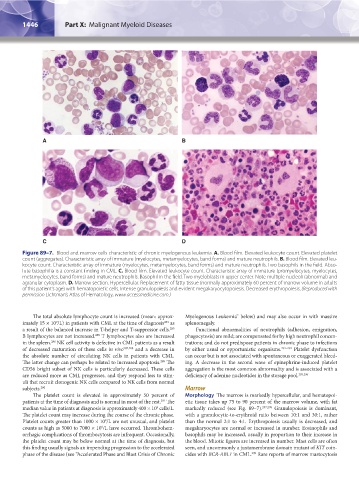
               Figure 89–7.  Blood and marrow cells characteristic of chronic myelogenous leukemia. A. Blood film. Elevated leukocyte count. Elevated platelet
               count (aggregates). Characteristic array of immature (myelocytes, metamyelocytes, band forms) and mature neutrophils. B. Blood film. Elevated leu-
               kocyte count. Characteristic array of immature (myelocytes, metamyelocytes, band forms) and mature neutrophils. Two basophils in the field. Abso-
               lute basophilia is a constant finding in CML. C. Blood film. Elevated leukocyte count. Characteristic array of immature (promyelocytes, myelocytes,
               metamyelocytes, band forms) and mature neutrophils. Basophil in the field. Two myeloblasts in upper center. Note multiple nucleoli (abnormal) and
               agranular cytoplasm. D. Marrow section. Hypercellular. Replacement of fatty tissue (normally approximately 60 percent of marrow volume in adults
               of this patient’s age) with hematopoietic cells. Intense granulopoiesis and evident megakaryocytopoiesis. Decreased erythropoiesis. (Reproduced with
               permission Lichtman’s Atlas of Hematology, www.accessmedicine.com.)


                   The total absolute lymphocyte count is increased (mean: approx-  Myelogenous Leukemia” below) and may also occur in with massive
               imately 15 × 10 /L) in patients with CML at the time of diagnosis  as   splenomegaly.
                           9
                                                               284
               a result of the balanced increase in T-helper and T-suppressor cells.    Functional abnormalities  of  neutrophils  (adhesion,  emigration,
                                                                 285
               B lymphocytes are not increased.  T lymphocytes also are increased   phagocytosis) are mild; are compensated for by high neutrophil concen-
                                        288
               in the spleen.  NK cell activity is defective in CML patients as a result   trations; and do not predispose patients in chronic phase to infections
                         286
               of decreased maturation of these cells in vivo 287,288  and a decrease in   by either usual or opportunistic organisms. 292–294  Platelet dysfunction
               the absolute number of circulating NK cells in patients with CML.   can occur but is not associated with spontaneous or exaggerated bleed-
               The latter change can perhaps be related to increased apoptosis.  The   ing. A decrease in the second wave of epinephrine-induced platelet
                                                              289
               CD56 bright subset of NK cells is particularly decreased. These cells   aggregation is the most common abnormality and is associated with a
               are reduced more as CML progresses, and they respond less to stim-  deficiency of adenine nucleotides in the storage pool. 295,296
               uli that recruit clonogenic NK cells compared to NK cells from normal
               subjects. 290                                          Marrow
                   The platelet count is elevated in approximately 50 percent of   Morphology  The marrow is markedly hypercellular, and hematopoi-
               patients at the time of diagnosis and is normal in most of the rest.  The   etic tissue takes up 75 to 90 percent of the marrow volume, with fat
                                                              291
               median value in patients at diagnosis is approximately 400 × 10  cells/L.   markedly  reduced (see Fig. 89–7). 297,298   Granulopoiesis  is  dominant,
                                                            9
               The platelet count may increase during the course of the chronic phase.   with a granulocytic-to-erythroid ratio between 10:1 and 30:1, rather
               Platelet counts greater than 1000 × 10 /L are not unusual, and platelet   than the normal 2:1 to 4:1. Erythropoiesis usually is decreased, and
                                           9
               counts as high as 5000 to 7000 × 10 /L have occurred. Thrombohem-  megakaryocytes are normal or increased in number. Eosinophils and
                                          9
               orrhagic complications of thrombocytosis are infrequent. Occasionally,   basophils may be increased, usually in proportion to their increase in
               the platelet count may be below normal at the time of diagnosis, but   the blood. Mitotic figures are increased in number. Mast cells are often
               this finding usually signals an impending progression to the accelerated   seen, and uncommonly a juxtamembrane domain mutant of KIT coin-
               phase of the disease (see “Accelerated Phase and Blast Crisis of Chronic   cides with BCR-ABL1 in CML.  Rare reports of marrow mastocytosis
                                                                                            299


          Kaushansky_chapter 89_p1437-1490.indd   1446                                                                  9/18/15   3:41 PM

