


Page 1519 - Williams Hematology ( PDFDrive )
P. 1519
1494           Part XI:  Malignant Lymphoid Diseases                                                                                                        Chapter 90:  Classification of Malignant Lymphoid Disorders          1495


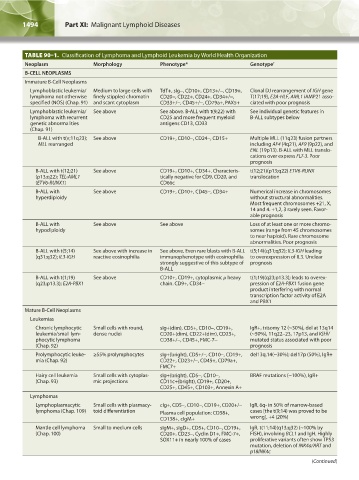
                TABLE 90–1.  Classification of Lymphoma and Lymphoid Leukemia by World Health Organization
                Neoplasm               Morphology             Phenotype*                    Genotype †
                B-CELL NEOPLASMS
                Immature B-Cell Neoplasms
                   Lymphoblastic leukemia/  Medium to large cells with   TdT+, sIg-, CD10+, CD13+/-, CD19+,   Clonal DJ rearrangement of IGH gene
                  lymphoma not otherwise   finely stippled chromatin   CD20-, CD22+, CD24+, CD34+/-,   T(17;19), E2A-HLF, AML1 iAMP21 asso-
                  specified (NOS) (Chap. 91)  and scant cytoplasm  CD33+/-, CD45+/-, CD79a+, PAX5+  ciated with poor prognosis
                   Lymphoblastic leukemia/  See above         See above. B-ALL with t(9;22) with   See individual genetic features in
                  lymphoma with recurrent                     CD25 and more frequent myeloid   B-ALL subtypes below
                  genetic abnormalities                       antigens CD13, CD33
                  (Chap. 91)
                        B-ALL with t(v;11q23);  See above     CD19+, CD10-, CD24-, CD15+    Multiple MLL (11q23) fusion partners
                     MLL rearranged                                                         including AF4 (4q21), AF9 (9p22), and
                                                                                            ENL (19p13). B-ALL with MLL translo-
                                                                                            cations over express FLT-3. Poor
                                                                                            prognosis
                     B-ALL with t(12;21)  See above           CD19+, CD10+, CD34+. Characteris-  t(12;21)(p13;q22) ETV6-RUNX
                    (p13;q22); TEL-AML1                       tically negative for CD9, CD20, and   translocation
                    (ETV6-RUNX1)                              CD66c
                   B-ALL with          See above              CD19+, CD10+, CD45-, CD34+    Numerical increase in chromosomes
                    hyperdiploidy                                                           without structural abnormalities.
                                                                                            Most frequent chromosomes +21, X,
                                                                                            14 and 4. +1,2, 3 rarely seen. Favor-
                                                                                            able prognosis
                   B-ALL with          See above              See above                     Loss of at least one or more chromo-
                    hypodiploidy                                                            somes (range from 45 chromosomes
                                                                                            to near haploid). Rare chromosome
                                                                                            abnormalities. Poor prognosis
                     B-ALL with t(5;14)  See above with increase in   See above. Even rare blasts with B-ALL  t(5;14)(q31;q32); IL3-IGH leading
                    (q31;q32); IL3-IGH  reactive eosinophilia  immunophenotype with eosinophilia   to overexpression of IL3. Unclear
                                                              strongly suggestive of this subtype of  prognosis
                                                              B-ALL
                     B-ALL with t(1;19)  See above            CD10+, CD19+, cytoplasmic μ heavy   t(1;19)(q23;p13.3); leads to overex-
                    (q23;p13.3); E2A-PBX1                     chain. CD9+, CD34-            pression of E2A-PBX1 fusion gene
                                                                                            product interfering with normal
                                                                                            transcription factor activity of E2A
                                                                                            and PBX1
                Mature B-Cell Neoplasms
                  Leukemias
                   Chronic lymphocytic   Small cells with round,   sIg+(dim), CD5+, CD10-, CD19+,   IgR+, trisomy 12 (~30%), del at 13q14
                    leukemia/small lym-  dense nuclei         CD20+(dim), CD22+(dim), CD23+,   (~50%), 11q22–23, 17p13, and IGHV
                    phocytic lymphoma                         CD38+/-, CD45+, FMC-7-        mutated status associated with poor
                    (Chap. 92)                                                              prognosis
                   Prolymphocytic leuke-  ≥55% prolymphocytes  sIg+(bright), CD5+/-, CD10-, CD19+,   del13q.14(~30%); del17p (50%), IgR+
                    mia (Chap. 92)                            CD22+, CD23+/-, CD45+, CD79a+,
                                                              FMC7+
                     Hairy cell leukemia   Small cells with cytoplas-  sIg+(bright), CD5-, CD10-,   BRAF mutations (~100%), IgR+
                    (Chap. 93)         mic projections        CD11c+(bright), CD19+, CD20+,
                                                              CD25+, CD45+, CD103+, Annexin A+
                  Lymphomas
                   Lymphoplasmacytic   Small cells with plasmacy-  cIg+, CD5-, CD10-, CD19+, CD20+/-  IgR, 6q- in 50% of marrow-based
                    lymphoma (Chap. 109)  toid differentiation  Plasma cell population: CD38+,   cases [the t(9;14) was proved to be
                                                              CD138+, cIgM+                 wrong], +4 (20%)
                     Mantle cell lymphoma   Small to medium cells  sIgM+, sIgD+, CD5+, CD10-, CD19+,   IgR, t(11;14)(q13;q32) (~100% by
                    (Chap. 100)                               CD20+, CD23-, Cyclin D1+, FMC-7+,   FISH), involving BCL1 and IgH. Highly
                                                              SOX11+ in nearly 100% of cases  proliferative variants often show TP53
                                                                                            mutation, deletion of INK4a/ART and
                                                                                            p18INK4c
                                                                                                                (Continued)


          Kaushansky_chapter 90_p1491-1504.indd   1494                                                                  9/21/15   4:07 PM

