


Page 1524 - Williams Hematology ( PDFDrive )
P. 1524
1498  Part XI:  Malignant Lymphoid Diseases     Chapter 90:  Classification of Malignant Lymphoid Disorders          1499


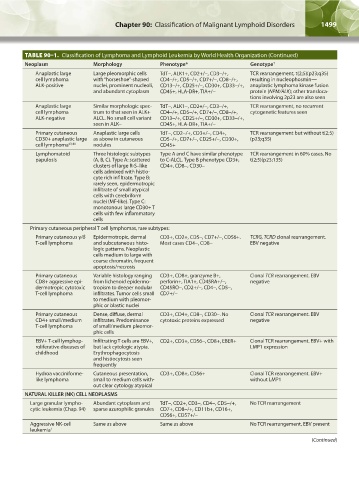
                   TABLE 90–1.  Classification of Lymphoma and Lymphoid Leukemia by World Health Organization (Continued)
                   Neoplasm               Morphology            Phenotype*                    Genotype †
                      Anaplastic large    Large pleomorphic cells   TdT-, ALK1+, CD2+/-, CD3-/+,    TCR rearrangement, t(2;5)(p23;q35)
                      cell lymphoma       with “horseshoe”-shaped   CD4-/+, CD5-/+, CD7+/-, CD8-/+,   resulting in nucleophosmin—
                      ALK-positive        nuclei, prominent nucleoli,   CD13-/+, CD25+/-, CD30+, CD33-/+,  anaplastic lymphoma kinase fusion
                                          and abundant cytoplasm  CD45+, HLA-DR+, TIA+/-      protein (NPM/ALK); other transloca-
                                                                                              tions involving 2p23 are also seen
                      Anaplastic large    Similar morphologic spec-  TdT-, ALK1-, CD2+/-, CD3-/+,    TCR rearrangement, no recurrent
                      cell lymphoma       trum to that seen in ALK+   CD4-/+, CD5-/+, CD7+/-, CD8-/+,   cytogenetic features seen
                      ALK-negative        ALCL. No small cell variant   CD13-/+, CD25+/-, CD30+, CD33-/+,
                                          seen in ALK–          CD45+, HLA-DR+, TIA+/-
                      Primary cutaneous   Anaplastic large cells   TdT-, CD2-/+, CD3+/-, CD4+,    TCR rearrangement but without t(2;5)
                      CD30+ anaplastic large  as above in cutaneous   CD5-/+, CD7+/-, CD25+/-, CD30+,   (p23;q35)
                      cell lymphoma 43,44  nodules              CD45+
                      Lymphomatoid        Three histologic subtypes   Type A and C have similar phenotype   TCR rearrangement in 60% cases. No
                      papulosis           (A, B, C). Type A: scattered   to C-ALCL. Type B phenotype CD3+,   t(2;5)(p23;135)
                                          clusters of large R-S–like   CD4+, CD8-, CD30-
                                          cells admixed with histio-
                                          cyte rich infiltrate. Type B:
                                          rarely seen, epidermotropic
                                          infiltrate of small atypical
                                          cells with cerebriform
                                          nuclei (MF-like). Type C:
                                          monotonous large CD30+ T
                                          cells with few inflammatory
                                          cells
                     Primary cutaneous peripheral T cell lymphomas, rare subtypes:
                      Primary cutaneous γ/δ   Epidermotropic, dermal   CD3+, CD2+, CD5-, CD7+/-, CD56+.   TCRG, TCRD clonal rearrangement.
                      T-cell lymphoma     and subcutaneous histo-  Most cases CD4-, CD8-      EBV negative
                                          logic patterns. Neoplastic
                                          cells medium to large with
                                          coarse chromatin, frequent
                                          apoptosis/necrosis
                      Primary cutaneous   Variable histology ranging   CD3+, CD8+, granzyme B+,    Clonal TCR rearrangement. EBV
                      CD8+ aggressive epi-  from lichenoid epidermo-  perforin+, TIA1+, CD45RA+/-,   negative
                      dermotropic cytotoxic   tropism to deeper nodular   CD45RO-, CD2+/-, CD4-, CD5-,
                      T-cell lymphoma     infiltrates. Tumor cells small  CD7+/-
                                          to medium with pleomor-
                                          phic or blastic nuclei
                      Primary cutaneous   Dense, diffuse, dermal   CD3+, CD4+, CD8-, CD30-. No    Clonal TCR rearrangement. EBV
                      CD4+ small/medium   infiltrates. Predominance   cytotoxic proteins expressed  negative
                      T-cell lymphoma     of small/medium pleomor-
                                          phic cells
                      EBV+ T-cell lymphop-  Infiltrating T cells are EBV+,   CD2+, CD3+, CD56-, CD8+, EBER+  Clonal TCR rearrangement. EBV+ with
                      roliferative diseases of   but lack cytologic atypia.                   LMP1 expression
                      childhood           Erythrophagocytosis
                                          and histiocytosis seen
                                          frequently
                      Hydroa vacciniforme-  Cutaneous presentation,   CD3+, CD8+, CD56+       Clonal TCR rearrangement. EBV+
                      like lymphoma       small to medium cells with-                         without LMP1
                                          out clear cytology atypical
                   NATURAL KILLER (NK) CELL NEOPLASMS
                      Large granular lympho-  Abundant cytoplasm and   TdT-, CD2+, CD3-, CD4-, CD5-/+,   No TCR rearrangement
                    cytic leukemia (Chap. 94)  sparse azurophilic granules  CD7+, CD8-/+, CD11b+, CD16+,
                                                                CD56+, CD57+/-
                      Aggressive NK-cell   Same as above        Same as above                 No TCR rearrangement, EBV present
                    leukemia 1
                                                                                                                   (Continued)


          Kaushansky_chapter 90_p1491-1504.indd   1499                                                                  9/21/15   4:07 PM

