


Page 1523 - Williams Hematology ( PDFDrive )
P. 1523
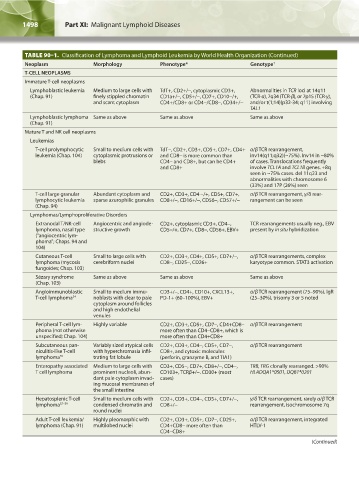
1498           Part XI:  Malignant Lymphoid Diseases                                                                                                        Chapter 90:  Classification of Malignant Lymphoid Disorders          1499


                TABLE 90–1.  Classification of Lymphoma and Lymphoid Leukemia by World Health Organization (Continued)
                Neoplasm               Morphology             Phenotype*                    Genotype †
                T-CELL NEOPLASMS
                Immature T-cell neoplasms
                   Lymphoblastic leukemia   Medium to large cells with   TdT+, CD2+/-, cytoplasmic CD3+,   Abnormalities in TCR loci at 14q11
                  (Chap. 91)           finely stippled chromatin   CD1a+/-, CD5+/-, CD7+, CD10-/+,   (TCR-α), 7q34 (TCR-β), or 7p15 (TCR-γ),
                                       and scant cytoplasm    CD4+/CD8+ or CD4-/CD8-, CD34+/-  and/or t(1;14)(p32-34; q11) involving
                                                                                            TAL1
                   Lymphoblastic lymphoma  Same as above      Same as above                 Same as above
                  (Chap. 91)
                Mature T and NK cell neoplasms
                  Leukemias
                     T-cell prolymphocytic   Small to medium cells with   TdT-, CD2+, CD3+, CD5+, CD7+, CD4+  α/β TCR rearrangement,
                    leukemia (Chap. 104)  cytoplasmic protrusions or   and CD8- is more common than   inv14(q11;q32)(~75%). Inv14 in ~80%
                                       blebs                  CD4- and CD8+, but can be CD4+   of cases. Translocations frequently
                                                              and CD8+                      involve TCL1A and TCL1B genes. +8q
                                                                                            seen in ~75% cases. del 11q23 and
                                                                                            abnormalities with chromosome 6
                                                                                            (33%) and 17P (26%) seen
                     T-cell large granular   Abundant cytoplasm and   CD2+, CD3+, CD4 -/+, CD5+, CD7+,   α/β TCR rearrangement, γ/δ rear-
                    lymphocytic leukemia   sparse azurophilic granules  CD8+/-, CD16+/-, CD56-, CD57+/-  rangement can be seen
                    (Chap. 94)
                  Lymphomas/Lymphoproliferative Disorders
                   Extranodal T/NK-cell   Angiocentric and angiode-  CD2+, cytoplasmic CD3+, CD4-,    TCR rearrangements usually neg., EBV
                    lymphoma, nasal type   structive growth   CD5-/+, CD7+, CD8-, CD56+, EBV+  present by in situ hybridization
                    (“angiocentric lym-
                    phoma”; Chaps. 94 and
                    104)
                   Cutaneous T-cell    Small to large cells with   CD2+, CD3+, CD4+, CD5+, CD7+/-,   α/β TCR rearrangements, complex
                    lymphoma (mycosis   cerebriform nuclei    CD8-, CD25-, CD26+            karyotype common. STAT3 activation
                    fungoides; Chap. 103)
                   Sézary syndrome     Same as above          Same as above                 Same as above
                    (Chap. 103)
                   Angioimmunoblastic   Small to medium immu-  CD3+/-, CD4+, CD10+, CXCL13+,   α/β TCR rearrangement (75–90%), IgR
                    T-cell lymphoma 34  noblasts with clear to pale   PD-1+ (60–100%), EBV+  (25–30%), trisomy 3 or 5 noted
                                       cytoplasm around follicles
                                       and high endothelial
                                       venules
                   Peripheral T-cell lym-  Highly variable    CD2+, CD3+, CD5+, CD7-, CD4+CD8-  α/β TCR rearrangement
                    phoma (not otherwise                      more often than CD4-CD8+, which is
                    unspecified; Chap. 104)                   more often than CD4+CD8+
                   Subcutaneous pan-   Variably sized atypical cells   CD2+, CD3+, CD4-, CD5+, CD7-,   α/β TCR rearrangement
                    niculitis-like T-cell   with hyperchromasia infil-  CD8+, and cytoxic molecules
                    lymphoma 35        trating fat lobule     (perforin, granzyme B, and TIA1)
                   Enteropathy associated  Medium to large cells with   CD3+, CD5-, CD7+, CD8+/-, CD4-,   TRB, TRG clonally rearranged. >90%
                    T cell lymphoma    prominent nucleoli, abun-  CD103+, TCRβ+/-. CD30+ (most   HLADQA1*0501, DQB1*0201
                                       dant pale cytoplasm invad-  cases)
                                       ing mucosal membranes of
                                       the small intestine
                   Hepatosplenic T-cell   Small to medium cells with   CD2+, CD3+, CD4-, CD5+, CD7+/-,   γ/δ TCR rearrangement, rarely α/β TCR
                    lymphoma 37–39     condensed chromatin and   CD8+/-                     rearrangement, isochromosome 7q
                                       round nuclei
                   Adult T-cell leukemia/  Highly pleomorphic with   CD2+, CD3+, CD5+, CD7-, CD25+,   α/β TCR rearrangement, integrated
                    lymphoma (Chap. 91)  multilobed nuclei    CD4+CD8- more often than      HTLV-1
                                                              CD4-CD8+
                                                                                                                (Continued)


          Kaushansky_chapter 90_p1491-1504.indd   1498                                                                  9/21/15   4:07 PM

