


Page 1521 - Williams Hematology ( PDFDrive )
P. 1521
1496           Part XI:  Malignant Lymphoid Diseases                                                                                                        Chapter 90:  Classification of Malignant Lymphoid Disorders          1497


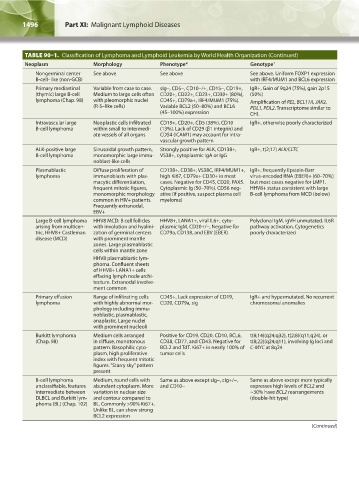
                TABLE 90–1.  Classification of Lymphoma and Lymphoid Leukemia by World Health Organization (Continued)
                Neoplasm               Morphology             Phenotype*                    Genotype †
                   Nongerminal center   See above             See above                     See above. Uniform FOXP1 expression
                    B-cell–like (non-GCB)                                                   with IRF4/MUM1 and BCL6 expression
                   Primary mediastinal   Variable from case to case.   sIg-, CD5-, CD10-/+, CD15-, CD19+,   IgR+, Gain of 9q24 (75%), gain 2p15
                    (thymic) large B-cell   Medium to large cells often  CD20+, CD22+, CD23+, CD30+ (80%),   (50%)
                    lymphoma (Chap. 98)  with pleomorphic nuclei   CD45+, CD79a+, IRF4/MUM1 (75%).   Amplification of REL, BCL11A, JAK2,
                                       (R-S–like cells)       Variable BCL2 (50–80%) and BCL6   PDL1, PDL2. Transcriptome similar to
                                                              (45–100%) expression          CHL
                   Intravascular large   Neoplastic cells infiltrated   CD19+, CD20+, CD5 (38%), CD10   IgR+, otherwise poorly characterized
                    B-cell lymphoma    within small to intermedi-  (13%). Lack of CD29 (β1 integrin) and
                                       ate vessels of all organs  CD54 (ICAM1) may account for intra-
                                                              vascular growth pattern
                   ALK-positive large   Sinusoidal growth pattern,   Strongly positive for ALK, CD138+,   IgR+, t(2;17) ALK/CLTC
                    B-cell lymphoma    monomorphic large immu-  VS38+, cytoplasmic IgA or IgG
                                       noblast-like cells
                   Plasmablastic       Diffuse proliferation of   CD138+, CD38+, VS38C, IRF4/MUM1+,  IgR+, frequently Epstein-Barr
                    lymphoma           immunoblasts with plas-  high Ki67, CD79a+ CD30+ in most   virus-encoded RNA (EBER)+ (60–70%)
                                       macytic differentiation,   cases. Negative for CD45, CD20, PAX5.  but most cases negative for LMP1.
                                       frequent mitotic figures,   Cytoplasmic Ig (50–70%). CD56 neg-  HHV8+ status consistent with large
                                       monomorphic morphology  ative (if positive, suspect plasma cell   B-cell lymphoma from MCD (below)
                                       common in HIV+ patients.   myeloma)
                                       Frequently extranodal,
                                       EBV+
                     Large B-cell lymphoma  HHV8 MCD: B cell follicles   HHV8+, LANA1+, viral IL6+, cyto-  Polyclonal IgM. IgVH unmutated. IL6R
                    arising from multicen-  with involution and hyalini-  plasmic IgM, CD20+/-, Negative for   pathway activation. Cytogenetics
                    tric, HHV8+ Castleman   zation of germinal centers   CD79a, CD138, and EBV (EBER)  poorly characterized
                    disease (MCD)      with prominent mantle
                                       zones. Large plasmablastic
                                       cells within mantle zone
                                       HHV8 plasmablastic lym-
                                       phoma. Confluent sheets
                                       of HHV8+ LANA1+ cells
                                       effacing lymph node archi-
                                       tecture. Extranodal involve-
                                       ment common
                   Primary effusion    Range of infiltrating cells   CD45+, Lack expression of CD19,   IgR+ and hypermutated. No recurrent
                    lymphoma           with highly abnormal mor-  CD20, CD79a, sIg          chromosomal anomalies
                                       phology including immu-
                                       noblastic, plasmablastic,
                                       anaplastic. Large nuclei
                                       with prominent nucleoli
                   Burkitt lymphoma    Medium cells arranged   Positive for CD19, CD20, CD10, BCL6,   t(8;14)(q24;q32), t(2;8)(q11;q24), or
                    (Chap. 98)         in diffuse, monotonous   CD38, CD77, and CD43. Negative for   t(8;22)(q24;q11), involving Ig loci and
                                       pattern. Basophilic cyto-  BCL2 and TdT. Ki67+ in nearly 100% of  C-MYC at 8q24
                                       plasm, high proliferative   tumor cells
                                       index with frequent mitotic
                                       figures. “Starry sky” pattern
                                       present
                   B-cell lymphoma     Medium, round cells with   Same as above except sIg-, cIg+/-,   Same as above except more typically
                    unclassifiable, features   abundant cytoplasm. More   and CD10-         expresses high levels of BCL2 and
                    intermediate between   variation in nuclear size                        ~30% have BCL2 rearrangements
                    DLBCL and Burkitt lym-  and contour compared to                         (double-hit type)
                    phoma (BL) (Chap. 102)  BL. Commonly >90% Ki67+.
                                       Unlike BL, can show strong
                                       BCL2 expression
                                                                                                                (Continued)


          Kaushansky_chapter 90_p1491-1504.indd   1496                                                                  9/21/15   4:07 PM

