


Page 1591 - Williams Hematology ( PDFDrive )
P. 1591
1566           Part XI:  Malignant Lymphoid Diseases                                                                                                                 Chapter 94:  Large Granular Lymphocytic Leukemia            1567


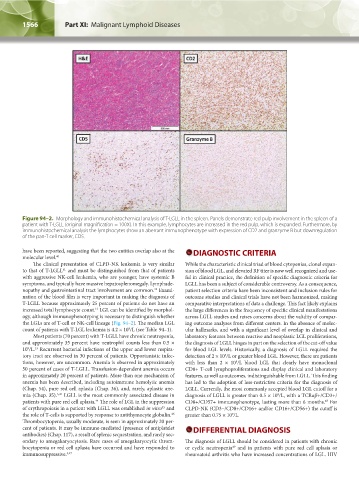
               Figure 94–2.  Morphology and immunohistochemical analysis of T-LGLL in the spleen. Panels demonstrate red pulp involvement in the spleen of a
               patient with T-LGLL (original magnification = 100X). In this example, lymphocytes are increased in the red pulp, which is expanded. Furthermore, by
               immunohistochemical analysis the lymphocytes show an aberrant immunophenotype with expression of CD2 and granzyme B but downregulation
               of the pan-T cell marker, CD5.

               have been reported, suggesting that the two entities overlap also at the   DIAGNOSTIC CRITERIA
               molecular level. 40
                   The clinical presentation of CLPD-NK leukemia is very similar   While the characteristic clinical triad of blood cytopenias, clonal expan-
               to that of T-LGLL  and must be distinguished from that of patients   sion of blood LGL, and elevated RF titer is now well recognized and use-
                             41
               with aggressive NK-cell leukemia, who are younger, have systemic B   ful in clinical practice, the definition of specific diagnostic criteria for
               symptoms, and typically have massive hepatosplenomegaly. Lymphade-  LGLL has been a subject of considerable controversy. As a consequence,
               nopathy and gastrointestinal tract involvement are common.  Exami-  patient selection criteria have been inconsistent and inclusion rules for
                                                            42
               nation of the blood film is very important in making the diagnosis of   outcome studies and clinical trials have not been harmonized, making
               T-LGLL because approximately 25 percent of patients do not have an   comparative interpretations of data a challenge. This fact likely explains
               increased total lymphocyte count.  LGL can be identified by morphol-  the large differences in the frequency of specific clinical manifestations
                                        13
               ogy, although immunophenotyping is necessary to distinguish whether   across LGLL studies and raises concerns about the validity of compar-
               the LGLs are of T-cell or NK-cell lineage (Fig. 94–2). The median LGL   ing outcome analyses from different centers. In the absence of molec-
               count of patients with T-LGL leukemia is 4.2 × 10 /L (see Table  94–1).  ular hallmarks, and with a significant level of overlap in clinical and
                                                   9
                   Most patients (70 percent) with T-LGLL have chronic neutropenia,   laboratory features between reactive and neoplastic LGL proliferations,
               and approximately 35 percent have neutrophil counts less than 0.5 ×   the diagnosis of LGLL hinges in part on the selection of the cut-off value
               10 /L.  Recurrent bacterial infections of the upper and lower respira-  for blood LGL levels. Historically, a diagnosis of LGLL required the
                    13
                 9
               tory tract are observed in 30 percent of patients. Opportunistic infec-  detection of 2 × 10 /L or greater blood LGL. However, there are patients
                                                                                   9
               tions, however, are uncommon. Anemia is observed in approximately   with less than 2 × 10 /L blood LGL that clearly have monoclonal
                                                                                       9
               50 percent of cases of T-LGLL. Transfusion-dependent anemia occurs   CD8+ T-cell lymphoproliferations and display clinical and laboratory
               in approximately 20 percent of patients. More than one mechanism of     features, as well as outcomes, indistinguishable from LGLL. This finding
               anemia has been described, including autoimmune hemolytic anemia   has led to the adoption of less-restrictive criteria for the diagnosis of
               (Chap. 54), pure red cell aplasia (Chap. 36), and, rarely, aplastic ane-  LGLL. Currently, the most commonly accepted blood LGL cutoff for a
               mia (Chap. 35).  LGLL is the most commonly associated disease in   diagnosis of LGLL is greater than 0.5 × 10 /L, with a TCRαβ+/CD3+/
                                                                                                     9
                           3,43
               patients with pure red cell aplasia.  The role of LGL in the suppression   CD8+/CD57+ immunophenotype, lasting more than 6 months.  For
                                        44
                                                                                                                     48
               of erythropoiesis in a patient with LGLL was established in vitro  and   CLPD-NK (CD3–/CD8+/CD16+ and/or CD16+/CD56+) the cutoff is
                                                              45
               the role of T-cells is supported by response to antithymocyte globulin.    greater than 0.75 × 10 /L.
                                                                 46
                                                                                      9
               Thrombocytopenia, usually moderate, is seen in approximately 20 per-
               cent of patients. It may be immune-mediated (presence of antiplatelet   DIFFERENTIAL DIAGNOSIS
               antibodies) (Chap. 117), a result of splenic sequestration, and rarely sec-
               ondary to amegakaryocytosis. Rare cases of amegakaryocytic throm-  The diagnosis of LGLL should be considered in patients with chronic
               bocytopenia or red cell aplasia have occurred and have responded to   or cyclic neutropenia  and in patients with pure red cell aplasia or
                                                                                      49
               immunosuppressive. 3,47                                rheumatoid arthritis who have increased concentrations of LGL. HIV
          Kaushansky_chapter 94_p1563-1568.indd   1566                                                                  9/18/15   10:53 AM

