


Page 1590 - Williams Hematology ( PDFDrive )
P. 1590
1564  Part XI:  Malignant Lymphoid Diseases             Chapter 94:  Large Granular Lymphocytic Leukemia             1565


                       HISTOLOGIC AND                                   receptor (KIR) expression.  The neoplastic NK cells often demonstrate
                                                                                           37
                                                                        abnormal KIR expression with either complete absence of   surface
                     IMMUNOPHENOTYPIC FEATURES                          KIR or restricted KIR expression indicating outgrowth of a clonal
                                                                        population. 38
                  The marrow biopsy in T-LGLL may be hypo-, normo-, or hypercellular,
                  with often preserved trilineage hematopoiesis. There may be occasional
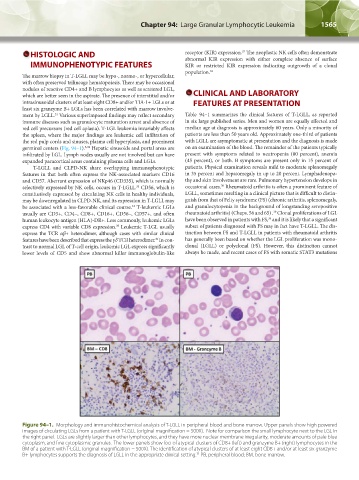
                  nodules of reactive CD4+ and B lymphocytes as well as scattered LGL,
                  which are better seen in the aspirate. The presence of interstitial and/or     CLINICAL AND LABORATORY
                  intrasinusoidal clusters of at least eight CD8+ and/or TIA-1+ LGLs or at   FEATURES AT PRESENTATION
                  least six granzyme B+ LGLs has been correlated with marrow involve-
                  ment by LGLL.  Various superimposed findings may reflect secondary   Table  94–1 summarizes the clinical features of T-LGLL, as reported
                             31
                  immune diseases such as granulocyte maturation arrest and absence of   in six large published series. Men and women are equally affected and
                  red cell precursors (red cell aplasia). T-LGL leukemia invariably affects   median age at diagnosis is approximately 60 years. Only a minority of
                  the spleen, where the major findings are leukemic cell infiltration of   patients are less than 50 years old. Approximately one-third of patients
                  the red pulp cords and sinuses, plasma cell hyperplasia, and prominent   with LGLL are asymptomatic at presentation and the diagnosis is made
                  germinal centers (Fig. 94–1).  Hepatic sinusoids and portal areas are   on an examination of the blood. The remainder of the patients typically
                                       3,32
                  infiltrated by LGL. Lymph nodes usually are not involved but can have   present with symptoms related to neutropenia (80 percent), anemia
                  expanded paracortical areas containing plasma cells and LGLs.  (45 percent), or both. B symptoms are present only in 15 percent of
                     T-LGLL and CLPD-NK share overlapping immunophenotypic   patients. Physical examination reveals mild to moderate splenomegaly
                  features in that both often express the NK-associated markers CD16   in 35 percent and hepatomegaly in up to 20 percent. Lymphadenopa-
                  and CD57. Aberrant expression of NKp46 (CD335), which is normally   thy and skin involvement are rare. Pulmonary hypertension develops in
                                                                                    30
                  selectively expressed by NK cells, occurs in T-LGLL.  CD56, which is   occasional cases.  Rheumatoid arthritis is often a prominent feature of
                                                        33
                  constitutively expressed by circulating NK cells in healthy individuals,   LGLL, sometimes resulting in a clinical picture that is difficult to distin-
                  may be downregulated in CLPD-NK, and its expression in T-LGLL may   guish from that of Felty syndrome (FS) (chronic arthritis, splenomegaly,
                  be associated with a less-favorable clinical course.  T-leukemic LGLs   and granulocytopenia in the background of longstanding seropositive
                                                       34
                                                                                                      39
                  usually are CD3+, CD4–, CD8+, CD16+, CD56–, CD57+, and often   rheumatoid arthritis) (Chaps. 56 and 65) .  Clonal proliferations of LGL
                                                                                                    39
                  human leukocyte antigen (HLA)-DR+. Less commonly, leukemic LGLs   have been observed in patients with FS,  and it is likely that a significant
                  express CD4 with variable CD8 expression.  Leukemic T-LGL usually     subset of patients diagnosed with FS may in fact have T-LGLL. The dis-
                                                 35
                  express the TCR  αβ+ heterodimer, although cases with similar clinical    tinction between FS and T-LGLL in patients with rheumatoid arthritis
                  features have been described that express the γδ TCR heterodimer.  In con-  has generally been based on whether the LGL proliferation was mono-
                                                              36
                  trast to normal LGL of T-cell origin, leukemic LGL express significantly   clonal (LGLL) or polyclonal (FS).  However, this distinction  cannot
                  lower levels of CD5 and show abnormal killer immunoglobulin- like    always be made, and recent cases of FS with somatic STAT3 mutations


                  Figure 94–1.  Morphology and immunohistochemical analysis of T-LGLL in peripheral blood and bone marrow. Upper panels show high powered
                  images of circulating LGLs from a patient with T-LGLL (original magnification = 500X).  Note for comparison the small lymphocyte next to the LGL in
                  the right panel.  LGLs are slightly larger than other lymphocytes, and they have more nuclear membrane irregularity, moderate amounts of pale blue
                  cytoplasm, and fine cytoplasmic granules.  The lower panels show foci of atypical clusters of CD8+ (left) and granzyme B+ (right) lymphocytes in the
                  BM of a patient with T-LGLL (original magnification = 500X). The identification of atypical clusters of at least eight CD8+ and/or at least six granzyme
                  B+ lymphocytes supports the diagnosis of LGLL in the appropriate clinical setting.  PB, peripheral blood; BM, bone marrow.
                                                                            31


          Kaushansky_chapter 94_p1563-1568.indd   1565                                                                  9/18/15   10:53 AM

