


Page 1595 - Williams Hematology ( PDFDrive )
P. 1595
1570           Part XI:  Malignant Lymphoid Diseases                                                                                                                Chapter 95:  General Considerations for Lymphomas            1571


               Cancer Institute attempted to reconcile the large number of competing   response criteria for NHL were initially published in 1999 by the
                                  6
               classifications then in use.  The Working Formulation was clinically use-  National Cancer Institute Working Group  and later revised in 2007
                                                                                                     13
               ful and gained wide popularity. It divided the specific subtypes among   to incorporate positron emission tomography (PET), marrow immu-
                                                                                                                    14
               high-grade, intermediate-grade, and low-grade lymphomas, focusing in   nohistochemistry and flow cytometry for response assessment.  PET/
               part on the expected rate of progression, and not just on the pheno-  CT imaging rendered the CRu designation obsolete in 2007, because
               type of the case in question. With advances in our understanding of the   residual radiographic abnormalities could be accurately determined
               immune system and lymphocyte progenitor developmental sequences,   to be either residual active lymphoma or posttreatment fibrosis, based
               and the availability of monoclonal antibodies for subtyping lymphoid   on the metabolic activity of the lesions. These criteria were critically
               cells and lymphocyte gene profiling, a new classification schema became   reviewed and analyzed by working groups at the 11th and 12th Interna-
               possible based on cell type, tissue of origin, immunophenotype, and   tional Conferences on Malignant Lymphoma in Lugano, Switzerland,
               genotype.                                              in 2011 and 2013 and at the 4th International Workshops on Positron
                   In 1994, a revised European-American classification of lymphoid   Emission Tomography in Lymphoma in Menton, France in 2012. 15,16
               neoplasms (the REAL classification) was proposed by the International   These international workshops were attended by leading hematolo-
                                                7
               Lymphoma Study Group (Chaps. 90 and 96).  This group distinguished   gists, oncologists, radiation oncologists, pathologists, radiologists, and
               three major categories of lymphoid malignancies, which included B-cell,   nuclear medicine physicians, representing all major lymphoma clinical
               T-cell, and Hodgkin lymphoma. Lymphomas were defined by morpho-  trials groups and cancer centers in North America, Europe, Japan, and
               logic, immunologic, and genetic techniques. Many of the lymphomas   Australasia. Their deliberations culminated in the publication in 2014
               were associated with distinct clinical presentations, and cases that did   of improved criteria for the initial evaluation, staging and response
               not fit into defined entities were left unclassified. Further subclassifi-  assessment for both HL and NHL  that are relevant for community
                                                                                               17
               cation  divided each of the B-cell and T-cell lineages into (1) indolent   physicians, investigator-led trials, cooperative groups, and registration
                    8
               lymphomas (low risk of rapid progression), (2) aggressive lymphomas   trials. These new rules, known as the “Lugano Classification,” depart
               (intermediate risk of progression), and (3) very aggressive lympho-  substantially from older staging and evaluation systems as detailed
               mas (high risk of progression). In 1995, a collaborative project of the    later in this chapter.
               European Association for Haematopathology and the Society for
               Hematopathology began to revise the REAL classification. In 2001,   EPIDEMIOLOGY
               they published the World Health Organization (WHO) Classification of
               Tumors of the Haematopoietic and Lymphoid Tissues that is used in this   Approximately 79,990 new cases of lymphoma were projected to be
               chapter and represents the current worldwide consensus classification   diagnosed and approximately 20,170 persons in the United States were
                                                                                                    18
               of malignancies that arise in a lymphocyte. In 2008, the WHO updated   expected to die of this disease in 2014.  These numbers represent
               this classification (Chaps. 90 and 96). 9,10           4.8 percent of the annual incidence of all cancers and 3.4 percent of
                   Emerging concepts in the staging, therapy, and response evalua-  annual cancer-related deaths. The most recent age-adjusted incidence
               tion of lymphomas evolved in parallel with the changing nomenclature.   rates per 100,000 population provided by Surveillance, Epidemiology,
               Initial efforts to define the extent of disease involvement were under-  and End Results (SEER) Program of the United States National Cancer
               taken primarily for Hodgkin lymphoma (HL) and ultimately led to the   Institute are: 24.9 for white males, 17.4 for black males, 17.2 for white
                                  11
               Ann Arbor classification,  which subdivided patients into four stages,   females, and 11.9 for black females.  The increased risk for men is sim-
                                                                                               19
               each subclassified into A and B groups based on the presence of fevers   ilar to that found in other countries, although the incidence of NHL in
               greater than 38.3°C, weight loss, and drenching night sweats. The Ann   the United States is approximately threefold that of several underdevel-
               Arbor system proved useful for decades and was subsequently applied   oped countries and twofold that of several comparable industrialized
                                                                             20
               also to non-Hodgkin lymphomas (NHLs). The Cotswold modification   countries.  The risk of developing lymphoma is less in the United States
                                      12
               of the Ann Arbor Classification  first formally incorporated computed   among persons of African descent in comparison to those of European
               tomography (CT) into clinical staging paradigms and introduced the   descent. An exponential increase in incidence in NHL among men and
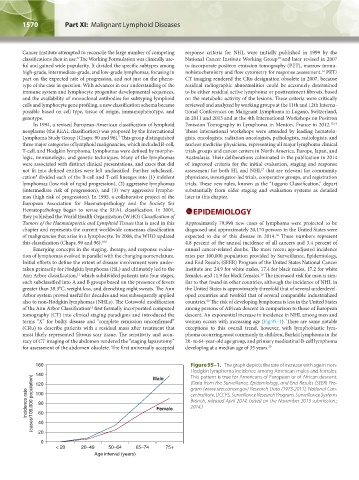
               terms  “X”  for  bulky  disease  and  “complete  remission  unconfirmed”   women occurs with increasing age (Fig.95–1). There are some notable
               (CRu) to describe patients with a residual mass after treatment that   exceptions  to  this  overall  trend,  however,  with  lymphoblastic  lym-
               most likely represented fibrous scar tissue. The sensitivity and accu-  phoma occurring most commonly in children, Burkitt lymphoma in the
               racy of CT imaging of the abdomen rendered the “staging laparotomy”   20- to 64-year-old age group, and primary mediastinal B-cell lymphoma
               for assessment of the abdomen obsolete. The first universally accepted   developing at a median age of 35 years. 20


                    160                                                 Figure 95–1.  The graph depicts the rate of increase with age in non-
                                                                        Hodgkin lymphoma incidence among American males and females.
                    140                                    Male         This pattern is true for Americans of European or of African descent.
                                                                        (Data from the Surveillance, Epidemiology, and End Results (SEER) Pro-
                    120
                                                                        gram (www.seer.cancer.gov) Research Data (1973-2011), National Can-
                 Incidence rate (cases/100,000 population)  100  Female  cer Institute, DCCPS, Surveillance Research Program, Surveillance Systems
                                                                        Branch, released April 2014, based on the November 2013 submission.;
                     80
                                                                        2014.)
                     60
                     40
                     20
                      0
                           < 20    20–49    50–64    65–74     75+
                                        Age interval (years)


          Kaushansky_chapter 95_p1569-1586.indd   1570                                                                  9/21/15   12:16 PM

