


Page 1629 - Williams Hematology ( PDFDrive )
P. 1629
1604           Part XI:  Malignant Lymphoid Diseases                                                                                                                                   Chapter 97:  Hodgkin Lymphoma             1605


                                                                                                           23
                TABLE 97–1.  Classification of Hodgkin Lymphoma       and colleagues represented another major advance.  Based on a more
                                                                      favorable safety profile and greater efficacy, ABVD replaced MOPP.
                Histologic Subtype        Immunophenotype
                Nodular                   CD20+ CD30− CD15− Ig+          EPIDEMIOLOGY
                lymphocyte-predominant
                Classical                 CD20−* CD30+ CD15+ Ig−      The estimated incidence of Hodgkin lymphoma in the United States was
                                                                      9190 cases in 2014, with equal incidences in Americans of European and
                  Nodular sclerosis
                                                                      African descent (2.9/100,000).  The disease has a median age of onset
                                                                                            24
                  Mixed cellularity                                   of 38 years with bimodal incidence peaks at ages 15 to 34 and older
                                                                                           25
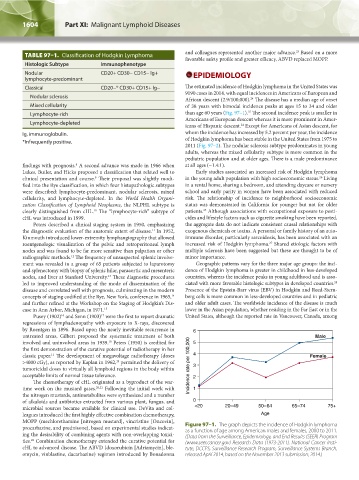
                  Lymphocyte-rich                                     than age 60 years (Fig. 97–1).  The second incidence peak is smaller in
                                                                      Americans of European descent whereas it is more prominent in Amer-
                  Lymphocyte-depleted
                                                                                         24
                                                                      icans of Hispanic descent.  Except for Americans of Asian descent, for
               Ig, immunoglobulin.                                    whom the incidence has increased by 5.2 percent per year, the incidence
               *Infrequently positive.                                of Hodgkin lymphoma has been stable in the United States from 1975 to
                                                                      2011 (Fig. 97–2). The nodular sclerosis subtype predominates in young
                                                                      adults, whereas the mixed cellularity subtype is more common in the
                                                                      pediatric population and at older ages. There is a male predominance
               findings with prognosis.  A second advance was made in 1966 when   at all ages (~1.4:1).
                                 8
               Lukes, Butler, and Hicks proposed a classification that related well to   Early studies associated an increased risk of Hodgkin lymphoma
                                                                                                                   26
               clinical presentation and course.  Their proposal was slightly modi-  in the young adult population with high socioeconomic status.  Living
                                        9
               fied into the Rye classification, in which four histopathologic subtypes   in a rental home, sharing a bedroom, and attending daycare or nursery
               were  described:  lymphocyte-predominant, nodular sclerosis, mixed     school and early parity in women have been associated with reduced
               cellularity,  and  lymphocyte-depleted. In the  World Health Organi-  risk. The relationship of incidence to neighborhood socioeconomic
               zation Classification of Lymphoid Neoplasms, the NLPHL subtype is   status was demonstrated in California for younger but not for older
                                                                            25
               clearly distinguished from cHL.  The “lymphocyte-rich” subtype of   patients.  Although associations with occupational exposure to pesti-
                                       10
               cHL was introduced in 1999.                            cides and lifestyle factors such as cigarette smoking have been reported,
                   Peters described a clinical staging system in 1950, emphasizing   the aggregate data do not indicate consistent causal relationships with
               the diagnostic evaluation of the anatomic extent of disease.  In 1952,   exogenous chemicals or toxins. A personal or family history of an auto-
                                                           11
               Kinmouth introduced lower-extremity lymphangiography that allowed   immune disorder, particularly sarcoidosis, has been associated with an
                                                                                                  27
               roentgenologic visualization of the pelvic and retroperitoneal lymph   increased risk of Hodgkin lymphoma.  Shared etiologic factors with
               nodes and was found to be far more sensitive than palpation or other   multiple sclerosis have been suggested but these are thought to be of
               radiographic methods.  The frequency of unsuspected splenic involve-  minor importance.
                                12
               ment was revealed in a group of 65 patients subjected to laparotomy   Geographic patterns vary for the three major age groups: the inci-
               and splenectomy with biopsy of splenic hilar, paraaortic and mesenteric   dence of Hodgkin lymphoma is greater in childhood in less-developed
               nodes, and liver at Stanford University.  These diagnostic procedures   countries, whereas the incidence peaks in young adulthood and is asso-
                                            13
                                                                                                                        28
               led to improved understanding of the mode of dissemination of the   ciated with more favorable histologic subtypes in developed countries.
               disease and correlated well with prognosis, culminating in the modern   Presence of the Epstein-Barr virus (EBV) in Hodgkin and Reed-Stern-
               concepts of staging codified at the Rye, New York, conference in 1965,    berg cells is more common in less-developed countries and in pediatric
                                                                 14
               and further refined at the Workshop on the Staging of Hodgkin’s Dis-  and older adult cases. The worldwide incidence of the disease is much
               ease in Ann Arbor, Michigan, in 1971. 15               lower in the Asian population, whether residing in the Far East or in the
                   Pusey (1902)  and Senn (1903)  were the first to report dramatic   United States, although the reported rate in Vancouver, Canada, among
                                          17
                            16
               regressions of lymphadenopathy with exposure to X-rays, discovered
               by Roentgen in 1896. Based upon the nearly inevitable recurrence in   6
               untreated areas, Gilbert proposed the systematic treatment of both                                 Male
               involved and uninvolved areas in 1939.  Peters (1950) is credited for   5
                                            18
               the first demonstration of the curative potential of radiotherapy in her
               classic paper.  The development of megavoltage radiotherapy (doses   4                           Female
                         11
               >4000 cGy), as reported by Kaplan in 1962,  permitted the delivery of
                                               19
               tumoricidal doses to virtually all lymphoid regions in the body within   Incidence rate per 100,000   3
               acceptable limits of normal tissue tolerance.             2
                   The chemotherapy of cHL originated as a byproduct of the war-
               time  work  on the mustard  gases. 20,21   Following  the initial  work with   1
               the nitrogen mustards, antimetabolites were synthesized and a number
               of alkaloids and antibiotics extracted from various plant, fungus, and   0
               microbial sources became available for clinical use. DeVita and col-  <20   20–49   50–64   65–74      75+
               leagues introduced the first highly effective combination chemotherapy,         Age
               MOPP (mechlorethamine [nitrogen mustard], vincristine [Oncovin],
               procarbazine, and prednisone), based on experimental studies indicat-  Figure 97–1.  The graph depicts the incidence of Hodgkin lymphoma
               ing the desirability of combining agents with non-overlapping toxici-  as a function of age among American males and females, 2000 to 2011.
                                                                      (Data from the Surveillance, Epidemiology, and End Results (SEER) Program
               ties.  Combination chemotherapy extended the curative potential for   (www.seer.cancer.gov) Research Data (1973-2011), National Cancer Insti-
                  22
               cHL to advanced disease. The ABVD (doxorubicin [Adriamycin], ble-  tute, DCCPS, Surveillance Research Program, Surveillance Systems Branch,
               omycin, vinblastine, dacarbazine) regimen introduced by Bonadonna   released April 2014, based on the November 2013 submission; 2014.)


          Kaushansky_chapter 97_p1603-1624.indd   1604                                                                  9/18/15   11:10 PM

