


Page 1630 - Williams Hematology ( PDFDrive )
P. 1630
1604  Part XI:  Malignant Lymphoid Diseases                                Chapter 97:  Hodgkin Lymphoma             1605


                         3.5                                            but not fraternal, twins provides the strongest evidence for a genetic
                                                                                 43
                                                                        association.  cHL-prone families, with or without other forms of
                          3
                     Incidence rate per  100,000   2.5                  4.5 percent of cases are familial. 44–46  The standard incidence ratio for
                                                                        cancer, have been described in the literature and it is estimated that
                          2
                                                                        age-specific familial risk from the Swedish Cancer Registry was higher
                         1.5
                                                                                                                 47
                                                                        for Hodgkin lymphoma (4.8) than any other neoplasm.  The relative
                                                                        risk for familial disease is stronger in individuals older than 40 years of
                          1
                         0.5
                                                                        kemia and non-Hodgkin lymphoma has been described.  An increased
                                                                                                                 46
                          0                                             age, males, and siblings, and a shared risk with chronic lymphocytic leu-
                                                                        incidence in same sex siblings (eight- to 12-fold) versus opposite-sex
                             1975  1977  1979  1981  1983  1985  1987  1989  1991  1993  1995  1997  1999  2001  2003  2005  2007  2009  2011  siblings (1.3- to 1.4-fold) detected in the Swedish registry is consistent
                                             Year                       with older data and has been interpreted to be supportive of an environ-
                                                                        mental influence or a pseudoautosomal susceptibility gene located on a
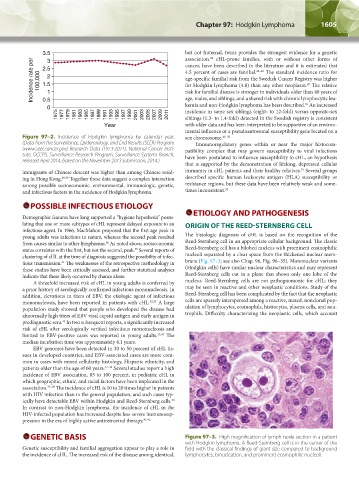
                  Figure 97–2.  Incidence of Hodgkin lymphoma  by calendar year.   sex chromosome. 48–50
                  (Data from the Surveillance, Epidemiology, and End Results (SEER) Program   Immunoregulatory genes within or near the major histocom-
                  (www.seer.cancer.gov) Research Data (1973-2011), National Cancer Insti-  patibility complex that may govern susceptibility to viral infections
                  tute, DCCPS, Surveillance Research Program, Surveillance Systems Branch,   have been postulated to influence susceptibility to cHL, an hypothesis
                  released April 2014, based on the November 2013 submission; 2014.)
                                                                        that is supported by the demonstration of lifelong, depressed cellular
                                                                                                               51
                  immigrants of Chinese descent was higher than among Chinese resid-  immunity in cHL patients and their healthy relatives.  Several groups
                  ing in Hong Kong. 29,30  Together these data suggest a complex interaction   described specific human leukocyte antigen (HLA) susceptibility or
                  among possible socioeconomic, environmental, immunologic, genetic,   resistance regions, but these data have been relatively weak and some-
                  and infectious factors in the incidence of Hodgkin lymphoma.  times inconsistent. 52
                     POSSIBLE INFECTIOUS ETIOLOGY
                  Demographic features have long supported a “hygiene hypothesis” postu-  ETIOLOGY AND PATHOGENESIS
                  lating that one or more subtypes of cHL represent delayed exposure to an   ORIGIN OF THE REED-STERNBERG CELL
                  infectious agent. In 1966, MacMahon proposed that the first age peak in
                  young adults was infectious in nature, whereas the second peak resulted   The histologic diagnosis of cHL is based on the recognition of the
                  from causes similar to other lymphomas.  As noted above, socioeconomic   Reed-Sternberg cell in an appropriate cellular background. The classic
                                              26
                  status correlates with the first, but not the second, peak.  Several reports of   Reed-Sternberg cell has a bilobed nucleus with prominent eosinophilic
                                                        25
                  clustering of cHL at the time of diagnosis suggested the possibility of infec-  nucleoli separated by a clear space from the thickened nuclear mem-
                  tious transmission.  The weaknesses of the retrospective methodology in   brane (Fig. 97–3; see also Chap. 96, Fig. 96–35). Mononuclear variants
                               31
                  these studies have been critically assessed, and further statistical analyses   (Hodgkin cells) have similar nuclear characteristics and may represent
                  indicate that these likely occurred by chance alone.  Reed-Sternberg  cells  cut  in  a  plane  that  shows  only  one  lobe  of  the
                     A threefold increased risk of cHL in young adults is conferred by   nucleus. Reed-Sternberg cells are not pathognomonic for cHL; they
                  a prior history of serologically confirmed infectious mononucleosis. In   may be seen in reactive and other neoplastic conditions. Study of the
                  addition, elevations in titers of EBV, the etiologic agent of infectious   Reed-Sternberg cell has been complicated by the fact that the neoplastic
                  mononucleosis, have been reported in patients with cHL. 32,33  A large   cells are sparsely interspersed among a reactive, mixed, nonclonal pop-
                  population study showed that people who developed the disease had   ulation of lymphocytes, eosinophils, histiocytes, plasma cells, and neu-
                  abnormally high titers of EBV viral capsid antigen and early antigen in   trophils. Difficulty characterizing the neoplastic cells, which account
                  prediagnostic sera.  In two subsequent reports, a significantly increased
                               34
                  risk of  cHL after serologically verified infectious mononucleosis and
                  limited  to  EBV-positive  cases  was  reported  in  young  adults. 35,36   The
                  median incubation time was approximately 4.1 years.
                     EBV genomes have been detected in 30 to 50 percent of cHL tis-
                  sues in developed countries, and EBV-associated cases are more com-
                  mon in cases with mixed cellularity histology, Hispanic ethnicity, and
                  patients older than the age of 60 years. 37–39  Several studies report a high
                  incidence of EBV association, 85 to 100 percent, in pediatric cHL in
                  which geographic, ethnic, and racial factors have been implicated in the
                  association. 37–39  The incidence of cHL is 10 to 20 times higher in patients
                  with HIV infection than in the general population, and such cases typ-
                  ically have detectable EBV within Hodgkin and Reed-Sternberg cells.
                                                                    40
                  In contrast to non-Hodgkin lymphoma, the incidence of cHL in the
                  HIV-infected population has increased despite less-severe immunosup-
                  pression in the era of highly active antiretroviral therapy. 41,42

                     GENETIC BASIS                                      Figure 97–3.  High magnification of lymph node section in a patient
                                                                        with Hodgkin lymphoma. A Reed-Sternberg cell is in the center of the
                  Genetic susceptibility and familial aggregation appear to play a role in   field with the classical findings of giant size compared to background
                  the incidence of cHL. The increased risk of the disease among identical,   lymphocytes, binucleation, and prominent eosinophilic nucleoli.


          Kaushansky_chapter 97_p1603-1624.indd   1605                                                                  9/18/15   11:11 PM

