


Page 1625 - Williams Hematology ( PDFDrive )
P. 1625
1600           Part XI:  Malignant Lymphoid Diseases                                                                                                                              Chapter 96:  Pathology of Lymphomas            1601


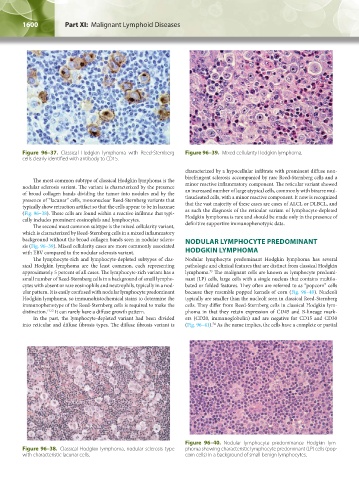
               Figure 96–37.  Classical Hodgkin lymphoma with Reed-Sternberg   Figure 96–39.  Mixed cellularity Hodgkin lymphoma.
               cells clearly identified with antibody to CD15.
                                                                      characterized by a hypocellular infiltrate with prominent diffuse non-
                                                                      birefringent sclerosis accompanied by rare Reed-Sternberg cells and a
                   The most common subtype of classical Hodgkin lymphoma is the
               nodular sclerosis variant. The variant is characterized by the presence   minor reactive inflammatory component. The reticular variant showed
               of broad collagen bands dividing the tumor into nodules and by the   an increased number of large atypical cells, commonly with bizarre mul-
               presence of “lacunar” cells, mononuclear Reed-Sternberg variants that   tinucleated cells, with a minor reactive component. It now is recognized
               typically show retraction artifact so that the cells appear to be in lacunae   that the vast majority of these cases are cases of ALCL or DLBCL, and
               (Fig. 96–38). These cells are found within a reactive infiltrate that typi-  as such the diagnosis of the reticular variant of lymphocyte-depleted
               cally includes prominent eosinophils and lymphocytes.  Hodgkin lymphoma is rare and should be made only in the presence of
                   The second most common subtype is the mixed cellularity variant,   definitive supportive immunophenotypic data.
               which is characterized by Reed-Sternberg cells in a mixed inflammatory
               background without the broad collagen bands seen in nodular sclero-  NODULAR LYMPHOCYTE PREDOMINANT
               sis (Fig. 96–39). Mixed cellularity cases are more commonly associated
               with EBV compared to the nodular sclerosis variant.    HODGKIN LYMPHOMA
                   The lymphocyte-rich and lymphocyte-depleted subtypes of clas-  Nodular lymphocyte predominant Hodgkin lymphoma has several
               sical Hodgkin lymphoma are the least common, each representing   pathologic and clinical features that are distinct from classical Hodgkin
               approximately 5 percent of all cases. The lymphocyte-rich variant has a   lymphoma.  The malignant cells are known as lymphocyte predomi-
                                                                              73
               small number of Reed-Sternberg cells in a background of small lympho-  nant (LP) cells, large cells with a single nucleus that contains multilo-
               cytes with absent or rare eosinophils and neutrophils, typically in a nod-  bated or folded features. They often are referred to as “popcorn” cells
               ular pattern. It is easily confused with nodular lymphocyte predominant   because they resemble popped kernels of corn (Fig. 96–40). Nucleoli
               Hodgkin lymphoma, so immunohistochemical stains to determine the   typically are smaller than the nucleoli seen in classical Reed-Sternberg
               immunophenotype of the Reed-Sternberg cells is required to make the   cells. They differ from Reed-Sternberg cells in classical Hodgkin lym-
               distinction. 71,72  It can rarely have a diffuse growth pattern.  phoma in that they retain expression of CD45 and B-lineage mark-
                   In the past, the lymphocyte-depleted variant had been divided   ers (CD20, immunoglobulin) and are negative for CD15 and CD30
               into reticular and diffuse fibrosis types. The diffuse fibrosis variant is   (Fig. 96–41).  As the name implies, the cells have a complete or partial
                                                                               74


                                                                      Figure 96–40.  Nodular lymphocyte predominance Hodgkin lym-
               Figure 96–38.  Classical Hodgkin lymphoma, nodular sclerosis type   phoma showing characteristic lymphocyte predominant (LP) cells (pop-
               with characteristic lacunar cells.                     corn cells) in a background of small benign lymphocytes.


          Kaushansky_chapter 96_p1587-1602.indd   1600                                                                  9/18/15   6:08 PM

