


Page 1679 - Williams Hematology ( PDFDrive )
P. 1679
1654           Part XI:  Malignant Lymphoid Diseases                                                                                                                               Chapter 100:  Mantle Cell Lymphoma            1655


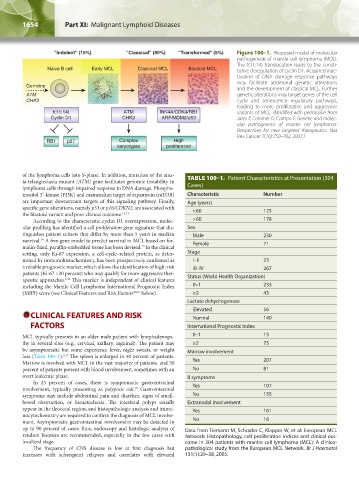
                          “Indolent” (15%)        “Classical” (80%)   “Transformed” (5%)   Figure 100–1.  Proposed model of molecular
                                                                                       pathogenesis of mantle cell lymphoma (MCL).
                                                                                       The t(11;14) translocation leads to the consti-
                        Naive B cell   Early MCL      Classical MCL    Blastoid MCL    tutive deregulation of cyclin D1. Acquired inac-
                                                                                       tivation of DNA damage response pathways
                                                                                       may facilitate additional genetic alterations
                 Germline
                                                                                       and the development of classical MCL. Further
                 ATM                                                                   genetic alterations may target genes of the cell
                 CHK2                                                                  cycle and senescence regulatory pathways,
                                                                                       leading to more proliferative and aggressive
                          t(11;14)               ATM         INK4A/CDK4/RB1            variants of MCL. (Modified with permission from
                         Cyclin D1               CHK2         ARF/MDM2/p53             Jares P, Colomer D, Campo E: Genetic and molec-
                                                                                       ular pathogenesis of mantle cell lymphoma:
                                                                                       Perspectives for new targeted therapeutics.  Nat
                                                                                       Rev Cancer 7(10):750–762, 2007.)
                        RB1   p27               Complex           High
                                               karyotypes       proliferation


               of the lymphoma cells into S-phase. In addition, mutation of the atax-  TABLE 100–1.  Patient Characteristics at Presentation (304
               ia-telangiectasia mutant (ATM) gene facilitates genomic instability in
               lymphoma cells through impaired response to DNA damage. Phospho-  Cases)
               inositol 3′-kinase (PI3K) and mammalian target of rapamycin (mTOR)   Characteristic  Number
               are important downstream targets of this signaling pathway. Finally,   Age (years)
               specific gene alterations, namely p53 or p16/CDKN2, are associated with
               the blastoid variant and poor clinical outcome. 12,13     <60                    123
                   According to the characteristic cyclin D1 overexpression, molec-    >60      178
               ular profiling has identified a cell proliferation gene signature that dis-  Sex
               tinguishes patient subsets that differ by more than 5 years in median     Male   230
               survival.  A five-gene model to predict survival in MCL based on for-
                      14
               malin-fixed, paraffin-embedded tissue has been devised.  In the clinical     Female  71
                                                       15
               setting, only Ki-67 expression, a cell-cycle–related protein, as deter-  Stage
               mined by immunohistochemistry, has been prospectively confirmed as     I–II      23
               a reliable prognostic marker, which allows the identification of high-risk     III–IV  267
               patients (Ki-67 >30 percent) who may qualify for more-aggressive ther-
               apeutic approaches.  This marker is independent of clinical features   Status (World Health Organization)
                              5,16
               including the Mantle Cell Lymphoma International Prognostic Index     0–1        233
               (MIPI) score (see Clinical Features and Risk Factors 20,21  below).    ≥2        43
                                                                       Lactate dehydrogenase
                                                                         Elevated               56
                    CLINICAL FEATURES AND RISK                           Normal                 140
                  FACTORS                                              International Prognostic Index

               MCL typically presents in an older male patient with lymphadenopa-    0–1        15
               thy in several sites (e.g., cervical, axillary, inguinal). The patient may     ≥2  75
               be asymptomatic but some experience fever, night sweats, or weight   Marrow involvement
               loss (Table 100–1).  The spleen is enlarged in 40 percent of patients.
                             5,17
               Marrow is involved with MCL in the vast majority of patients, and 50     Yes     207
               percent of patients present with blood involvement, sometimes with an     No     81
               overt leukemic phase.                                   B symptoms
                   In 25 percent of cases, there is symptomatic gastrointestinal
               involvement, typically presenting as  polyposis coli.  Gastrointestinal     Yes  107
                                                     18
               symptoms may include abdominal pain and diarrhea, signs of small-    No          155
               bowel obstruction, or hematochezia. The intestinal polyps usually   Extranodal involvement
               appear in the ileocecal region, and histopathologic analysis and immu-    Yes    161
               nocytochemistry are required to confirm the diagnosis of MCL involve-
               ment. Asymptomatic gastrointestinal involvement may be detected in     No        16
               up to 90 percent of cases; thus, endoscopy and histologic analysis of   Data from Tiemann M, Schrader C, Klapper W, et al: European MCL
               random biopsies are recommended, especially in the few cases with   Network: Histopathology, cell proliferation indices and clinical out-
               localized stage.                                       come in 304 patients with mantle cell lymphoma (MCL): A clinico-
                   The frequency of CNS disease is low at first diagnosis but   pathological study from the European MCL Network. Br J Haematol
               increases with subsequent relapses and correlates with elevated   131(1):29–38, 2005.


          Kaushansky_chapter 100_p1653-1662.indd   1654                                                                 9/18/15   5:06 PM

