


Page 173 - Williams Hematology ( PDFDrive )
P. 173
148            Part IV:  Molecular and Cellular Hematology                                                                                                        Chapter 10:  Genetic Principles and Molecular Biology            149


               complete set of genes (see Fig. 10–1). Occasionally, however, an error   AUTOSOMAL DOMINANT INHERITANCE
               occurs and pairing during meiosis is imperfect. Under these circum-  Diseases caused by autosomal dominant genes are rare, with the most
               stances—unequal crossing over (see Fig. 10–5)—one of the daughter   common occurring in fewer than 1 in 500 individuals. Therefore, it is
               chromosomes contains a duplicated gene, while the other one exists   uncommon for two individuals who are both affected by the same auto-
               with a gene deleted. Once a duplication has occurred, further dupli-  somal dominant disease to produce offspring together. Affected offspring
               cations occur more readily, because pairing of the first of the duplicate   are usually produced by the union of a normal parent with an affected
               genes on one chromosome with the second gene of the duplicate on   heterozygous parent. The affected parent can pass either a disease gene
               the other produces one chromosome with a triplicated gene and one   or a normal gene to the next generation. On average, half the children
               with a single gene (Chap. 48). Duplication has probably played a very   will be heterozygous and will express the disease, and half will be normal.
               important role in the course of evolution  because the presence of two   The pedigree in Fig. 10–2 shows the transmission of an autoso-
                                             11
               genes with the same function allows experiments of nature: Mutations   mal dominant trait or disease. Several important characteristics of this
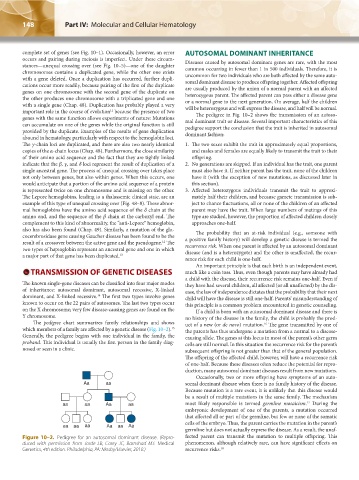
               can accumulate on one of the genes while the original function is still   pedigree support the conclusion that the trait is inherited in autosomal
               provided by the duplicate. Examples of the results of gene duplication   dominant fashion:
               abound in hematology, particularly with respect to the hemoglobin loci.
               The γ-chain loci are duplicated, and there are also two nearly identical   1.  The two sexes exhibit the trait in approximately equal proportions,
               copies of the α-chain locus (Chap. 48). Furthermore, the close similarity   and males and females are equally likely to transmit the trait to their
               of their amino acid sequence and the fact that they are tightly linked   offspring.
               indicate that the β, γ, and δ loci represent the result of duplication of a   2.  No generations are skipped. If an individual has the trait, one parent
               single ancestral gene. The process of unequal crossing over takes place   must also have it. If neither parent has the trait, none of the children
               not only between genes, but also within genes. When this occurs, one   have it (with the exception of new mutations, as discussed later in
               would anticipate that a portion of the amino acid sequence of a protein   this section).
               is represented twice on one chromosome and is missing on the other.   3.  Affected heterozygous individuals transmit the trait to approxi-
               The Lepore hemoglobins, leading to a thalassemic clinical state, are an   mately half their children, and because gamete transmission is sub-
               example of this type of unequal crossing over (Fig. 48–8). These abnor-  ject to chance fluctuations, all or none of the children of an affected
               mal hemoglobins have the amino acid sequence of the δ chain at the   parent may have the trait. When large numbers of matings of this
               amino end, and the sequence of the β chain at the carboxyl end. The   type are studied, however, the proportion of affected children closely
               complement to this kind of abnormality, the “anti-Lepore” hemoglobin,   approaches one-half.
               also has also been found (Chap. 49). Similarly, a mutation of the glu-  The probability that an at-risk individual (e.g., someone with
               cocerebrosidase gene causing Gaucher disease has been found to be the   a positive family history) will develop a genetic disease is termed the
                                                              12
               result of a crossover between the active gene and the pseudogene.  The   recurrence risk. When one parent is affected by an autosomal dominant
               two types of haptoglobin represent an ancestral gene and one in which   disease (and is a heterozygote) and the other is unaffected, the recur-
               a major part of that gene has been duplicated. 13
                                                                      rence risk for each child is one-half.
                                                                          An important principle is that each birth is an independent event,
                  TRANSMISSION OF GENETIC DISEASES                    much like a coin toss. Thus, even though parents may have already had
                                                                      a child with the disease, their recurrence risk remains one-half. Even if
               The known single-gene diseases can be classified into four major modes   they have had several children, all affected (or all unaffected) by the dis-
               of inheritance: autosomal dominant, autosomal recessive, X-linked   ease, the law of independence dictates that the probability that their next
               dominant, and X-linked recessive.  The first two types involve genes   child will have the disease is still one-half. Parents’ misunderstanding of
                                         14
               known to occur on the 22 pairs of autosomes. The last two types occur   this principle is a common problem encountered in genetic counseling.
               on the X chromosome; very few disease-causing genes are found on the   If a child is born with an autosomal dominant disease and there is
               Y chromosome.                                          no history of the disease in the family, the child is probably the prod-
                   The  pedigree chart summarizes family relationships and shows   uct of a new (or de novo) mutation.  The gene transmitted by one of
                                                                                                16
                                                                 15
               which members of a family are affected by a genetic disease (Fig. 10–2).    the parents has thus undergone a mutation from a normal to a disease-
               Generally, the pedigree begins with one individual in the family, the   causing allele. The genes at this locus in most of the parent’s other germ
               proband. This individual is usually the first person in the family diag-  cells are still normal. In this situation the recurrence risk for the parent’s
               nosed or seen in a clinic.                             subsequent offspring is not greater than that of the general population.
                                                                      The offspring of the affected child, however, will have a recurrence risk
                                                                      of one-half. Because these diseases often reduce the potential for repro-
                                                                      duction, many autosomal dominant diseases result from new mutations.
                                                                          Occasionally, two or more offspring have symptoms of an auto-
                                    Aa     aa                         somal dominant disease when there is no family history of the disease.
                                                                      Because mutation is a rare event, it is unlikely that this disease would
                                                                      be a result of multiple mutations in the same family. The mechanism
                                                                                                               17
                             aa     aa     Aa      aa                 most likely responsible is termed  germline mosaicism.  During the
                                                                      embryonic development of one of the parents, a mutation occurred
                                                                      that affected all or part of the germline, but few or none of the somatic
                                                                      cells of the embryo. Thus, the parent carries the mutation in the parent’s
                             aa  aa  aa     Aa  aa  Aa
                                                                      germline but does not actually express the disease. As a result, the unaf-
               Figure 10–2.  Pedigree for an autosomal dominant disease.  (Repro-  fected parent can transmit the mutation to multiple offspring. This
               duced with permission from Jorde LB, Carey JC, Barnshad MJ: Medical   phenomenon, although relatively rare, can have significant effects on
               Genetics, 4th edition. Philadelphia, PA: Mosby/Elsevier, 2010.)  recurrence risks. 18


          Kaushansky_chapter 10_p0143-0154.indd   148                                                                   9/18/15   10:22 PM

