


Page 176 - Williams Hematology ( PDFDrive )
P. 176
150  Part IV:  Molecular and Cellular Hematology      Chapter 10:  Genetic Principles and Molecular Biology           151


                  of factor VIII or factor IX, but autosomal recessive inheritance should   interaction with other genes, and the likelihood that certain individuals
                  suggest to the physician a deficiency of other clotting factors, such as   will develop a genetic disease.
                  factor X, XI, or V. Careful analysis of the family history not only will   Mendel’s  second  law,  the  principle of  independent  assortment,
                  make possible more appropriate genetic counseling to the patient and   states that an individual’s genes will be transmitted to the next genera-
                  family, but also will shorten the road to a correct diagnosis.  tion independently of one another. This law is only partly true, however,
                                                                        because genes located close together on the same chromosome do tend
                                                                        to be transmitted together to the offspring. Thus Mendel’s principle of
                       EPIGENETICS AND GENOMIC                          independent assortment holds true for most pairs of genes but not those
                     IMPRINTING                                         that occupy the same region of a chromosome. Such loci demonstrate
                                                                        linkage and are said to be linked.
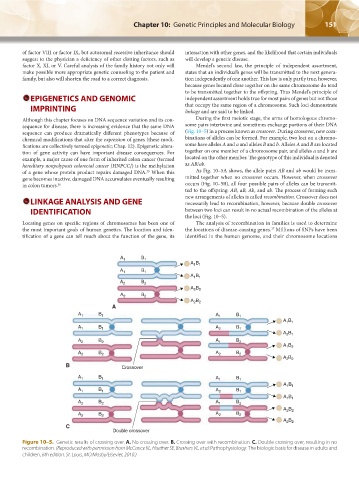
                  Although this chapter focuses on DNA sequence variation and its con-  During the first meiotic stage, the arms of homologous chromo-
                  sequence for disease, there is increasing evidence that the same DNA   some pairs intertwine and sometimes exchange portions of their DNA
                  sequence can produce dramatically different phenotypes because of   (Fig. 10–5) in a process known as crossover. During crossover, new com-
                  chemical modifications that alter the expression of genes (these modi-  binations of alleles can be formed. For example, two loci on a chromo-
                  fications are collectively termed epigenetic; Chap. 12). Epigenetic altera-  some have alleles A and a and alleles B and b. Alleles A and B are located
                  tion of gene activity can have important disease consequences. For   together on one member of a chromosome pair, and alleles a and b are
                  example, a major cause of one form of inherited colon cancer (termed   located on the other member. The genotype of this individual is denoted
                  hereditary nonpolyposis colorectal cancer [HNPCC]) is the methylation   as AB/ab.
                                                           35
                  of a gene whose protein product repairs damaged DNA.  When this   As Fig. 10–5A shows, the allele pairs AB and ab would be trans-
                  gene becomes inactive, damaged DNA accumulates eventually resulting   mitted together when no crossover occurs. However, when crossover
                  in colon tumors. 36                                   occurs (Fig. 10–5B), all four possible pairs of alleles can be transmit-
                                                                        ted to the offspring: AB, aB, Ab, and ab. The process of forming such
                                                                        new arrangements of alleles is called recombination. Crossover does not
                       LINKAGE ANALYSIS AND GENE                        necessarily lead to recombination, however, because double crossover
                     IDENTIFICATION                                     between two loci can result in no actual recombination of the alleles at
                                                                        the loci (Fig. 10–5).
                  Locating genes on specific regions of chromosomes has been one of   The analysis of recombination in families is used to determine
                                                                                                     37
                  the most important goals of human genetics. The location and iden-  the locations of disease-causing genes.  Millions of SNPs have been
                  tification of a gene can tell much about the function of the gene, its   identified in the human genome, and their chromosome locations


                                                   A 1    B 1
                                                                          A B
                                                                           1 1
                                                   A 1    B 1
                                                                          A B
                                                                           1 1
                                                   A 2    B 2
                                                                          A B
                                                                           2 2
                                                   A 2    B 2
                                                                          A B
                                                                           2 2
                                                A
                                    A 1    B 1                                     A 1   B 1
                                                                                                         A B
                                                                                                          1 1
                                    A 1    B 1                                     A 2   B 1
                                                                                                         A B
                                                                                                          2 1
                                    A 2    B 2                                     A 1   B 2
                                                                                                         A B
                                                                                                          1 2
                                    A 2    B 2                                     A 2   B 2
                                                                                                         A B
                                                                                                          2 2
                                B                  Crossover
                                    A 1    B 1                                     A 1   B 1
                                                                                                         A B
                                                                                                          1 1
                                    A 1    B 1                                     A 2   B 1
                                                                                                         A B
                                                                                                          1 1
                                    A 2    B 2                                     A 1   B 2
                                                                                                         A B
                                                                                                          2 2
                                    A 2    B 2                                     A 2   B 2
                                                                                                         A B
                                                                                                          2 2
                                C
                                                Double crossover
                  Figure 10–5.  Genetic results of crossing over. A. No crossing over. B. Crossing over with recombination. C. Double crossing over, resulting in no
                  recombination. (Reproduced with permission from McCance KL, Huether SE, Brashers VL, et al: Pathophysiology: The biologic basis for disease in adults and
                  children, 6th edition. St. Louis, MO:Mosby/Elsevier, 2010.)


          Kaushansky_chapter 10_p0143-0154.indd   151                                                                   9/18/15   10:22 PM

