


Page 175 - Williams Hematology ( PDFDrive )
P. 175
150            Part IV:  Molecular and Cellular Hematology                                                                                                        Chapter 10:  Genetic Principles and Molecular Biology            151


               Y chromosome does not carry a normal allele to counteract the effects   Persons with abnormal numbers of X chromosomes, such as those
               of the disease gene. Because a single copy of an X-linked recessive gene   with Turner syndrome or Klinefelter syndrome, are not physically nor-
               will cause disease in a male, whereas two copies are required for disease   mal. This situation presents a puzzle because they presumably have only
               expression in females, more males are affected by X-linked recessive dis-  one active X chromosome, just as individuals with normal numbers of
               eases than are females.                                chromosomes do. This is probably because the distal tips of the short
                                                                      and long arms of the X chromosome, as well as several other regions on
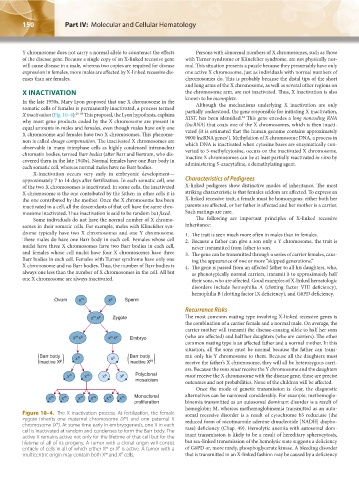
               X INACTIVATION                                         the chromosome arm, are not inactivated. Thus, X inactivation is also
               In the late 1950s, Mary Lyon proposed that one X chromosome in the   known to be incomplete.
               somatic cells of females is permanently inactivated, a process termed   Although the mechanisms underlying X inactivation are only
               X inactivation (Fig. 10–4). 29–33  This proposal, the Lyon hypothesis, explains   partially understood, the gene responsible for initiating X inactivation,
                                                                                         34
               why most gene products coded by the X chromosome are present in   XIST, has been identified.  This gene encodes a long noncoding RNA
               equal amounts in males and females, even though males have only one   (lncRNA) that coats one of the X chromosomes, which is then inacti-
               X chromosome and females have two X chromosomes. This phenome-  vated (it is estimated that the human genome contains approximately
                                                                                    1
               non is called dosage compensation. The inactivated X chromosomes are   9000 lncRNA genes ). Methylation of X chromosome DNA, a process in
               observable in many interphase cells as highly condensed intranuclear   which DNA is inactivated when cytosine bases are enzymatically con-
               chromatin bodies, termed Barr bodies (after Barr and Bertram, who dis-  verted to 5-methylcytosine, occurs on the inactivated X chromosome.
               covered them in the late 1940s). Normal females have one Barr body in   Inactive X chromosomes can be at least partially reactivated in vitro by
               each somatic cell, whereas normal males have no Barr bodies.  administering 5-azacytidine, a demethylating agent.
                   X-inactivation occurs very early in embryonic development—
               approximately 7 to 14 days after fertilization. In each somatic cell, one   Characteristics of Pedigrees
               of the two X chromosomes is inactivated. In some cells, the inactivated   X-linked pedigrees show distinctive modes of inheritance. The most
               X chromosome is the one contributed by the father; in other cells it is   striking characteristic is that females seldom are affected. To express an
               the one contributed by the mother. Once the X chromosome has been   X-linked recessive trait, a female must be homozygous: either both her
               inactivated in a cell, all the descendants of that cell have the same chro-  parents are affected, or her father is affected and her mother is a carrier.
               mosome inactivated. Thus inactivation is said to be random but fixed.  Such matings are rare.
                   Some individuals do not have the normal number of X chromo-  The following are important principles of X-linked recessive
               somes in their somatic cells. For example, males with Klinefelter syn-  inheritance:
               drome typically have two X chromosomes and one Y chromosome.   1.  The trait is seen much more often in males than in females.
               These males do have one Barr body in each cell. Females whose cell   2.  Because a father can give a son only a Y chromosome, the trait is
               nuclei have three X chromosomes have two Barr bodies in each cell,   never transmitted from father to son.
               and females whose cell nuclei have four X chromosomes have three   3.  The gene can be transmitted through a series of carrier females, caus-
               Barr bodies in each cell. Females with Turner syndrome have only one   ing the appearance of one or more “skipped generations.”
               X chromosome and no Barr bodies. Thus, the number of Barr bodies is   4.  The gene is passed from an affected father to all his daughters, who,
               always one less than the number of X chromosomes in the cell. All but   as phenotypically normal carriers, transmit it to approximately half
               one X chromosome are always inactivated.                 their sons, who are affected. Good examples of X-linked hematologic
                                                                        disorders include hemophilia A (clotting factor VIII deficiency),
                                                                        hemophilia B (clotting factor IX deficiency), and G6PD deficiency.
                          Ovum    X m       X p   Sperm
                                                                      Recurrence Risks
                                       m   p
                                      X X     Zygote                  The most common mating type involving X-linked recessive genes is
                                                                      the combination of a carrier female and a normal male. On average, the
                                                                      carrier mother will transmit the disease-causing allele to half her sons
                                 m   p
                                             m  p
                                X X         X X    Embryo             (who are affected) and half her daughters (who are carriers). The other
                                                                      common mating type is an affected father and a normal mother. In this
                                                                      situation, all the sons must be normal because the father can trans-
                     Barr body   X m         X p   Barr body          mit only his Y chromosome to them. Because all the daughters must
                     inactive X p                  inactive X m       receive the father’s X chromosome, they will all be heterozygous carri-
                                                                      ers. Because the sons must receive the Y chromosome and the daughters
                              X m   X m   X p   X p  Polyclonal       must receive the X chromosome with the disease gene, these are precise
                                                     mosaicism
                                                                      outcomes and not probabilities. None of the children will be affected.
                                                                          Once the mode of genetic transmission is clear, the diagnostic
                        X m  X m  X m  X m  X m  X m  Monoclonal      alternatives can be narrowed considerably. For example, methemoglo-
                                                     proliferation    binemia transmitted as an autosomal dominant disorder is a result of
                                                                      hemoglobin M, whereas methemoglobinemia transmitted as an auto-
               Figure 10–4.  The X inactivation process. At fertilization, the female   somal recessive disorder is a result of cytochrome b5 reductase (the
               zygote inherits one maternal chromosome  (X ) and one paternal X   reduced form of nicotinamide adenine dinucleotide [NADH] diapho-
                                                  m
               chromosome (X ). At some time early in embryogenesis, one X in each   rase) deficiency (Chap. 49). Hemolytic anemia with autosomal dom-
                           P
               cell is inactivated at random and condenses to form the Barr body. The
               active X remains active not only for the lifetime of that cell but for the   inant transmission is likely to be a result of hereditary spherocytosis,
               lifetime of all of its progeny. A tumor with a clonal origin will consist   but sex-linked transmission of the hemolytic state suggests a deficiency
               entirely of cells in all of which either X  or X  is active. A tumor with a   of G6PD or, more rarely, phosphoglycerate kinase. A bleeding disorder
                                                P
                                           m
                                                 P
                                           m
               multicentric origin may contain both X  and X  cells.  that is transmitted in an X-linked fashion may be caused by a deficiency


          Kaushansky_chapter 10_p0143-0154.indd   150                                                                   9/18/15   10:22 PM

