


Page 1750 - Williams Hematology ( PDFDrive )
P. 1750
1724  Part XI:  Malignant Lymphoid Diseases               Chapter 106:  Essential Monoclonal Gammopathy              1725


                                                                                              159
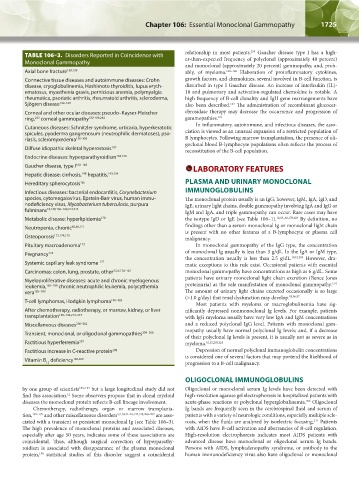
                   TABLE 106–3.  Disorders Reported in Coincidence with   relationship in most patients.  Gaucher disease type I has a high-
                                                                        er-than-expected frequency of polyclonal (approximately 40 percent)
                   Monoclonal Gammopathy
                                                                        and monoclonal (approximately 20 percent) gammopathy, and, prob-
                   Axial bone fracture 138,139                          ably, of myeloma. 160–162  Elaboration of proinflammatory cytokines,
                   Connective tissue diseases and autoimmune diseases: Crohn   growth factors, and chemokines, several involved in B-cell function, is
                   disease, cryoglobulinemia, Hashimoto thyroiditis, lupus eryth-  disturbed in type I Gaucher disease. An increase of interleukin (IL)-
                   ematosus, myasthenia gravis, pernicious anemia, polymyalgia   10 and pulmonary and activation-regulated chemokine is notable. A
                   rheumatica, psoriatic arthritis, rheumatoid arthritis, scleroderma,   high frequency of B-cell clonality and IgH gene rearrangements have
                   Sjögren disease 140–149                              also been described.  The administration of recombinant glucocer-
                                                                                        162
                   Corneal and other ocular diseases: pseudo–Kayser-Fleischer   ebrosidase therapy may decrease the occurrence and progression of
                   ring,  corneal gammopathy 102-106,244                gammopathies. 161
                      243
                                                                            In inflammatory, autoimmune, and infectious diseases, the asso-
                   Cutaneous diseases: Schnitzler syndrome, urticaria, hyperkeratotic
                   spicules, pyoderma gangrenosum (neutrophilic dermatoses), pso-  ciation is viewed as an unusual expansion of a restricted population of
                   riasis, scleromyxedema 150–156                       B lymphocytes. Following marrow transplantation, the presence of oli-
                                                                        goclonal blood B-lymphocyte populations often reflects the process of
                   Diffuse idiopathic skeletal hyperostosis 157
                                                                        reconstitution of the B-cell population.
                   Endocrine diseases: hyperparathyroidism 158,159
                   Gaucher disease, type I 160–162                         LABORATORY FEATURES
                   Hepatic disease: cirrhosis,  hepatitis, 163,164
                                      148
                   Hereditary spherocytosis 165                         PLASMA AND URINARY MONOCLONAL
                   Infectious diseases: bacterial endocarditis, Corynebacterium   IMMUNOGLOBULINS
                   species, cytomegalovirus, Epstein-Barr virus, human immu-  The monoclonal protein usually is an IgG; however, IgM, IgA, IgD, and
                   nodeficiency virus, Mycobacterium tuberculosis, purpura   IgE, urinary light chains, double gammopathy involving IgA and IgG or
                   fulminans 19,148,166–169,212,215                     IgM and IgA, and triple gammopathy can occur. Rare cases may have
                   Metabolic disease: hyperlipidemia 170                the isotype IgD or IgE (see Table  106–1). 12,63–66,178,203  By definition, no
                   Neutropenia, chronic 85,86,171                       findings other than a serum monoclonal Ig or monoclonal light chain
                                                                        is present with no other features of a B-lymphocyte or plasma cell
                   Osteoporosis 172,174,175                             malignancy.
                   Pituitary macroadenoma 173                               In monoclonal gammopathy of the IgG type, the concentration
                   Pregnancy 174                                        of monoclonal Ig usually is less than 3 g/dL. In the IgA or IgM type,
                                                                        the concentration usually is less than 2.5 g/dL. 10,12,203  However, dra-
                   Systemic capillary leak syndrome  177                matic exceptions to this rule exist. Occasional patients with essential
                   Carcinomas: colon, lung, prostate, other 3,5,6,178–181  monoclonal gammopathy have concentrations as high as 6 g/dL. Some
                   Myeloproliferative diseases: acute and chronic myelogenous   patients have urinary monoclonal light chain excretion (Bence Jones
                                                                                                                          1,10
                   leukemia, 182–184  chronic neutrophilic leukemia, polycythemia   proteinuria) as the sole manifestation of monoclonal gammopathy.
                   vera 185–189                                         The amount of urinary light chains excreted occasionally is so large
                                                                        (>1.0 g/day) that renal dysfunction may develop. 93,96,97
                   T-cell lymphomas, Hodgkin lymphoma 190–193
                                                                            Most patients with myeloma or macroglobulinemia have sig-
                   After chemotherapy, radiotherapy, or marrow, kidney, or liver   nificantly depressed nonmonoclonal Ig levels. For example, patients
                   transplantation 194–198,213–215                      with IgG myeloma usually have very low IgA and IgM concentrations
                   Miscellaneous diseases 200–202                       and a reduced polyclonal IgG level. Patients with monoclonal gam-
                                                                        mopathy usually have normal polyclonal Ig levels; and, if a decrease
                   Transient, monoclonal, or oligoclonal gammopathies 204–206
                                                                        of their polyclonal Ig levels is present, it is usually not as severe as in
                   Factitious hyperferremia 207                         myeloma. 10,12,203,210
                   Factitious increase in C-reactive protein 208            Depression of normal polyclonal immunoglobulin concentrations
                                                                        is considered one of several factors that may portend the likelihood of
                   Vitamin B  deficiency 140,209
                          12                                            progression to a B-cell malignancy.

                                                                        OLIGOCLONAL IMMUNOGLOBULINS
                  by one group of scientists 183–184  but a large longitudinal study did not   Oligoclonal or monoclonal serum Ig levels have been detected with
                  find this association.  Some observers propose that in clonal myeloid   high-resolution agarose gel electrophoresis in hospitalized patients with
                                 12
                  diseases the monoclonal protein reflects B-cell lineage involvement.  acute-phase reactions or polyclonal hyperglobulinemia.  Oligoclonal
                                                                                                                 206
                     Chemotherapy, radiotherapy,  organ  or  marrow  transplanta-  Ig bands are frequently seen in the cerebrospinal fluid and serum of
                  tion, 194–199  and other miscellaneous disorders 5,7,10,24–26,147,148,200–202  are asso-  patients with a variety of neurologic conditions, especially multiple scle-
                                                                                                                    211
                  ciated with a transient or persistent monoclonal Ig (see Table  106–3).   rosis, when the fluids are analyzed by isoelectric focusing.  Patients
                  The high prevalence of monoclonal proteins and associated diseases,   with AIDS have B-cell activation and aberrancies of B-cell regulation.
                  especially after age 50 years, indicates some of these associations are   High-resolution electrophoresis indicates most AIDS patients with
                  coincidental.  Thus,  although  surgical  correction  of  hyperparathy-  advanced disease have monoclonal or oligoclonal serum Ig bands.
                  roidism is associated with disappearance of the plasma monoclonal   Persons with AIDS, lymphadenopathy syndrome, or antibody to the
                  protein,  statistical studies of this disorder suggest a coincidental   human immunodeficiency virus also have oligoclonal or monoclonal
                       158


          Kaushansky_chapter 106_p1721-1732.indd   1725                                                                 9/21/15   12:40 PM

