


Page 1747 - Williams Hematology ( PDFDrive )
P. 1747
1722           Part XI:  Malignant Lymphoid Diseases                                                                                                                  Chapter 106:  Essential Monoclonal Gammopathy              1723


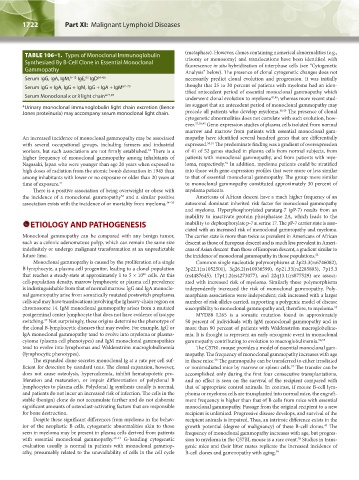
                TABLE 106–1.  Types of Monoclonal Immunoglobulin      (metaphase). However, clones containing numerical abnormalities (e.g.,
                                                                      trisomy or monosomy) and translocations have been identified with
                Synthesized By B-Cell Clone in Essential Monoclonal   fluorescence in situ hybridization of interphase cells (see “Cytogenetic
                Gammopathy                                            Analysis” below). The presence of clonal cytogenetic changes does not
                Serum IgG, IgA, IgM, 6–12  IgE,  IgD 64–66            necessarily predict clonal evolution and progression. It was initially
                                     63
                Serum IgG + IgA, IgG + IgM, IgG + IgA + IgM 67–70     thought that 25 to 30 percent of patients with myeloma had an iden-
                                                                      tified antecedent period of essential monoclonal gammopathy which
                Serum Monoclonal κ or λ light chain* 71,97            underwent clonal evolution to myeloma 43,46 ; whereas more recent stud-
               *Urinary monoclonal immunoglobulin light chain excretion (Bence   ies suggest that an antecedent period of monoclonal gammopathy may
               Jones proteinuria) may accompany serum monoclonal light chain.  precede all patients who develop myeloma. 48,49  The presence of clonal
                                                                      cytogenetic abnormalities does not correlate with such evolution, how-
                                                                      ever. 37,38,45  Gene-expression studies of plasma cells isolated from normal
                                                                      marrow and marrow from patients with essential monoclonal gam-
               An increased incidence of monoclonal gammopathy may be associated   mopathy have identified several hundred genes that are differentially
               with  several occupational  groups,  including farmers and  industrial   expressed. 50,51  The predominate finding was a gradient of overexpression
               workers, but such associations are not firmly established.  There is a   of 41 of 52 genes studied in plasma cells from normal subjects, from
                                                          32
               higher  frequency  of  monoclonal  gammopathy  among  inhabitants of   patients with monoclonal gammopathy, and from patients with mye-
               Nagasaki, Japan who were younger than age 20 years when exposed to   loma, respectively.  In addition, myeloma patients could be stratified
                                                                                   51
               high doses of radiation from the atomic bomb detonation in 1945 than   into those with gene-expression profiles that were more or less similar
               among inhabitants with lower or no exposure or older than 20 years at   to that of essential monoclonal gammopathy. The group more similar
               time of exposure. 21                                   to monoclonal gammopathy constituted approximately 30 percent of
                   There is a positive association of being overweight or obese with   myeloma patients.
               the incidence of a monoclonal gammopathy  and a similar positive   Americans of African descent have a much higher frequency of an
                                                33
               association exists with the incidence of or mortality from myeloma. 34–36  autosomal dominant inherited risk factor for monoclonal gammopathy
                                                                      and myeloma. Hyperphosphorylated  paratarg-7  (pP-7)  results  from an
                                                                      inability to inactivate protein phosphatase 2A, which leads to the
                  ETIOLOGY AND PATHOGENESIS                           inability to dephosphorylate p-7 at serine 17. The pP-7 carrier state is asso-
                                                                      ciated with an increased risk of monoclonal gammopathy and myeloma.
               Monoclonal  gammopathy  can  be  compared  with  any  benign  tumor,   The carrier state is more than twice as prevalent in Americans of African
               such as a colonic adenomatous polyp, which can remain the same size   descent as those of European descent and is much less prevalent in Ameri-
               indefinitely or undergo malignant transformation at an unpredictable   cans of Asian descent  than those of European descent, a gradient similar to
               future time.                                           the incidence of monoclonal gammopathy in those populations. 52
                   Monoclonal gammopathy is caused by the proliferation of a single   Common single nucleotide polymorphisms at 2p23.3(rs6746082),
               B lymphocyte, a plasma cell progenitor, leading to a clonal population   3p22.1(rs1052501), 3q26.2(rs10936599), 6p21.33(rs2285803), 7p15.3
               that reaches a steady-state at approximately 1 to 5 × 10  cells. At this   (rs4487645), 17p11.2(rs4273077), and 22q13.1(rs877529) are associ-
                                                        10
               cell-population density, marrow lymphocyte or plasma cell prevalence   ated with increased risk of myeloma. Similarly these polymorphisms
               is indistinguishable from that of normal marrow. IgG and IgA monoclo-  independently increased the risk of monoclonal gammopathy. Poly-
               nal gammopathy arise from somatically mutated postswitch preplasma   morphism associations were independent; risk increased with a larger
               cells and may have translocations involving the Ig heavy-chain region on   number of risk alleles carried, supporting a polygenic model of disease
               chromosome 14. IgM monoclonal gammopathy arises from a mutated   susceptibility to monoclonal gammopathy and, therefore, to myeloma. 53
               postgerminal center lymphocyte that does not have evidence of isotype   MYD88  L265 is a  somatic  mutation found  in approximately
               switching.  Not surprisingly, these origins determine the phenotype of   50 percent of individuals with IgM monoclonal gammopathy and in
                       37
               the clonal B-lymphocytic diseases that may evolve. For example, IgG or   more than 90 percent of patients with Waldenström macroglobuline-
               IgA monoclonal gammopathy tend to evolve into myeloma or plasma-  mia. It is thought to represent an early oncogenic event in monoclonal
               cytoma (plasma cell phenotypes) and IgM monoclonal gammopathies   gammopathy contributing to evolution to macroglobulinemia. 54,55
               tend to evolve into lymphomas and Waldenström macroglobulinemia   The C57BL mouse provides a model of essential monoclonal gam-
               (lymphocytic phenotypes).                              mopathy. The frequency of monoclonal gammopathy increases with age
                   The expanded clone secretes monoclonal Ig at a rate per cell suf-  in these mice.  The gammopathy can be transferred to either irradiated
                                                                                56
               ficient for detection by standard tests. The clonal expansion, however,   or nonirradiated mice by marrow or spleen cells.  The transfer can be
                                                                                                          57
               does not cause osteolysis, hypercalcemia, inhibit hematopoietic pro-  accomplished only during the first four consecutive transplantations,
               liferation and maturation, or impair differentiation of polyclonal B   and no effect is seen on the survival of the recipient compared with
               lymphocytes to plasma cells. Polyclonal Ig synthesis usually is normal,   that of appropriate control animals. In contrast, if mouse B-cell lym-
               and patients do not incur an increased risk of infection. The cells in the   phoma or myeloma cells are transplanted into normal mice, the engraft-
               stable (benign) clone do not accumulate further and do not elaborate   ment frequency is higher than that of B cells from mice with essential
               significant amounts of osteoclast-activating factors that are responsible   monoclonal gammopathy. Passage from the original recipient to a new
               for bone destruction.                                  recipient is unlimited. Progressive disease develops, and survival of the
                   Despite these significant differences from myeloma in the behav-  recipient animals is impaired. Thus, an intrinsic difference exists in the
               ior of the neoplastic B cells, cytogenetic abnormalities akin to those   growth potential (degree of malignancy) of these B-cell clones.  The
                                                                                                                     43
               seen in myeloma may be present in plasma cells derived from patients   frequency of monoclonal gammopathy increases with age, but progres-
               with essential monoclonal gammopathy. 37–47  G-banding cytogenetic   sion to myeloma in the C57BL mouse is a rare event.  Studies in trans-
                                                                                                            58
               evaluation usually is normal in patients with monoclonal gammop-  genic mice and their litter mates replicate the increased incidence of
               athy, presumably related to the unavailability of cells in the cell cycle   B-cell clones and gammopathy with aging. 59


          Kaushansky_chapter 106_p1721-1732.indd   1722                                                                 9/21/15   12:39 PM

