


Page 1748 - Williams Hematology ( PDFDrive )
P. 1748
1722  Part XI:  Malignant Lymphoid Diseases               Chapter 106:  Essential Monoclonal Gammopathy              1723


                     Occasionally, monoclonal gammopathy is the result of exaggerated   Some pathologists are still reluctant to give up urinary measurements
                  production of natural antibody by a B-lymphocyte clone.  For exam-  because of the uncommon occurrence of urinary monoclonal light
                                                            60
                  ple, patients with cold agglutinins may have monoclonal IgM for years.   chains in the absence of evidence of an abnormality of serum mono-
                                                                                      76
                  A few monoclonal IgM antibodies act as rheumatoid factors and may   clonal light chains.  Followup of these cases has not shown any clini-
                  form cryoglobulins through complex formation with IgG molecules.  cal consequence of these uncommon false-negative serum light-chain
                                                                        measurements. Serum protein gel electrophoresis has a limit of detec-
                     CLINICAL FEATURES                                  tion of approximately 0.03 g/dL, if the monoclonal protein migrates in
                                                                        the γ-globulin fraction. Small monoclonal proteins that migrate in the
                  BLOOD CELLS AND MARROW                                α- or β-globulin fraction are more difficult to identify on electrophore-
                  Blood counts and the marrow examination are normal. Notably anemia   sis. Immunofixation electrophoresis is used to confirm a monoclonal
                                                                        protein found on gel electrophoresis. Immunofixation electrophoresis
                  is not present and the proportion of plasma cells in marrow is less than   may also detect a monoclonal protein not evident on serum protein gel
                  10 percent. Although an increased percent of plasma cells is the most   electrophoresis, usually because the protein is in too low a concentra-
                  constant morphologic feature of myeloma, the presence of cytologic   tion or is embedded in the normal polyclonal α- or β-globulin peak.
                  atypia as judged by frequent binucleate plasma cells and large plasma   Monoclonal proteins identified by immunofixation electrophoresis may
                  cell nucleoli are findings more specific for myeloma.  Quantitative   be transient (approximately 15 to 20 percent) and have a greater like-
                                                          61
                  microscopy  of  the  number  of  marrow  microvessels  per  high-power   lihood to progress to a disease if they are of an IgA or IgM isotype.
                                                                                                                          77
                  field, using immunohistochemistry, indicates microvessel density on   In the future, mass spectroscopy may be a more sensitive and specific
                  average is threefold greater than in normal persons, but far less than in   method to identify monoclonal proteins. 78
                  patients with myeloma, although some overlap with myeloma occurs. 62  In individuals with a serum monoclonal IgG of less than 1.5 g/dL,
                                                                        especially if of an older age and with no overt end-organ abnormality,
                  CYTOGENETIC ANALYSIS                                  marrow examination and radiographic examination of the bones have a
                  Hyperdiploidy, assessed by DNA content, is present in about half the   very low diagnostic yield and can be omitted. A presumptive diagnosis
                  cases and hypodiploidy is present in approximately 10 percent of cases   of essential monoclonal gammopathy can be made with reexamination
                  of monoclonal gammopathy.  Use of interphase fluorescence  in situ   at approximately 6 months and at appropriate intervals, thereafter. 79,80
                                       42
                  hybridization has uncovered numerical chromosome abnormalities in
                  the plasma cells of more than 50 percent of subjects. Clones containing   FUNCTIONAL IMPAIRMENT FROM A
                  trisomy or monosomy involving chromosomes 3, 6, 7, 9, 11, 13, 17, and   MONOCLONAL PROTEIN
                  18 have been identified. 38–41,44,45  Deletions of 13q14 are present in about
                  one-quarter of patients and abnormalities involving 14q32, the site of
                  the Ig heavy-chain genes, are present in approximately 60 percent of   Interaction with Plasma Protein or Blood Cells
                  subjects. 38–41  Chromosomal changes do not appear to be correlated with   Some patients have monoclonal proteins with antibody specific-
                  progression.                                          ity directed against plasma or cell proteins, resulting in symptomatic
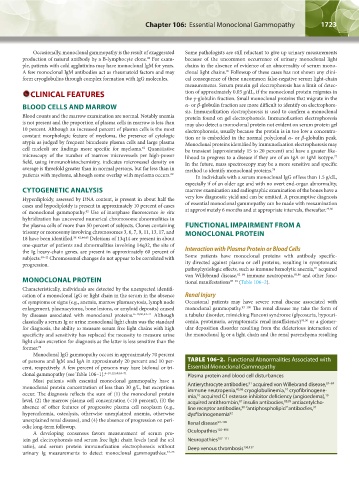
                                                                        pathophysiologic effects, such as immune hemolytic anemia,  acquired
                                                                                                                    81
                                                                        von Willebrand disease, 82–84  immune neutropenia, 85,86  and other func-
                  MONOCLONAL PROTEIN                                    tional manifestations 87–92  (Table 106–2).
                  Characteristically, individuals are detected by the unexpected identifi-
                  cation of a monoclonal IgG or light chain in the serum in the absence   Renal Injury
                  of symptoms or signs (e.g., anemia, marrow plasmacytosis, lymph node   Occasional  patients  may  have  severe  renal  disease  associated  with
                  enlargement, plasmacytoma, bone lesions, or amyloid deposits) caused   monoclonal gammopathy. 93–100  The renal disease my take the form of
                  by diseases associated with monoclonal proteins. 6–10,60,63–71  Although   a tubular disorder, mimicking Fanconi syndrome (glycosuria, hypouri-
                  classically a serum Ig or urine monoclonal light chain was the standard   cemia, proteinuria, asymptomatic renal insufficiency) 93,96  or a glomer-
                  for diagnosis, the ability to measure serum free light chains with high   ular deposition disorder resulting from the deleterious interaction of
                  specificity and sensitivity has replaced the necessity to measure urine   the monoclonal Ig or a light chain and the renal parenchyma resulting
                  light chain excretion for diagnosis as the latter is less sensitive than the
                  former. 72
                     Monoclonal IgG gammopathy occurs in approximately 70 percent
                  of persons and IgM and IgA in approximately 20 percent and 10 per-  TABLE 106–2.  Functional Abnormalities Associated with
                  cent, respectively. A few percent of persons may have biclonal or tri-  Essential Monoclonal Gammopathy
                  clonal gammopathy (see Table  106–1). 6–10,12,60,63–71  Plasma protein and blood cell disturbances
                     Most patients with essential monoclonal gammopathy have a                81                        82–84
                  monoclonal protein concentration of less than 30 g/L, but exceptions   Antierythrocyte antibodies,  acquired von Willebrand disease,
                                                                                          85,86
                                                                                                          10
                  occur.  The  diagnosis  reflects  the  sum  of  (1)  the  monoclonal  protein   immune neutropenia,   cryoglobulinemia,  cryofibrinogene- 10
                                                                         mia,  acquired C1 esterase inhibitor deficiency (angioedema),
                                                                            10
                  level, (2) the marrow plasma cell concentration (<10 percent), (3) the   acquired antithrombin,  insulin antibodies, 88,89  antiacetylcho-
                                                                                           87
                  absence of other features of progressive plasma cell neoplasm (e.g.,   line receptor antibodies,  “antiphospholipid” antibodies,
                                                                                                                   91
                                                                                           90
                  hypercalcemia, osteolysis, otherwise unexplained anemia, otherwise   dysfibrinogenemia 92
                  unexplained renal disease), and (4) the absence of progression on peri-  Renal disease 93–100
                  odic long-term followup.
                     A developing consensus favors measurement of serum pro-  Oculopathies 102–106
                  tein gel electrophoresis and serum free light chain levels (and the κ:λ   Neuropathies 107–111
                  ratio), and serum protein immunofixation electrophoresis without   Deep venous thrombosis 136,137
                  urinary Ig measurements to detect monoclonal gammopathies. 73–75


          Kaushansky_chapter 106_p1721-1732.indd   1723                                                                 9/21/15   12:39 PM

