


Page 1759 - Williams Hematology ( PDFDrive )
P. 1759
1734           Part XI:  Malignant Lymphoid Diseases                                                                                                                                             Chapter 107:  Myeloma           1735


                                                                                              28
                  EPIDEMIOLOGY                                        or myeloma after 15 to 20 years,  and accelerates MG transformation
                                                                               29
                                                                      to myeloma.  People exposed to fresh wood, wood dust, or working in
               INCIDENCE AND PREVALENCE                               saw mill factories had an increased risk of myeloma in some studies. 30,31
               Myeloma  represents  the  second  most  common  hematologic  cancer,   Finally, associations between myeloma risk and autoimmune diseases
                                                                                            32,33
                                                                                                or pernicious anemia ) or infections
                                                                      (especially rheumatoid arthritis
                                                                                                              34
               accounting for 1.4 percent of all cancers and 10 percent of hemato-  (HIV and hepatitis C 35,36 ) have been proposed, based on a retrospec-
               logic malignancies, with a prevalence of 83,367 people in 2011.  The   tive study among American male military veterans, 37,38  suggesting an
                                                               2
               American Cancer Society has estimated that 24,050 new myeloma cases   immune-mediated mechanism for malignant transformation. Human
               were diagnosed in the United States in 2014, of which approximately   herpes virus 8 DNA sequences responsible for Kaposi sarcoma and Cas-
               11,090 will die. Most of the patients are diagnosed among people ages   tleman disease pathogenesis  have been reported by some investigators
                                                                                          39
               65 to 74 years, with a median age at onset of 69 years; only 4 percent of   in marrow dendritic cells of myeloma patients, although other studies
               cases occur before age 45 years. Men are affected more frequently than   suggest that this is an epiphenomenon. 40,41
               women (1.6:1 ratio) and individuals of African descent have twice the
               prevalence of myeloma as those of European descent. Conversely, indi-
               viduals of Japanese and Spanish (Latino) descent have very low preva-  ETIOLOGY AND PATHOGENESIS
               lence rates.  Myeloma is always preceded by a condition called MG,
                        3–5
               as has been demonstrated by long-term followup studies of a cohort   CELL OF ORIGIN
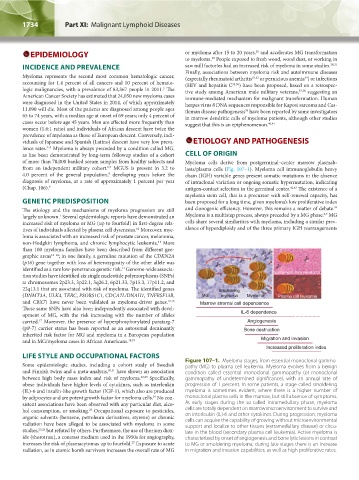
               of more than 70,000 banked serum samples from healthy subjects and   Myeloma cells derive from postgerminal–center marrow plasmab-
               from an independent military cohort.  MGUS is present in 3.2 to    lasts/plasma cells (Fig. 107–1). Myeloma cell immunoglobulin heavy
                                            6,7
               4.0 percent of the general population,  developing years before the    chain (IGH) variable genes present somatic mutations in the absence
                                            8
               diagnosis  of myeloma, at a rate of approximately 1 percent per year   of intraclonal variation or ongoing somatic hypermutation, indicating
               (Chap. 106). 9                                         antigen-contact selection in the germinal center. 42,43  The existence of a
                                                                      myeloma stem cell, that is a precursor with self-renewal capacity, has
               GENETIC PREDISPOSITION                                 been proposed for a long time, given myeloma’s low proliferative index
                                                                                                                        44
               The etiology and the mechanisms of myeloma progression are still   and clonogenic efficiency. However, this remains a matter of debate.
                                                                                                                    6,7
               largely unknown.  Several epidemiologic reports have demonstrated an   Myeloma is a multistep process, always preceded by a MG phase.  MG
                            1
               increased risk of myeloma or MG (up to fourfold) in first-degree rela-  cells share several similarities with myeloma, including a similar prev-
               tives of individuals affected by plasma cell dyscrasias.  Moreover, mye-  alence of hyperdiploidy and of the three primary IGH rearrangements
                                                      10
               loma is associated with an increased risk of prostate cancer, melanoma,
               non-Hodgkin lymphoma, and chronic lymphocytic leukemia.  More
                                                             11
               than 100 myeloma families have been described from different geo-
               graphic areas 12–14 ; in one family, a germline mutation of the CDKN2A
               (p16) gene together with loss of heterozygosity of the other allele was
               identified as a rare low-penetrance genetic risk.  Genome-wide associa-
                                                 13
               tion studies have identified six single nucleotide polymorphisms (SNPs)              Extramedullary myeloma
               at chromosomes 2p23.3, 3p22.1, 3q26.2, 6p21.33, 7p15.3, 17p11.2, and
               22q13.1 that are associated with risk of myeloma. The identified genes   Smoldering
               (DNMT3A, ULK4, TERC, PSORS1C1, CDCA7L/DNAH1, TNFRSF13B,      MG    myeloma  Myeloma   Plasma cell leukemia
               and  CBX7) have never been validated as myeloma-driver genes. 15,16    Marrow stromal cell dependence
               These same SNPs have also been independently associated with devel-
               opment of MG, with the risk increasing with the number of alleles         IL-6 dependence
               carried.   Moreover,  the  presence  of  hyperphosphorylated  paratarg-7    Angiogenesis
                     17
               (pP-7) carrier status has been reported as an autosomal dominantly         Bone destruction
               inherited risk factor for MG and myeloma in a European population
               and in MG/myeloma cases in African Americans. 18,19                             Migration and invasion
                                                                                                 Increased proliferation index
               LIFE STYLE AND OCCUPATIONAL FACTORS
               Some epidemiologic studies, including a cohort study of Swedish   Figure 107–1.  Myeloma stages, from essential monoclonal gammo-
                                                                      pathy (MG) to plasma cell leukemia. Myeloma evolves from a benign
               and Finnish twins and a meta-analysis, 20,21  have shown an association   condition called essential monoclonal gammopathy (or monoclonal
               between high body mass index and risk of myeloma. 22,23  Specifically,   gammopathy of undetermined significance), with an annual rate of
               obese individuals have higher levels of cytokines, such as interleukin   progression of 1 percent. In some patients, a stage called smoldering
               (IL)-6 and insulin-like growth factor (IGF-1), which also are produced   myeloma is sometimes evident, where there is a higher number of
               by adipocytes and are potent growth factor for myeloma cells.  No con-  monoclonal plasma cells in the marrow, but still absence of symptoms.
                                                           24
               sistent associations have been observed with any particular diet, alco-  At early stages  during the so-called intramedullary phase, myeloma
               hol consumption, or smoking.  Occupational exposure to pesticides,   cells are totally dependent on marrow microenvironment to survive and
                                      25
               organic solvents (benzene, petroleum derivatives, styrene) or chronic   on interleukin (IL)-6 and other cytokines. During progression, myeloma
               radiation have been alleged to be associated with myeloma in some   cells can acquire the capability of growing without microenvironmental
                                                                      support and localize to other tissues (extramedullary disease) or circu-
               studies, 25,26  but refuted by others. Furthermore, the use of thorium diox-  late in the blood (secondary plasma cell leukemia). Active myeloma is
               ide (thorotrast), a contrast medium used in the 1950s for angiography,   characterized by onset of angiogenesis and bone lytic lesions in contrast
               increases the risk of plasmacytomas up to fourfold.  Exposure to acute   to MG or smoldering myeloma; during late stages there is an increase
                                                    27
               radiation, as in atomic bomb survivors increases the overall rate of MG   in migration and invasion capabilities, as well as high proliferative rates.


          Kaushansky_chapter 107_p1733-1772.indd   1734                                                                 9/21/15   12:33 PM

