


Page 1763 - Williams Hematology ( PDFDrive )
P. 1763
1738           Part XI:  Malignant Lymphoid Diseases                                                                                                                                             Chapter 107:  Myeloma           1739


                                                 MDSCs                 Myeloma cell  GSK3b
                                                                                     FKHR
                                                                           Akt       mTOR
                                                                  PI3K
                               Dendritic cells    OPG                      PKC       Migration
                                            RANKL                JAK/
                                                                 STAT3               BCL-X L
                                                                                     MCL1
                                                   RANK
                                                                   Raf              MEK/ERK
                                                                                                MYC
                                                                                     BCL-X L
                                                                                      IAP
                                Osteoblasts            IL-6
                                          Osteoclasts                               Cyclin D1

                                                                  CD138             Survival
                                                                                  Antiapoptosis
                                                                                  Proliferation
                                                                                   Migration
                                                        ECM
                                                                          VLA4
                                                                                                 VEGF
                              B-Lymphocytes                                          IL-6         HGF
                                                                                     IGF-1
                                                                     VCAM1
                                               BMSCs                          VEGF
                               T-Lymphocytes                                  HGF       Angiogenesis

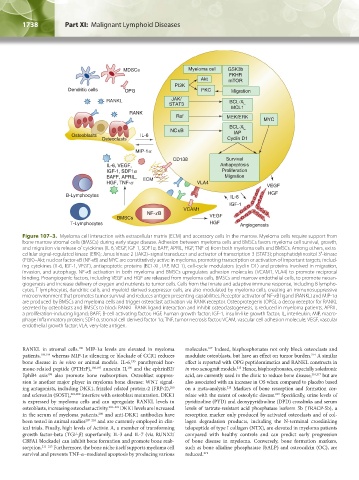
               Figure 107–3.  Myeloma cell interaction with extracellular matrix (ECM) and accessory cells in the marrow. Myeloma cells require support from
               bone marrow stromal cells (BMSCs) during early stage disease. Adhesion between myeloma cells and BMSCs favors myeloma cell survival, growth,
               and migration via release of cytokines (IL-6, VEGF, IGF-1, SDF1α, BAFF, APRIL, HGF, TNF-α) from both myeloma cells and BMSCs. Among others, extra-
               cellular signal-regulated kinase (ERK); Janus kinase 2 (JAK2)–signal transducer and activator of transcription 3 (STAT3); phosphatidylinositol 3′-kinase
               (PI3K)–Akt; nuclear factor-κB (NF-κB) and MYC are constitutively active in myeloma, promoting transcription or activation of important targets, includ-
               ing cytokines (IL-6, IGF-1, VEGF), antiapoptotic proteins (BCL-XL, IAP, MCL1), cell-cycle modulators (cyclin D1) and proteins involved in migration,
               invasion, and autophagy. NF-κB activation in both myeloma and BMSCs upregulates adhesion molecules (VCAM1, VLA4) to promote reciprocal
               binding. Proangiogenic factors, including VEGF and HGF are released from myeloma cells, BMSCs and marrow endothelial cells, to promote neoan-
               giogenesis and increase delivery of oxygen and nutrients to tumor cells. Cells from the innate and adaptive immune response, including B lympho-
               cytes, T lymphocytes, dendritic cells, and myeloid-derived suppressor cells, are also modulated by myeloma cells, creating an immunosuppressive
               microenvironment that promotes tumor survival and reduces antigen presenting capabilities. Receptor activator of NF-κB ligand (RANKL) and MIP-1α
               are produced by BMSCs and myeloma cells and trigger osteoclast activation via RANK receptor. Osteoprotegerin (OPG), a decoy receptor for RANKL
               secreted by osteoblasts and BMSCs to block RANKL–RANK ligand interaction and inhibit osteoclastogenesis, is reduced in myeloma patients. APRIL,
               a proliferation-inducing ligand; BAFF, B-cell activating factor; HGF, human growth factor; IGF-1, insulin-like growth factor; IL, interleukin; MIP, macro-
               phage inflammatory protein; SDF1α, stromal cell derived factor 1α; TNF, tumor necrosis factor; VCAM, vascular cell adhesion molecule; VEGF, vascular
               endothelial growth factor; VLA, very-late antigen.


               RANKL in stromal cells.  MIP-1α levels are elevated in myeloma   molecules.  Indeed, bisphosphonates not only block osteoclasts and
                                  190
                                                                              167
               patients, 193,194  whereas MIP-1α silencing or blockade of CCR1 reduces   modulate osteoblasts, but have an effect on tumor burden.  A similar
                                                                                                                214
               bone  disease  in  in vitro  or animal  models.  IL-6,   parathyroid  hor-  effect is reported with OPG peptidomimetics and RANKL constructs in
                                                    195
               mone-related peptide (PTHrP), 196,197  annexin II,  and the ephrinB2/  in vivo xenograft models.  Hence, bisphosphonates, especially zoledronic
                                                   198
                                                                                       215
               EphB4  axis   also  promote  bone  reabsorption.  Osteoblast  suppres-  acid, are currently used in the clinic to reduce bone disease, 216,217  but are
                        199
               sion is another major player in myeloma bone disease: WNT signal-  also associated with an increase in OS when compared to placebo based
               ing antagonists, including DKK1, frizzled related protein-2 (FRP-2),    on a meta-analysis.  Markers of bone resorption and formation cor-
                                                                 200
                                                                                    218
               and sclerostin (SOST), 201,202  interfere with osteoblast maturation. DKK1   relate with the extent of osteolytic disease.  Specifically, urine levels of
                                                                                                    219
               is  expressed  by  myeloma  cells  and  can  upregulate  RANKL  levels  in   pyridinoline (PYD) and deoxypyridinoline (DPD) crosslinks and serum
               osteoblasts, increasing osteoclast activity. 203–205  DKK1 levels are increased   levels of tartrate-resistant acid phosphatase isoform 5b (TRACP-5b),  a
               in the serum of myeloma patients,  and anti-DKK1 antibodies have   resorption marker only produced by activated osteoclasts and of col-
                                         206
               been tested in animal studies 207–210  and are currently employed in clin-  lagen degradation products, including the N-terminal crosslinking
               ical trials. Finally, high levels of Activin A, a member of transforming   telopeptide of type I collagen (NTX), are elevated in myeloma patients
               growth factor-beta (TGF-β) superfamily, IL-3 and IL-7 (via RUNX2/  compared with healthy controls and can predict early progression
               CBFA1 blockade) can inhibit bone formation and promote bone reab-  of bone disease in myeloma. Conversely, bone formation markers,
               sorption. 211–213  Furthermore, the bone niche itself supports myeloma cell   such as bone alkaline phosphatase (bALP) and osteocalcin (OC), are
               survival and prevents TNF-α–mediated apoptosis by producing various   reduced. 219

          Kaushansky_chapter 107_p1733-1772.indd   1738                                                                 9/21/15   12:34 PM

