


Page 1761 - Williams Hematology ( PDFDrive )
P. 1761
1736           Part XI:  Malignant Lymphoid Diseases                                                                                                                                             Chapter 107:  Myeloma           1737


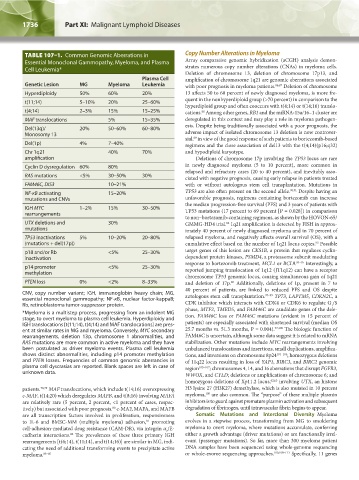
                TABLE 107–1.  Common Genomic Aberrations in           Copy Number Alterations in Myeloma
                Essential Monoclonal Gammopathy, Myeloma, and Plasma   Array  comparative  genomic  hybridization  (aCGH)  analysis  demon-
                                                                      strates numerous copy number alterations (CNAs) in myeloma cells.
                Cell Leukemia*
                                                                      Deletion of chromosome 13, deletion of chromosome 17p13, and
                                                        Plasma Cell   amplification of chromosome 1q21 are genomic aberrations associated
                Genetic Lesion     MG       Myeloma     Leukemia      with poor prognosis in myeloma patients. 86,87  Deletion of chromosome
                Hyperdiploidy      50%      60%         20%           13 affects 50 to 60 percent of newly diagnosed myeloma, is more fre-
                                                                      quent in the nonhyperdiploid group (>70 percent) in comparison to the
                t(11;14)           5–10%    20%         25–60%
                                                                      hyperdiploid group and often cooccurs with t(4;14) or t(14;16) translo-
                t(4;14)            2–3%     15%         15–25%        cations.  Among other genes, RB1 and the miRNA-15a/16–1 cluster are
                                                                            88
                MAF translocations          5%          15–35%        deregulated in this context and may play a role in myeloma pathogen-
                                                                      esis. Despite being traditionally associated with a poor prognosis, the
                Del(13q)/          20%      50–60%      60–80%
                Monosomy 13                                           adverse impact of isolated chromosome 13 deletion is now controver-
                                                                      sial,  in view of the good response of such patients to bortezomib-based
                                                                         89
                Del(1p)            4%       7–40%                     regimens and the close association of del13 with the t(4;14)(p16;q32)
                Chr 1q21                    40%         70%           and hypodiploid karyotype.
                amplification                                             Deletions of chromosome 17p involving the TP53 locus are rare
                Cyclin D dysregulation 60%  80%                       in newly diagnosed myeloma (5 to 10 percent), more common in
                                                                      relapsed and refractory cases (20 to 40 percent), and inevitably asso-
                RAS mutations      <5%      30–50%      30%           ciated with negative prognosis, causing early relapse in patients treated
                FAM46C, DIS3                10–21%                    with or without autologous stem cell transplantation. Mutations in
                NF-κB activating            15–20%                    TP53 are also often present on the second allele. 90,91  Despite having an
                mutations and CNVs                                    unfavorable prognosis, regimens containing bortezomib can increase
                                                                      the median progression-free survival (PFS) and 3 years of patients with
                IGH MYC            1–2%     15%         30–50%        TP53 mutations (17 percent to 69 percent [P = 0.028]) in comparison
                rearrangements
                                                                      to non–bortezomib-containing regimens, as shown by the HOVON-65/
                UTX deletions and           30%                       GMMG-HD4 trial.  1q21 amplification is detected by FISH in approx-
                                                                                    92
                mutations                                             imately 40 percent of newly diagnosed myeloma and in 70 percent of
                TP53 inactivations   5%     10–20%      20–80%        relapsed myeloma, and negatively affects overall survival (OS), with a
                (mutations + del(17p))                                cumulative effect based on the number of 1q21 locus copies.  Possible
                                                                                                                  93
                p18 and/or Rb               <5%         25–30%        target genes of this lesion are CKS1B, a protein that regulates cyclin-
                inactivation                                          dependent protein kinases, PSMD4, a proteasome subunit modulating
                                                                      response to bortezomib treatment, MCL1 or BCL9. 93–95  Interestingly, a
                p14 promoter                <5%         25–30%        reported jumping translocation of 1q12 (JT1q12) can have a receptor
                methylation
                                                                      chromosome TP53 genomic locus, causing simultaneous gain of 1q21
                PTEN loss          0%       <2%         8–33%         and deletion of 17p.  Additionally, deletions of 1p, present in 7 to
                                                                                     96
                                                                      40 percent of patients, are linked to reduced PFS and OS despite
               CNV, copy number variant; IGH, immunoglobin heavy chain; MG,   autologous stem cell transplantation. 97–99  TP73, LAPTM5, CDKN2C, a
               essential  monoclonal  gammopathy;  NF-κB,  nuclear  factor-kappaB;
               Rb, retinoblastoma tumor-suppressor protein.           CDK inhibitor which interacts with CDK4 or CDK6 to regulate G /S
                                                                                                                       1
               *Myeloma is a multistep process, progressing from an indolent MG   phase, MTF2, TMED5, and FAM46C are candidate genes of the dele-
                                                                      tion.  FAM46C loss or  FAM46C mutations (evident in 15 percent of
               stage, to overt myeloma to plasma cell leukemia. Hyperdiploidy and
               IGH translocations [t(11;14), t(4;14) and MAF translocations] are pres-  patients) are especially associated with shortened survival (median OS
               ent at similar rates in MG and myeloma. Conversely, MYC secondary   25.7 months vs. 51.3 months, P = 0.004). 97,100  The biologic function of
               rearrangements,  deletion 13p, chromosome  1 abnormalities, and   FAM46C is uncertain, although some data suggest it is related to mRNA
               RAS mutations are more common in active myeloma and they have   stabilization. Other mutations include MYC rearrangements involving
               been postulated as driver myeloma events. Plasma cell leukemia   unbalanced translocations and insertions, small duplications, amplifica-
               shows distinct abnormalities, including p14 promoter methylation   tions, and inversions on chromosome 8p24 101–104 ; homozygous deletions
               and  PTEN losses. Frequencies of common genomic aberrancies in   of 11q22 locus resulting in loss of YAP1, BIRC3, and BIRC2 genomic
               plasma cell dyscrasias are reported. Blank spaces are left in case of   region 105–107 ; chromosomes 4, 14, and 16 aberrations that disrupt FGFR3,
               unknown data.                                          WWOX, and CYLD; deletions or amplifications of chromosome 6; and
                                                                      homozygous deletions of Xp11.2 locus, 62,63  involving UTX, an histone
               patients. 78,79  MAF translocations, which include t(14;16) overexpressing   H3 lysine 27 (H3K27) demethylase, which is also mutated in 10 percent
                                                                             100
               c-MAF, t(14;20) which deregulates MAFB, and t(8;16) involving MAFA   myeloma,  are also common. The “purpose” of these multiple plasmin
               are  relatively  rare  (5  percent,  2  percent,  <1  percent  of  cases,  respec-  inhibitors is to guard against premature plasmin activation and subsequent
               tively) but associated with poor prognosis.  c-MAF, MAFA, and MAFB   degradation of fibrinogen, until intravascular fibrin begins to appear.
                                              80
               are all transcription factors involved in proliferation, responsiveness   Somatic Mutations and Interclonal Diversity  Myeloma
               to IL-6 and BMSC-MM  (multiple  myeloma)  adhesion,  promoting   evolves  in  a  stepwise  process,  transforming  from  MG  to  smoldering
                                                         81
               cell-adhesion-mediated drug resistance (CAM-DR), via integrin α /E-  myeloma to overt myeloma, where mutations accumulate, conferring
                                                                7
               cadherin interactions.  The prevalences of these three primary IGH   either a growth advantage (driver mutations) or are functionally irrel-
                               82
               rearrangements [t(6;14), t(11;14), and t(14;16)] are similar in MG, indi-  evant (passenger mutations). So far, more than 300 myeloma patient
               cating the need of additional transforming events to precipitate active   DNA samples have been sequenced using whole-genome sequencing
               myeloma. 83–85                                         or whole-exome sequencing approaches. 100,108–113  Specifically, 11 genes


          Kaushansky_chapter 107_p1733-1772.indd   1736                                                                 9/21/15   12:34 PM

