


Page 1799 - Williams Hematology ( PDFDrive )
P. 1799
1774           Part XI:  Malignant Lymphoid Diseases                                                                                                            Chapter 108:  Immunoglobulin Light-Chain Amyloidosis             1775


                TABLE 108–1.  Nomenclature of Amyloidosis             is important for clinicians to have an operational approach to avoid
                                                                      inappropriate resource utilization. Only 1 percent of patients with AL
                                                  Clinical Organ      amyloidosis are younger than age 40 years. Consequently, it would be
                Amyloid Type    Subunit Protein   Involvement         unlikely for younger patients to have AL amyloidosis, although this age
                AL (κ or λ) or AH  Immunoglobulin light  Heart        group regularly can be seen with secondary systemic amyloidosis. The
                                or heavy chain    Kidney              majority of patients with AL amyloidosis are males (66 percent), unlike
                                May be localized or   Liver           myeloma, where the male-to-female is 52:48. 15
                                systemic                                  The most common symptoms reported by patients with amyloido-
                                                  Nerve
                                                                      sis are fatigue, weight loss, and lower-extremity edema. Unfortunately,
                AA              Secondary serum   Kidney              these symptoms are too nonspecific to be used as a trigger to screen
                                amyloid A         Gastrointestinal    patients, as the yield for these vague symptoms would be very low. The
                                                  Thyroid             mechanism underlying fatigue in this disorder is usually amyloid heart
                                                                      disease, which can be an extremely subtle diagnosis and is discussed
                ATTR            Senile systemic   Heart               further under the specific amyloid syndromes. Weight loss accompany-
                (age relelated)  transthyretin    Carpal tunnel       ing amyloidosis can be impressive, and may exceed 20 kg. This usually
                ATTR (mutant)   Familial transthyretin  Heart         results in an investigation for occult malignancy; but even if blind biop-
                                                  Nerve               sies are performed, the diagnosis may be overlooked if a specific request
                                                                      for amyloid stains is not made to the pathologist. Lower-extremity edema
                A Lect-2        Leukocyte chemotac-  Kidney           may be attributable to nephrotic range proteinuria, hypoalbuminemia,
                                tic factor                            and transudation of serum into the extracellular space. Edema may also
                                No mutation found                     be seen from high filling pressures caused by the restrictive cardiomyo-
                A Ins           Insulin localized to   Skin           pathy, which, again, can easily be overlooked because of the subtle diag-
                                injection sites                       nostic testing required. These patients are often treated empirically with
                A Fib           Fibrinogen A-2    Kidney              diuretics until cardiac dysfunction becomes more evident.
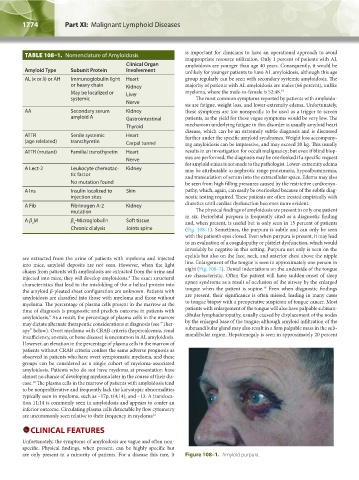
                                mutation                                  The physical findings of amyloidosis are present in only one patient
                                                                      in six. Periorbital purpura is frequently cited as a diagnostic finding
                A β M           β -Microglobulin  Soft tissue
                   2             2                                    and, when present, is useful but is only seen in 15 percent of patients
                                Chronic dialysis  Joints spine        (Fig. 108–1). Sometimes, the purpura is subtle and can only be seen
                                                                      with the patient’s eyes closed. Even when purpura is present, it may lead
                                                                      to an evaluation of a coagulopathy or platelet dysfunction, which would
                                                                      invariably be negative in this setting. Purpura not only is seen on the
               are extracted from the urine of patients with myeloma and injected   eyelids but also on the face, neck, and anterior chest above the nipple
               into mice, amyloid deposits are not seen. However, when the light   line. Enlargement of the tongue is seen in approximately one person in
               chains from patients with amyloidosis are extracted from the urine and   eight (Fig. 108–2). Dental indentations on the underside of the tongue
               injected into mice, they will develop amyloidosis.  The exact structural   are characteristic. Often the patient will have sudden-onset of sleep
                                                   8
               characteristics that lead to the misfolding of the α helical protein into   apnea syndrome as a result of occlusion of the airway by the enlarged
                                                                                                16
               the amyloid β-pleated sheet configuration are unknown. Patients with   tongue when the patient is supine.  Even when diagnostic findings
               amyloidosis are classified into those with myeloma and those without   are present, their significance is often missed, leading in many cases
               myeloma. The percentage of plasma cells present in the marrow at the   to tongue biopsy with a preoperative suspicion of tongue cancer. Most
               time of diagnosis is prognostic and predicts outcome in patients with   patients with enlargement of the tongue will also have palpable subman-
               amyloidosis.  As a result, the percentage of plasma cells in the marrow   dibular lymphadenopathy, usually caused by displacement of the nodes
                        9
               may dictate alternate therapeutic considerations at diagnosis (see “Ther-  by the enlarged base of the tongue; although amyloid infiltration of the
               apy” below). Overt myeloma with CRAB criteria (hypercalcemia, renal   submandibular gland may also result in a firm palpable mass in the sub-
               insufficiency, anemia, or bone disease) is uncommon in AL amyloidosis.   mandibular region. Hepatomegaly is seen in approximately 20 percent
               However, an elevation in the percentage of plasma cells in the marrow of
               patients without CRAB criteria confers the same adverse prognosis as
               observed in patients who have overt symptomatic myeloma, and these
               groups can be considered as a single cohort of myeloma-associated
               amyloidosis. Patients who do not have myeloma at presentation have
               almost no chance of developing myeloma later in the course of their dis-
               ease.  The plasma cells in the marrow of patients with amyloidosis tend
                   10
               to be nonproliferative and frequently lack the karyotypic abnormalities
               typically seen in myeloma, such as –17p, t(4;14), and –13. A transloca-
               tion 11;14 is commonly seen in amyloidosis and appears to confer an
               inferior outcome. Circulating plasma cells detectable by flow cytometry
               are uncommonly seen relative to their frequency in myeloma 12
                  CLINICAL FEATURES

               Unfortunately, the symptoms of amyloidosis are vague and often non-
               specific. Physical findings, when present, can be highly specific but
               are only present in a minority of patients. For a disease this rare, it   Figure 108–1.  Amyloid purpura.


          Kaushansky_chapter 108_p1773-1784.indd   1774                                                                 9/18/15   9:52 AM

