


Page 1801 - Williams Hematology ( PDFDrive )
P. 1801
1776           Part XI:  Malignant Lymphoid Diseases                                                                                                            Chapter 108:  Immunoglobulin Light-Chain Amyloidosis             1777


                        A                       B                                C
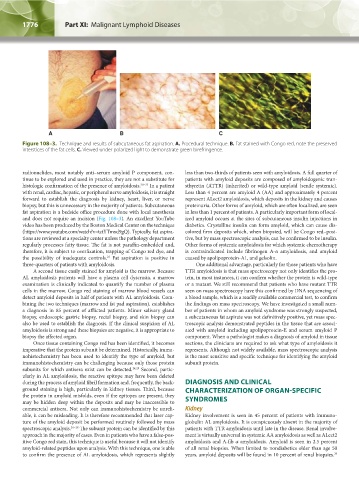
               Figure 108–3.  Technique and results of subcutaneous fat aspiration. A. Procedural technique. B. Fat stained with Congo red, note the preserved
               interstices of the fat cells. C. Viewed under polarized light to demonstrate green birefringence.


               radionuclides, most notably anti–serum amyloid P component, con-  less than two-thirds of patients seen with amyloidosis. A full quarter of
               tinue to be explored and used in practice, they are not a substitute for   patients with amyloid deposits are composed of amyloidogenic tran-
               histologic confirmation of the presence of amyloidosis. 20–22  In a patient   sthyretin (ATTR) (inherited) or wild-type amyloid (senile systemic).
               with renal, cardiac, hepatic, or peripheral nerve amyloidosis, it is straight   Less than 4 percent are amyloid A (AA) and approximately 4 percent
               forward to establish the diagnosis by kidney, heart, liver, or nerve   represent ALect2 amyloidosis, which deposits in the kidney and causes
               biopsy, but this is unnecessary in the majority of patients. Subcutaneous   proteinuria. Other forms of amyloid, which are often localized, are seen
               fat aspiration is a bedside office procedure done with local anesthesia   in less than 1 percent of patients. A particularly important form of local-
               and does not require an incision (Fig. 108–3). An excellent YouTube   ized amyloid occurs at the sites of subcutaneous insulin injections in
               video has been produced by the Boston Medical Center on the technique   diabetics. Crystalline insulin can form amyloid, which can cause dis-
               (https://www.youtube.com/watch?v=tctYTmxd9gQ). Typically, fat aspira-  colored firm deposits which, when biopsied, will be Congo red–posi-
               tions are reviewed at a specialty center unless the pathology department   tive, but by mass spectroscopic analysis, can be confirmed to be insulin.
               regularly processes fatty tissue. The fat is not paraffin-embedded and,   Other forms of systemic amyloidosis for which systemic chemotherapy
               therefore, it is subject to overfixation, trapping of Congo red dye, and   is contraindicated include fibrinogen A-α amyloidosis, and amyloid
               the possibility of inadequate controls.  Fat aspiration is positive in   caused by apolipoprotein-A1, and gelsolin.
                                            23
               three-quarters of patients with amyloidosis.               One additional advantage, particularly for those patients who have
                   A second tissue easily stained for amyloid is the marrow. Because   TTR amyloidosis is that mass spectroscopy not only identifies the pro-
               AL amyloidosis patients will have a plasma cell dyscrasia, a marrow   tein, in most instances, it can confirm whether the protein is wild-type
               examination is clinically indicated to quantify the number of plasma   or a mutant. We still recommend that patients who have mutant TTR
               cells in the marrow. Congo red staining of marrow blood vessels can   seen on mass spectroscopy have this confirmed by DNA sequencing of
               detect amyloid deposits in half of patients with AL amyloidosis. Com-  a blood sample, which is a readily available commercial test, to confirm
               bining the two techniques (marrow and fat pad aspiration), establishes   the findings on mass spectroscopy. We have investigated a small num-
               a diagnosis in  85 percent of  afflicted patients.  Minor salivary  gland   ber of patients in whom an amyloid syndrome was strongly suspected,
               biopsy, endoscopic gastric biopsy, rectal biopsy, and skin biopsy can   a subcutaneous fat aspirate was not definitively positive, yet mass spec-
               also be used to establish the diagnosis. If the clinical suspicion of AL   troscopic analysis demonstrated peptides in the tissue that are associ-
               amyloidosis is strong and these biopsies are negative, it is appropriate to   ated with amyloid including apolipoprotein-E and serum amyloid P
               biopsy the affected organ.                             component. When a pathologist makes a diagnosis of amyloid in tissue
                   Once tissue containing Congo red has been identified, it becomes   sections, the clinicians are required to ask what type of amyloidosis it
               imperative that the protein subunit be determined. Historically, immu-  represents. Although not widely available, mass spectroscopic analysis
               nohistochemistry has been used to identify the type of amyloid, but   is the most sensitive and specific technique for identifying the amyloid
               immunohistochemistry can be challenging because only those protein   subunit protein.
               subunits for which antisera exist can be detected. 24,25  Second, partic-
               ularly in AL amyloidosis, the reactive epitope may have been deleted
               during the process of amyloid fibril formation and, frequently, the back-  DIAGNOSIS AND CLINICAL
               ground staining is high, particularly in kidney tissues. Third, because   CHARACTERIZATION OF ORGAN-SPECIFIC
               the protein in amyloid misfolds, even if the epitopes are present, they
               may be hidden deep within the deposits and may be inaccessible to   SYNDROMES
               commercial antisera. Not only can immunohistochemistry be unreli-  Kidney
               able, it can be misleading. It is therefore recommended that laser cap-  Kidney involvement is seen in 45 percent of patients with immuno-
               ture of the amyloid deposit be performed routinely followed by mass   globulin AL amyloidosis. It is conspicuously absent in the majority of
               spectroscopic analysis. 26–28  The subunit protein can be identified by this   patients with TTR amyloidosis until late in the disease. Renal involve-
               approach in the majority of cases. Even in patients who have a false-pos-  ment is virtually universal in systemic AA amyloidosis as well as ALect2
               itive Congo red stain, this technique is useful because it will not identify   amyloidosis and A-fib α amyloidosis. Amyloid is seen in 2.5 percent
               amyloid-related peptides upon analysis. With this technique, one is able   of all renal biopsies. When limited to nondiabetics older than age 50
               to confirm the presence of AL amyloidosis, which represents slightly   years, amyloid deposits will be found in 10 percent of renal biopsies.
                                                                                                                        29


          Kaushansky_chapter 108_p1773-1784.indd   1776                                                                 9/18/15   9:53 AM

