


Page 1804 - Williams Hematology ( PDFDrive )
P. 1804
1778  Part XI:  Malignant Lymphoid Diseases         Chapter 108:  Immunoglobulin Light-Chain Amyloidosis             1779


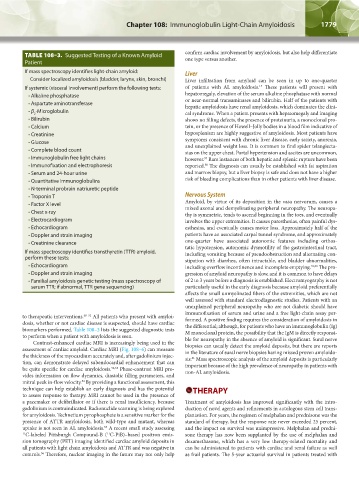
                   TABLE 108–3.  Suggested Testing of a Known Amyloid   confirm cardiac involvement by amyloidosis, but also help differentiate
                                                                        one type versus another.
                   Patient
                   If mass spectroscopy identifies light-chain amyloid:  Liver
                     Consider localized amyloidosis (bladder, larynx, skin, bronchi)  Liver  infiltration from amyloid can  be seen in  up to  one-quarter
                                                                                                 17
                   If systemic (visceral involvement) perform the following tests:  of patients with AL amyloidosis.  These patients will present with
                    • Alkaline phosphatase                              hepatomegaly, elevation of the serum alkaline phosphatase with normal
                    • Aspartate aminotransferase                        or near-normal transaminases and bilirubin. Half of the patients with
                                                                        hepatic amyloidosis have renal amyloidosis, which dominates the clini-
                    • β -Microglobulin
                      2                                                 cal syndrome. When a patient presents with hepatomegaly and imaging
                    • Bilirubin                                         shows no filling defects, the presence of proteinuria, a monoclonal pro-
                    • Calcium                                           tein, or the presence of Howell–Jolly bodies in a blood film indicative of
                    • Creatinine                                        hyposplenism are highly suggestive of amyloidosis. Most patients have
                    • Glucose                                           symptoms consistent with chronic liver disease, early satiety, anorexia,
                    • Complete blood count                              and unexplained weight loss. It is common to find spider telangiecta-
                                                                        sias on the upper chest. Portal hypertension and ascites are uncommon,
                    • Immunoglobulin free light chains                  however.  Rare instances of both hepatic and splenic rupture have been
                                                                               57
                    • Immunofixation and electrophoresis                reported.  The diagnosis can usually be established with fat aspiration
                                                                               58
                    • Serum and 24-hour urine                           and marrow biopsy, but a liver biopsy is safe and does not have a higher
                    • Quantitative immunoglobulins                      risk of bleeding complications than in other patients with liver disease.
                    • N-terminal probrain natriuretic peptide
                    • Troponin T                                        Nervous System
                    • Factor X level                                    Amyloid, by virtue of its deposition in the vasa nervorum, causes a
                    • Chest x-ray                                       mixed axonal and demyelinating peripheral neuropathy. The neuropa-
                                                                        thy is symmetric, tends to ascend beginning in the toes, and eventually
                    • Electrocardiogram                                 involves the upper extremities. It causes paresthesias, often painful dys-
                    • Echocardiogram                                    esthesias, and eventually causes motor loss. Approximately half of the
                    • Doppler and strain imaging                        patients have an associated carpal tunnel syndrome, and approximately
                    • Creatinine clearance                              one-quarter  have  associated  autonomic  features  including  orthos-
                                                                        tatic hypotension, autonomic dysmotility of the gastrointestinal tract,
                   If mass spectroscopy identifies transthyretin (TTR) amyloid,    including vomiting because of pseudoobstruction and alternating con-
                   perform these tests:                                 stipation with diarrhea, often intractable, and bladder abnormalities,
                    • Echocardiogram                                    including overflow incontinence and incomplete emptying. 59,60  The pro-
                    • Doppler and strain imaging                        gression of amyloid neuropathy is slow, and it is common to have delays
                    • Familial amyloidosis genetic testing (mass spectroscopy of   of 2 to 3 years before a diagnosis is established. Electromyography is not
                     serum TTR; if abnormal, TTR gene sequencing)       particularly useful in the early diagnosis because amyloid preferentially
                                                                        affects the small unmyelinated fibers of the extremities, which are not
                                                                        well assessed with standard electrodiagnostic studies. Patients with an
                                                                        unexplained peripheral neuropathy who are not diabetic should have
                                                                        immunofixation of serum and urine and a free light-chain assay per-
                  to therapeutic interventions. 49–51  All patients who present with amyloi-
                  dosis, whether or not cardiac disease is suspected, should have cardiac   formed. A positive finding requires the consideration of amyloidosis in
                  biomarkers performed. Table 108–3 lists the suggested diagnostic tests   the differential; although, for patients who have an immunoglobulin (Ig)
                  to perform when a patient with amyloidosis is seen.   M monoclonal protein, the possibility that the IgM is directly responsi-
                     Contrast-enhanced cardiac MRI is increasingly being used in the   ble for neuropathy in the absence of amyloid is significant. Sural nerve
                  assessment of cardiac amyloid. Cardiac MRI (Fig. 108–6) can measure   biopsies can usually detect the amyloid deposits, but there are reports
                  the thickness of the myocardium accurately and, after gadolinium injec-  in the literature of sural nerve biopsies having missed proven amyloido-
                                                                           61
                  tion, can demonstrate delayed subendocardial enhancement that can   sis.  Mass spectroscopic analysis of the amyloid deposits is particularly
                  be quite specific for cardiac amyloidosis. 52,53  Phase-contrast MRI pro-  important because of the high prevalence of neuropathy in patients with
                  vides information on flow dynamics, diastolic filling parameters, and   non-AL amyloidosis.
                  mitral peak in-flow velocity.  By providing a functional assessment, this
                                      54
                  technique can help establish an early diagnosis and has the potential   THERAPY
                  to assess response to therapy. MRI cannot be used in the presence of
                  a pacemaker or defibrillator or if there is renal insufficiency, because   Treatment  of  amyloidosis  has  improved  significantly  with  the  intro-
                  gadolinium is contraindicated. Radionuclide scanning is being explored   duction of novel agents and refinements in autologous stem cell trans-
                  for amyloidosis. Technetium pyrophosphate is a sensitive marker for the   plantation. For years, the regimen of melphalan and prednisone was the
                  presence of ATTR amyloidosis, both wild-type and mutant, whereas   standard of therapy, but the response rate never exceeded 25 percent,
                  uptake is not seen in AL amyloidosis.  A recent small study assessing   and the impact on survival was unimpressive. Melphalan and predni-
                                             55
                                              11
                  11 C-labeled Pittsburgh Compound-B ( C-PiB)–based positron emis-  sone therapy has now been supplanted by the use of melphalan and
                  sion tomography (PET) imaging identified cardiac amyloid deposits in   dexamethasone, which has a very low therapy-related mortality and
                  all patients with light chain amyloidosis and ATTR and was negative in   can be administered to patients with cardiac and renal failure as well
                  controls.  Therefore, nuclear imaging in the future may not only help   as frail patients. The 5-year actuarial survival in patients treated with
                        56


          Kaushansky_chapter 108_p1773-1784.indd   1779                                                                 9/18/15   9:53 AM

