


Page 1805 - Williams Hematology ( PDFDrive )
P. 1805
1780           Part XI:  Malignant Lymphoid Diseases                                                                                                            Chapter 108:  Immunoglobulin Light-Chain Amyloidosis             1781


                          A                                          B
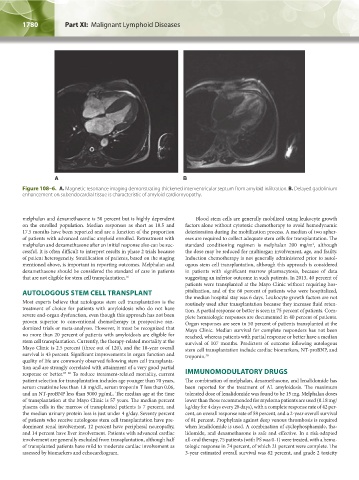
               Figure 108–6.  A. Magnetic resonance imaging demonstrating thickened interventricular septum from amyloid infiltration. B. Delayed gadolinium
               enhancement on subendocardial tissue is characteristic of amyloid cardiomyopathy.


               melphalan and dexamethasone is 50 percent but is highly dependent   Blood stem cells are generally mobilized using leukocyte growth
               on the enrolled population. Median responses as short as 10.5 and   factors alone without cytotoxic chemotherapy to avoid hemodynamic
               17.5 months have been reported and are a function of the proportion   deterioration during the mobilization process. A median of two apher-
               of patients with advanced cardiac amyloid enrolled. Retreatment with   eses are required to collect adequate stem cells for transplantation. The
               melphalan and dexamethasone after an initial response also can be suc-  standard conditioning regimen is melphalan 200 mg/m , although
                                                                                                                 2
               cessful. It is often difficult to interpret results in phase 2 trials because   the dose may be reduced for multiorgan involvement, age, and frailty.
               of patient heterogeneity. Stratification of patients, based on the staging   Induction chemotherapy is not generally administered prior to autol-
               mentioned above, is important in reporting outcomes. Melphalan and   ogous stem cell transplantation, although this approach is considered
               dexamethasone should be considered the standard of care in patients   in patients with significant marrow plasmacytosis, because of data
               that are not eligible for stem cell transplantation. 66  suggesting an inferior outcome in such patients. In 2013, 40 percent of
                                                                      patients were transplanted at the Mayo Clinic without requiring hos-
               AUTOLOGOUS STEM CELL TRANSPLANT                        pitalization, and of the 60 percent of patients who were hospitalized,
                                                                      the median hospital stay was 6 days. Leukocyte growth factors are not
               Most experts believe that autologous stem cell transplantation is the   routinely used after transplantation because they increase fluid reten-
               treatment of choice for patients with amyloidosis who do not have   tion. A partial response or better is seen in 75 percent of patients. Com-
               severe end-organ dysfunction, even though this approach has not been   plete hematologic responses are documented in 40 percent of patients.
               proven superior to conventional chemotherapy in prospective ran-  Organ responses are seen in 50 percent of patients transplanted at the
               domized trials or meta-analyses. However, it must be recognized that   Mayo Clinic. Median survival for complete responders has not been
               no more than 20 percent of patients with amyloidosis are eligible for   reached, whereas patients with partial response or better have a median
               stem cell transplantation. Currently, the therapy-related mortality at the   survival of 107 months. Predictors of outcome following autologous
               Mayo Clinic is 2.5 percent (three out of 120), and the 10-year overall   stem cell transplantation include cardiac biomarkers, NT-proBNP, and
               survival is 43 percent. Significant improvements in organ function and   troponin. 70
               quality of life are commonly observed following stem cell transplanta-
               tion and are strongly correlated with attainment of a very good partial
               response or better. 67–69  To reduce treatment-related mortality, current   IMMUNOMODULATORY DRUGS
               patient selection for transplantation includes age younger than 70 years,   The combination of melphalan, dexamethasone, and lenalidomide has
               serum creatinine less than 1.8 mg/dL, serum troponin T less than 0.06,   been reported for the treatment of AL amyloidosis. The maximum
               and an NT-proBNP less than 5000 pg/mL. The median age at the time   tolerated dose of lenalidomide was found to be 15 mg. Melphalan doses
               of transplantation at the Mayo Clinic is 57 years. The median percent   lower than those recommended for myeloma patients are used (0.18 mg/
               plasma cells in the marrow of transplanted patients is 7 percent, and   kg/day for 4 days every 28 days), with a complete response rate of 42 per-
               the median urinary protein loss is just under 4 g/day. Seventy percent   cent, an overall response rate of 58 percent, and a 2-year overall survival
               of patients who receive autologous stem cell transplantation have pre-  of 81 percent. Prophylaxis against deep venous thrombosis is required
               dominant renal involvement, 12 percent have peripheral neuropathy,   when lenalidomide is used. A combination of cyclophosphamide, tha-
               and 14 percent have liver involvement. Patients with advanced cardiac   lidomide, and dexamethasone is safe and effective. In a risk-adapted
               involvement are generally excluded from transplantation, although half   all-oral therapy, 75 patients (with PS was 0-1) were treated, with a hema-
               of transplanted patients have mild to moderate cardiac involvement as   tologic response in 74 percent, of which 21 percent were complete. The
               assessed by biomarkers and echocardiogram.             3-year estimated overall survival was 82 percent, and grade 2 toxicity


          Kaushansky_chapter 108_p1773-1784.indd   1780                                                                 9/18/15   9:53 AM

