


Page 1811 - Williams Hematology ( PDFDrive )
P. 1811
1786           Part XI:  Malignant Lymphoid Diseases                                                                                                                                  Chapter 109:  Macroglobulinemia            1787


                 A                                                   B


                 C                                                   D

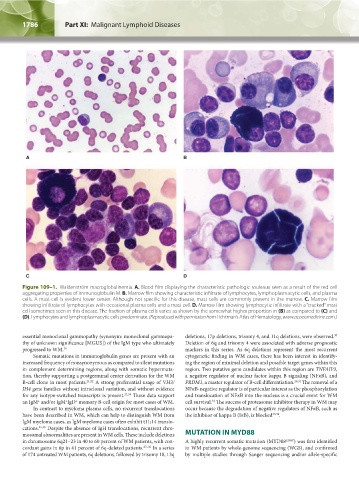
               Figure 109–1.  Waldenström macroglobulinemia. A. Blood film displaying the characteristic pathologic rouleaux seen as a result of the red cell
               aggregating properties of immunoglobulin M. B. Marrow film showing characteristic infiltrate of lymphocytes, lymphoplasmacytic cells, and plasma
               cells. A mast cell is evident lower center. Although not specific for this disease, mast cells are commonly present in the marrow. C. Marrow film
               showing infiltrate of lymphocytes with occasional plasma cells and a mast cell. D. Marrow film showing lymphocytic infiltrate with a “cracked” mast
               cell sometimes seen in this disease. The fraction of plasma cells varies as shown by the somewhat higher proportion in (B) as compared to (C) and
               (D). Lymphocytes and lymphoplasmacytic cells predominate. (Reproduced with permission from Lichtman’s Atlas of Hematology, www.accessmedicine.com.)


                                                                                                                        30
               essential monoclonal gammopathy (synonym: monoclonal gammopa-  deletions, 17p deletions, trisomy 4, and 11q deletions, were observed.
               thy of unknown significance [MGUS]) of the IgM type who ultimately   Deletion of 6q and trisomy 4 were associated with adverse prognostic
               progressed to WM. 20                                   markers in this series. As 6q deletions represent the most recurrent
                   Somatic mutations in immunoglobulin genes are present with an   cytogenetic finding in WM cases, there has been interest in identify-
               increased frequency of nonsynonymous as compared to silent mutations   ing the region of minimal deletion and possible target genes within this
               in complement determining regions, along with somatic hypermuta-  region. Two putative gene candidates within this region are TNFAIP3,
               tion, thereby supporting a postgerminal center derivation for the WM   a negative regulator of nuclear factor kappa B signaling (NFκB), and
               B-cell clone in most patients. 21,22  A strong preferential usage of VH3/  PRDM1, a master regulator of B-cell differentiation. 29,31  The removal of a
               JH4 gene families without intraclonal variation, and without evidence   NFκB-negative regulator is of particular interest as the phosphorylation
               for any isotype-switched transcripts is present. 23,24  These data support   and translocation of NFκB into the nucleus is a crucial event for WM
                     +
               an IgM  and/or IgM IgD  memory B-cell origin for most cases of WM.  cell survival.  The success of proteasome inhibitor therapy in WM may
                                                                               32
                                 +
                              +
                   In contrast to myeloma plasma cells, no recurrent translocations   occur because the degradation of negative regulators of NFκB, such as
               have been described in WM, which can help to distinguish WM from   the inhibitor of kappa B (IκB), is blocked 33,34 .
               IgM myeloma cases, as IgM myeloma cases often exhibit t11;14 translo-
               cations. 25,26  Despite the absence of IgH translocations, recurrent chro-
               mosomal abnormalities are present in WM cells. These include deletions   MUTATION IN MYD88
               in chromosome 6q21–23 in 40 to 60 percent of WM patients, with con-  A highly recurrent somatic mutation (MYD88 L265P ) was first identified
               cordant gains in 6p in 41 percent of 6q-deleted patients. 27–30  In a series   in WM patients by whole-genome sequencing (WGS), and confirmed
               of 174 untreated WM patients, 6q deletions, followed by trisomy 18, 13q   by multiple studies through Sanger sequencing and/or allele-specific


          Kaushansky_chapter 109_p1785-1802.indd   1786                                                                 9/21/15   12:30 PM

