


Page 1814 - Williams Hematology ( PDFDrive )
P. 1814
1788  Part XI:  Malignant Lymphoid Diseases                               Chapter 109:  Macroglobulinemia            1789


                   TABLE 109–2.  Physicochemical and Immunological Properties of the Monoclonal Immunoglobulin M Protein in
                   Waldenström’s Macroglobulinemia
                   Properties of IgM Monoclonal Protein  Diagnostic Condition  Clinical Manifestations
                   Pentameric structure               Hyperviscosity          Headaches, blurred vision, epistaxis, retinal hemorrhages,
                                                                              leg cramps, impaired mentation, intracranial hemorrhage
                   Precipitation on cooling           Cryoglobulinemia (type I)  Raynaud phenomenon, acrocyanosis, ulcers, purpura, cold
                                                                              urticaria
                   Autoantibody activity to myelin-associated   Peripheral neuropathies  Sensorimotor neuropathies, painful neuropathies, ataxic
                   glycoprotein, ganglioside M , sulfatide moi-               gait, bilateral foot drop
                                       1
                   eties on peripheral nerve sheaths
                   Autoantibody activity to IgG       Cryoglobulinemia (type II)  Purpura, arthralgia, renal failure, sensorimotor
                                                                              neuropathies
                   Autoantibody activity to red blood cell   Cold agglutinins  Hemolytic anemia, Raynaud phenomenon, acrocyanosis,
                   antigens                                                   livedo reticularis
                   Tissue deposition as amorphous aggregates  Organ dysfunction  Skin: bullous skin disease, papules, Schnitzler syndrome
                                                                              Gastrointestinal: diarrhea, malabsorption, bleeding
                                                                              Kidney: proteinuria, renal failure (light-chain component)
                   Tissue deposition as amyloid fibrils (light-  Organ dysfunction  Fatigue, weight loss, edema, hepatomegaly, macroglossia,
                   chain component most commonly)                             organ dysfunction of involved organs (heart, kidney, liver,
                                                                              peripheral sensory and autonomic nerves)
                  Ig, immunoglobulin.


                  to inappropriately low erythropoietin production, which is the major   viscosity is greater than 4.0 centipoises (cp), but there is individual vari-
                  reason for anemia in these patients.  Renal synthesis of erythropoie-  ability, with some patients showing no evidence of hyperviscosity even
                                            67
                  tin is inversely correlated with plasma viscosity. Clinical manifestations   at 10 cp.  The most common symptoms are oronasal mucosal bleeding,
                                                                              64
                  are related to circulatory disturbances that can be best appreciated by   visual disturbances because of retinal bleeding, and dizziness that rarely
                  ophthalmoscopy, which shows distended and tortuous retinal veins,   may lead to stupor or coma. Heart failure can be aggravated, particu-
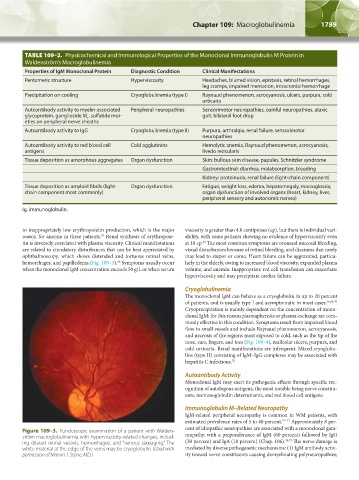
                  hemorrhages, and papilledema (Fig. 109–3).  Symptoms usually occur   larly in the elderly, owing to increased blood viscosity, expanded plasma
                                                  68
                  when the monoclonal IgM concentration exceeds 50 g/L or when serum   volume, and anemia. Inappropriate red cell transfusion can exacerbate
                                                                        hyperviscosity and may precipitate cardiac failure.
                                                                        Cryoglobulinemia
                                                                        The monoclonal IgM can behave as a cryoglobulin in up to 20 percent
                                                                        of patients, and is usually type I and asymptomatic in most cases. 16,64,70
                                                                        Cryoprecipitation is mainly dependent on the concentration of mono-
                                                                        clonal IgM; for this reason plasmapheresis or plasma exchange are com-
                                                                        monly effective in this condition. Symptoms result from impaired blood
                                                                        flow in small vessels and include Raynaud phenomenon, acrocyanosis,
                                                                        and necrosis of the regions most exposed to cold, such as the tip of the
                                                                        nose, ears, fingers, and toes (Fig. 109–4), malleolar ulcers, purpura, and
                                                                        cold urticaria. Renal manifestations are infrequent. Mixed cryoglobu-
                                                                        lins (type II) consisting of IgM–IgG complexes may be associated with
                                                                        hepatitis C infections. 70

                                                                        Autoantibody Activity
                                                                        Monoclonal IgM may exert its pathogenic effects through specific rec-
                                                                        ognition of autologous antigens, the most notable being nerve constitu-
                                                                        ents, immunoglobulin determinants, and red blood cell antigens.

                                                                        Immunoglobulin M–Related Neuropathy
                                                                        IgM-related peripheral neuropathy is common in WM patients, with
                                                                        estimated prevalence rates of 5 to 40 percent. 71–73  Approximately 8 per-
                                                                        cent of idiopathic neuropathies are associated with a monoclonal gam-
                  Figure 109–3.  Funduscopic examination of a patient with Walden-
                  ström macroglobulinemia with hyperviscosity-related changes, includ-  mopathy, with a preponderance of IgM (60 percent) followed by IgG
                  ing  dilated  retinal  vessels,  hemorrhages,  and “venous  sausaging.” The   (30 percent) and IgA (10 percent) (Chap. 106). 74,75  The nerve damage is
                  white material at the edge of the veins may be cryoglobulin. (Used with   mediated by diverse pathogenetic mechanisms: (1) IgM antibody activ-
                  permission of Marvin J. Stone, MD.)                   ity toward nerve constituents causing demyelinating polyneuropathies;


          Kaushansky_chapter 109_p1785-1802.indd   1789                                                                 9/21/15   12:30 PM

