


Page 1812 - Williams Hematology ( PDFDrive )
P. 1812
1786  Part XI:  Malignant Lymphoid Diseases                               Chapter 109:  Macroglobulinemia            1787


                  polymerase chain reaction (PCR) assays. 35–40  MYD88 L265P  is expressed in   CXCR4 WHIM  Mutations
                  90 to 95 percent of WM cases when more sensitive allele-specific PCR has   The second most common somatic mutation after MYD88 L265P  revealed
                  been employed, using both CD19-sorted and unsorted marrow cells. 36–40    by WGS was found in the C-terminus of the CXCR4 receptor. These
                  By comparison, MYD88 L265P  was absent in myeloma samples, including   mutations are present in 30 to 35 percent of WM patients, and impact
                  IgM myeloma, and was expressed in a small subset (6 to 10 percent) of   serine phosphorylation sites that regulate CXCR4 signaling by its only
                  marginal zone lymphoma patients, who surprisingly have WM-related   known ligand, stromal cell-derived factor (SDF)-1a (CXCL12). 29,50–52
                  features. 36–38,41  By PCR assays, 50 to 80 percent of IgM MGUS patients,   The location of somatic mutations found in the C-terminus of CXCR4
                  also express MYD88 L265P , and expression of this mutation was associ-  in WM are similar to those observed in the germline of patients with
                  ated with increased risk for malignant progression. 36–38,42  The presence   WHIM (warts, hypogammaglobulinemia, infections, and myelo-
                  of MYD88 L265P  in IgM MGUS patient suggests a role for this mutation   kathexis) syndrome, a congenital immunodeficiency disorder char-
                  as an early oncogenic driver, and other mutations and/or copy number   acterized by chronic  noncyclic  neutropenia.  Patients with  WHIM
                                                                                                          53
                  alterations leading to abnormal gene expression are likely to promote   syndrome exhibit impaired CXCR4 receptor internalization following
                  disease progression. 29                               SDF-1a stimulation, which results in persistent CXCR4 activation and
                     The impact of MYD88 L265P  to growth and survival signaling in   myelokathexis. 54
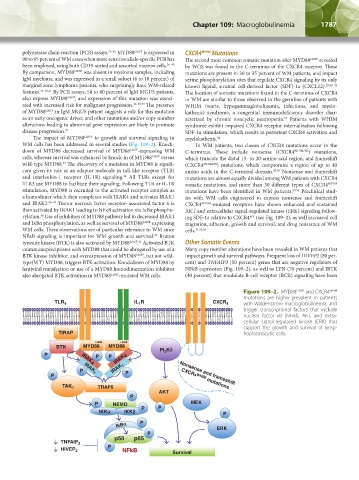
                  WM cells has been addressed in several studies (Fig. 109–2). Knock-  In WM patients, two classes of CXCR4 mutations occur in the
                  down  of  MYD88  decreased survival of  MYD88 L265P -expressing WM   C-terminus. These include nonsense (CXCR4 WHIM/NS ) mutations,
                  cells, whereas survival was enhanced by knock-in of MYD88 L265P  versus   which truncate the distal 15- to 20-amino-acid region, and frameshift
                               43
                  wild-type MYD88.  The discovery of a mutation in MYD88 is signifi-  (CXCR4 WHIM/FS ) mutations, which compromise a region of up to 40
                  cant given its role as an adaptor molecule in toll-like receptor (TLR)   amino acids in the C-terminal domain. 29,50  Nonsense and frameshift
                                                    44
                  and interleukin-1 receptor (IL-1R) signaling.  All TLRs except for   mutations are almost equally divided among WM patients with CXCR4
                  TLR3 use MYD88 to facilitate their signaling. Following TLR or IL-1R   somatic mutations, and more than 30 different types of CXCR4 WHIM
                  stimulation, MYD88 is recruited to the activated receptor complex as   mutations  have  been  identified  in  WM  patients. 29,50   Preclinical  stud-
                  a homodimer which then complexes with IRAK4 and activates IRAK1   ies with WM cells engineered to express nonsense and frameshift
                  and IRAK2. 45–47  Tumor necrosis factor receptor–associated factor 6 is   CXCR4 WHIM -mutated receptors have shown enhanced and sustained
                  then activated by IRAK1 leading to NFκB activation via IκBα phospho-  AKT and extracellular signal-regulated kinase (ERK) signaling follow-
                        48
                  rylation.  Use of inhibitors of MYD88 pathway led to decreased IRAK1   ing SDF-1a relative to CXCR4  (see Fig. 109–2), as well increased cell
                                                                                              WT
                  and IκBα phosphorylation, as well as survival of MYD88 L265P  expressing   migration, adhesion, growth and survival, and drug resistance of WM
                  WM cells. These observations are of particular relevance to WM since   cells. 51,55,56
                                                              49
                  NFκB signaling is important for WM growth and survival.  Bruton
                  tyrosine kinase (BTK) is also activated by MYD88 L265P 43  Other Somatic Events
                                                        .  Activated BTK
                  coimmunoprecipitates with MYD88 that could be abrogated by use of a   Many copy number alterations have been revealed in WM patients that
                  BTK kinase inhibitor, and overexpression of MYD88 L265P , but not wild-  impact growth and survival pathways. Frequent loss of HIVEP2 (80 per-
                  type(WT) MYD88, triggers BTK activation. Knockdown of MYD88 by   cent) and TNFAIP3 (50 percent) genes that are negative regulators of
                  lentiviral transfection or use of a MYD88 homodimerization inhibitor   NFkB expression (Fig. 109–2), as well as LYN (70 percent) and IBTK
                  also abrogated BTK activation in MYD88 L265P -mutated WM cells.  (40 percent) that modulate B-cell receptor (BCR) signaling have been

                                                                                            Figure 109–2.  MYD88 L265P  and CXCR4 WHIM
                                                                                            mutations are highly prevalent in patients
                             TLR 4                     IL R                       CXCR 4    with Waldenström macroglobulinemia, and
                                                         1
                                                                                            trigger transcriptional factors that include
                                                                                            nuclear factor  κB (NFκB), AKT, and extra-
                                                                                            cellular  signal-regulated  kinase  (ERK)  that
                                                                                            support the growth and survival of lymp-
                              TIRAP                                                         hoplasmacytic cells.

                                          L265P    L265P
                             BTK      MYD88    MYD88            PI Kc
                         P            IRAK 4 P  P  IRAK 4        3

                                     P  IRAK 1  IRAK 1
                           P                        P                  Nonsense and frameshift
                               TAK 1       TRAF6
                                                                       CXCR4 WHIM  mutations
                                                                AKT
                                                      P
                                          P     NEMO                      MEK
                                           IKK`     IKKa  P    P                     P
                                                 IkB`    P                         ERK
                                                            P
                                                 p50   p65
                               TNFAIP 3
                               HIVEP 2         P   NFkB             Survival


          Kaushansky_chapter 109_p1785-1802.indd   1787                                                                 9/21/15   12:30 PM

