


Page 1815 - Williams Hematology ( PDFDrive )
P. 1815
1790           Part XI:  Malignant Lymphoid Diseases                                                                                                                                  Chapter 109:  Macroglobulinemia            1791


                              A


                              B

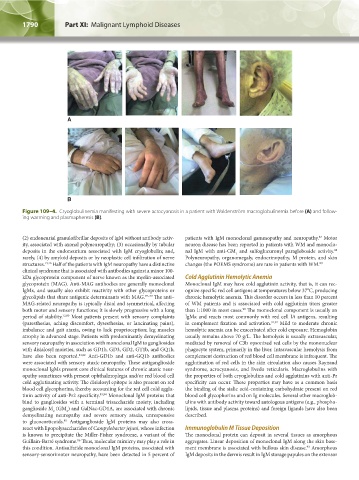
               Figure 109–4.  Cryoglobulinemia manifesting with severe acrocyanosis in a patient with Waldenström macroglobulinemia before (A) and follow-
               ing warming and plasmapheresis (B).


                                                                                                                   87
               (2) endoneurial granulofibrillar deposits of IgM without antibody activ-  patients with IgM monoclonal gammopathy and neuropathy.  Motor
               ity, associated with axonal polyneuropathy; (3) occasionally by tubular   neuron disease has been reported in patients with WM and monoclo-
               deposits in the endoneurium associated with IgM cryoglobulin; and,   nal IgM with anti-GM  and sulfoglucuronyl paragloboside activity.
                                                                                                                        88
                                                                                       1
               rarely, (4) by amyloid deposits or by neoplastic cell infiltration of nerve   Polyneuropathy, organomegaly, endocrinopathy, M protein, and skin
               structures. 73,76  Half of the patients with IgM neuropathy have a distinctive   changes (the POEMS syndrome) are rare in patients with WM. 89
               clinical syndrome that is associated with antibodies against a minor 100-
               kDa glycoprotein component of nerve known as the myelin-associated   Cold Agglutinin Hemolytic Anemia
               glycoprotein (MAG). Anti-MAG antibodies are generally monoclonal   Monoclonal IgM may have cold agglutinin activity, that is, it can rec-
               IgMκ, and usually also exhibit reactivity with other glycoproteins or   ognize specific red cell antigens at temperatures below 37°C, producing
               glycolipids that share antigenic determinants with MAG. 77–79  The anti–  chronic hemolytic anemia. This disorder occurs in less than 10 percent
               MAG-related neuropathy is typically distal and symmetrical, affecting   of WM patients and is associated with cold agglutinin titers greater
               both motor and sensory functions; it is slowly progressive with a long   than 1:1000 in most cases.  The monoclonal component is usually an
                                                                                         90
               period of stability. 72,80  Most patients present with sensory complaints   IgMκ and reacts most commonly with red cell I/i antigens, resulting
               (paresthesias, aching discomfort, dysesthesias, or lancinating pains),   in complement fixation and activation. 91,92  Mild to moderate chronic
               imbalance and gait ataxia, owing to lack proprioception; leg muscles   hemolytic anemia can be exacerbated after cold exposure. Hemoglobin
               atrophy in advanced stage. Patients with predominantly demyelinating   usually remains above 70 g/L. The hemolysis is usually extravascular,
               sensory neuropathy in association with monoclonal IgM to gangliosides   mediated by removal of C3b opsonized red cells by the mononuclear
               with disialosyl moieties, such as GD1b, GD3, GD2, GT1b, and GQ1b,   phagocyte system, primarily in the liver. Intravascular hemolysis from
               have also been reported. 81,82  Anti-GD1b and anti-GQ1b antibodies   complement destruction of red blood cell membrane is infrequent. The
               were associated with sensory ataxic neuropathy. These antiganglioside   agglutination of red cells in the skin circulation also causes Raynaud
               monoclonal IgMs present core clinical features of chronic ataxic neur-  syndrome, acrocyanosis, and livedo reticularis. Macroglobulins with
               opathy sometimes with present ophthalmoplegia and/or red blood cell   the properties of both cryoglobulins and cold agglutinins with anti-Pr
               cold agglutinating activity. The disialosyl epitope is also present on red   specificity can occur. These properties may have as a common basis
               blood cell glycophorins, thereby accounting for the red cell cold agglu-  the binding of the sialic acid-containing carbohydrate present on red
               tinin activity of anti-Pr2 specificity. 83,84  Monoclonal IgM proteins that   blood cell glycophorins and on Ig molecules. Several other macroglob-
               bind to gangliosides with a terminal trisaccharide moiety, including   ulins with antibody activity toward autologous antigens (e.g., phospho-
               ganglioside M  (GM ) and GalNac-GD1A, are associated with chronic   lipids, tissue and plasma proteins) and foreign ligands have also been
                          2
                              2
               demyelinating neuropathy and severe sensory ataxia, unresponsive   described.
               to  glucocorticoids.   Antiganglioside  IgM  proteins  may  also  cross-
                             85
               react with lipopolysaccharides of Campylobacter jejuni, whose infection     Immunoglobulin M Tissue Deposition
               is known to precipitate the Miller-Fisher syndrome, a variant of the   The monoclonal protein can deposit in several tissues as amorphous
                                  86
               Guillain-Barré syndrome.  Thus, molecular mimicry may play a role in   aggregates. Linear deposition of monoclonal IgM along the skin base-
                                                                                                               93
               this condition. Antisulfatide monoclonal IgM proteins, associated with   ment membrane is associated with bullous skin disease.  Amorphous
               sensory-sensorimotor neuropathy, have been detected in 5 percent of   IgM deposits in the dermis result in IgM storage papules on the extensor


          Kaushansky_chapter 109_p1785-1802.indd   1790                                                                 9/21/15   12:30 PM

