


Page 1813 - Williams Hematology ( PDFDrive )
P. 1813
1788           Part XI:  Malignant Lymphoid Diseases                                                                                                                                  Chapter 109:  Macroglobulinemia            1789


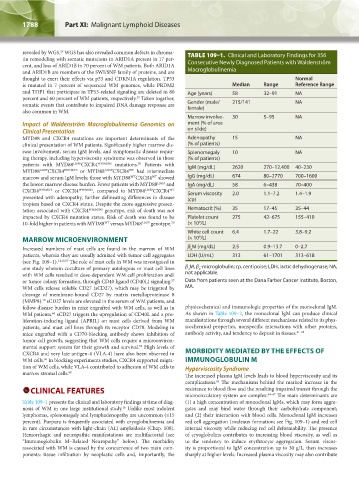
               revealed by WGS.  WGS has also revealed common defects in chroma-  TABLE 109–1.  Clinical and Laboratory Findings for 356
                            29
               tin remodeling with somatic mutations in ARID1A present in 17 per-
               cent, and loss of ARID1B in 70 percent of WM patients. Both ARID1A   Consecutive Newly Diagnosed Patients with Waldenström
               and ARID1B are members of the SWI/SNF family of proteins, and are   Macroglobulinemia
               thought to exert their effects via p53 and CDKN1A regulation. TP53                          Normal
               is mutated in 7 percent of sequenced WM genomes, while PRDM2           Median    Range      Reference Range
               and TOP1 that participate in TP53-related signaling are deleted in 80   Age (years)  58  32–91  NA
                                                      29
               percent and 60 percent of WM patients, respectively.  Taken together,
               somatic events that contribute to impaired DNA damage response are   Gender (male/  215/141     NA
                                                                       female)
               also common in WM.
                                                                       Marrow involve-  30      5–95       NA
               Impact of Waldenström Macroglobulinemia Genomics on     ment (% of area
               Clinical Presentation                                   on slide)
               MYD88  and CXCR4 mutations are important determinants of  the   Adenopathy    15            NA
               clinical presentation of WM patients. Significantly higher marrow dis-  (% of patients)
               ease involvement, serum IgM levels, and symptomatic disease requir-  Splenomegaly    10     NA
               ing therapy, including hyperviscosity syndrome was observed in those   (% of patients)
                                                      50
               patients with MYD88 L265P CXCR4 WHIM/NS  mutations.  Patients with   IgM (mg/dL)  2620  270–12,400  40–230
               MYD88 L265P CXCR4 WHIM/FS  or MYD88 L265P CXCR4  had intermediate
                                                   WT
                                                    WT
                                                           WT
               marrow and serum IgM levels; those with MYD88 CXCR4  showed   IgG (mg/dL)  674   80–2770    700–1600
               the lowest marrow disease burden. Fewer patients with MYD88 L265P  and   IgA (mg/dL)  58  6–438  70–400
               CXCR4 WHIM/FS  or CXCR4 WHIM/NS , compared to MYD88 L265P CXCR4    Serum viscosity   2.0  1.1–7.2  1.4–1.9
                                                                 WT
               presented with adenopathy, further delineating differences in disease   (cp)
               tropism based on CXCR4 status. Despite the more-aggressive presen-
               tation associated with CXCR4 WHIM/NS  genotype, risk of death was not   Hematocrit (%)  35  17–45  35–44
               impacted by CXCR4 mutation status. Risk of death was found to be   Platelet count    275  42–675  155–410
               10-fold higher in patients with MYD88  versus MYD88 L265P  genotype. 50  (× 10 /L)
                                                                           9
                                           WT
                                                                       White cell count   6.4   1.7–22     3.8–9.2
                                                                           9
               MARROW MICROENVIRONMENT                                 (× 10 /L)
               Increased numbers of mast cells are found in the marrow of WM   β M (mg/dL)  2.5  0.9–13.7  0–2.7
                                                                        2
               patients, wherein they are usually admixed with tumor cell aggregates   LDH (U/mL)  313  61–1701  313–618
               (see Fig. 109–1). 14,18,57  The role of mast cells in WM was investigated in
               one study wherein coculture of primary autologous or mast cell lines   β M, β -microglobulin; cp, centipoise; LDH, lactic dehydrogenase; NA,
                                                                       2
                                                                           2
               with WM cells resulted in dose-dependent WM cell proliferation and/  not applicable.
               or tumor colony formation, through CD40 ligand (CD40L) signaling.    Data from patients seen at the Dana Farber Cancer Institute, Boston,
                                                                 57
               WM cells release soluble CD27 (sCD27), which may be triggered by   MA.
               cleavage of membrane-bound CD27 by matrix metalloproteinase 8
                      58
               (MMP8).  sCD27 levels are elevated in the serum of WM patients, and
               follow disease burden in mice engrafted with WM cells, as well as in   physicochemical and immunologic properties of the monoclonal IgM.
                         60
               WM patients.  sCD27 triggers the upregulation of CD40L and a pro-  As shown in Table 109–2, the monoclonal IgM can produce clinical
               liferation-inducing ligand (APRIL) on mast cells derived from WM   manifestations through several different mechanisms related to its phys-
               patients, and mast cell lines through its receptor CD70. Modeling in   icochemical properties, nonspecific interactions with other proteins,
               mice  engrafted  with  a  CD70-blocking  antibody  shows  inhibition  of   antibody activity, and tendency to deposit in tissues. 61–63
               tumor cell growth, suggesting that WM cells require a microenviron-
                                                       59
               mental support system for their growth and survival.  High levels of
               CXCR4 and very late antigen-4 (VLA-4) have also been observed in   MORBIDITY MEDIATED BY THE EFFECTS OF
               WM cells.  In blocking experiments studies, CXCR4 supported migra-  IMMUNOGLOBULIN M
                       60
               tion of WM cells, while VLA-4 contributed to adhesion of WM cells to   Hyperviscosity Syndrome
               marrow stromal cells. 60                               The increased plasma IgM levels leads to blood hyperviscosity and its
                                                                      complications.  The mechanisms behind the marked increase in the
                                                                                64
                  CLINICAL FEATURES                                   resistance to blood flow and the resulting impaired transit through the
                                                                      microcirculatory system are complex. 64–67  The main determinants are
               Table 109–1 presents the clinical and laboratory findings at time of diag-  (1) a high concentration of monoclonal IgMs, which may form aggre-
                                                 16
               nosis  of  WM  in  one  large  institutional  study.   Unlike  most  indolent   gates and may bind water through their carbohydrate component;
               lymphomas, splenomegaly and lymphadenopathy are uncommon (≤15   and (2) their interaction with blood cells. Monoclonal IgM increases
               percent). Purpura is frequently associated with cryoglobulinemia and   red cell aggregation (rouleaux formation; see Fig. 109–1) and red cell
               in rare circumstances with light-chain (AL) amyloidosis (Chap. 108).     internal viscosity while reducing red cell deformability. The presence
               Hemorrhagic  and  neuropathic  manifestations  are  multifactorial  (see   of cryoglobulins contributes to increasing blood viscosity, as well as
               “Immunoglobulin  M–Related Neuropathy” below). The  morbidity   to the tendency to induce erythrocyte aggregation. Serum viscos-
               associated with WM is caused by the concurrence of two main com-  ity is proportional to IgM concentration up to 30 g/L, then increases
               ponents:  tissue infiltration by neoplastic cells  and, importantly, the   sharply at higher levels. Increased plasma viscosity may also contribute


          Kaushansky_chapter 109_p1785-1802.indd   1788                                                                 9/21/15   12:30 PM

