


Page 1862 - Williams Hematology ( PDFDrive )
P. 1862
1836  Part XII:  Hemostasis and Thrombosis   Chapter 112:  Platelet Morphology, Biochemistry, and Function           1837


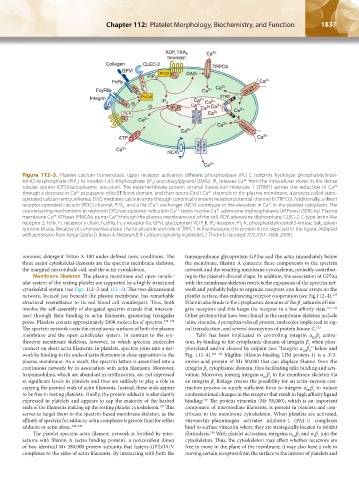
                  Figure 112–3.  Platelet calcium homeostasis. Upon receptor activation different phospholipase (PL) C isoforms hydrolyze phosphatidylinosi-
                                                                                            2+
                  tol-4,5-bisphosphate (PIP ) to inositol-1,4,5-trisphosphate (IP ) and diacylglycerol (DAG). IP  releases Ca  from the intracellular stores in the dense
                                                                                   3
                                    2
                                                             3
                                                                                                                          2+
                  tubular  system (DTS)/sarcoplasmic reticulum. The transmembrane  protein stromal interaction molecule 1  (STIM1) senses  the reduction in Ca
                                                                                2+
                  through a decrease in Ca  occupancy of its EF hand domain, and then opens Orai1 Ca  channels in the plasma membrane, a process called store-
                                    2+
                  operated calcium entry, whereas DAG mediates calcium entry through canonical transient receptor potential channel 6 (TRPC6). Additionally, a direct
                                                              2+
                                                                                                    2+
                  receptor-operated calcium (ROC) channel, P2X , and a Na /Ca  exchanger (NCX) contribute to the elevation in Ca  in the platelet cytoplasm. The
                                                           +
                                                    1
                                                                     2+
                  counteracting mechanisms to replenish DTS/sarcoplasmic reticulum Ca  stores involve Ca  adenosine triphosphatases (ATPases) (SERCAs). Plasma
                                                                                   2+
                            2+
                  membrane Ca  ATPases (PMCAs) pump Ca  through the plasma membrane out of the cell. ADP, adenosine diphosphate; CLEC-2, C-type lectin-like
                                                 2+
                  receptor 2; FcRγ, Fc receptor γ chain; FcγRIIa, Fc γ receptor IIa; GPVI, glycoprotein VI; IP R, IP -receptor; PI -K, phosphatidylinositol 3-kinase; Syk, spleen
                                                                              3
                                                                                           3
                                                                                  3
                  tyrosine kinase. Because of controversies about the localization and role of TRPC1 in the literature, this protein is not depicted in the figure. (Adapted
                  with permission from Varga-Szabo D, Braun A, Nieswandt B: Calcium signaling in platelets. J Thromb Haemost 7(7):1057–1066, 2009.)
                  nonionic detergent Triton X-100 under defined ionic conditions. The   transmembrane glycoprotein GPIbα and the actin immediately below
                  three major cytoskeletal elements are the spectrin membrane skeleton,   the membrane, filamin A connects these components to the spectrin
                  the marginal microtubule coil, and the actin cytoskeleton.  network and the resulting membrane cytoskeleton, probably contribut-
                     Membrane Skeleton  The plasma membrane and open canalic-  ing to the platelet’s discoid shape. In addition, the association of GPIbα
                  ular system of the resting platelet are supported by a highly structured   with the membrane skeleton restricts the expansion of the spectrin net-
                  cytoskeletal system (see Figs. 112–2 and 112–4). This two-dimensional   work and probably helps to organize receptors into linear arrays on the
                                                                                                                          133
                  network, located just beneath the plasma membrane, has remarkable   platelet surface, thus enhancing receptor cooperation (see Fig.112–4).
                  structural resemblance to its red blood cell counterpart. Thus, both   Filamin also binds to the cytoplasmic domains of the β  subunits of inte-
                                                                                                               3
                  involve the self-assembly of elongated spectrin strands that intercon-  grin receptors and this keeps the receptor in a low affinity state. 141–143
                  nect through their binding to actin filaments, generating triangular   Other proteins that have been found in the membrane skeleton include
                  pores. Platelets contain approximately 2000 molecules of spectrin. 133–136    talin, vinculin, dystrophin-related protein, molecules implicated in sig-
                  The spectrin network coats the cytoplasmic surfaces of both the plasma   nal transduction, and several isoenzymes of protein kinase C. 133
                  membrane and the open canalicular system. In contrast to the ery-  Talin has been implicated in controlling integrin  α β  activa-
                                                                                                                   IIb 3
                  throcyte membrane skeleton, however, in which spectrin molecules   tion, by binding to the cytoplasmic domain of integrin β  when phos-
                                                                                                                  3
                  connect on short actin filaments, in platelets, spectrin joins into a net-  phorylated and/or cleaved by calpain (see “Integrin α β ” below and
                                                                                                                IIb 3
                  work by binding to the ends of actin filaments in close apposition to the   Fig. 112–4). 144–148  Migfilin (filamin-binding LIM protein-1) is a 373-
                  plasma membrane. As a result, the spectrin lattice is assembled into a   amino-acid protein of Mr 50,000 that can displace filamin from the
                  continuous network by its association with actin filaments. Moreover,   integrin β  cytoplasmic domain, thus facilitating talin binding and acti-
                                                                               3
                  tropomodulins, which are abundant in erythrocytes, are not expressed   vation. Moreover, joining integrin α β  to the membrane skeleton via
                                                                                                   IIb 3
                  at significant levels in platelets and thus are unlikely to play a role in   an integrin β  linkage creates the possibility for an actin–myosin con-
                                                                                  3
                  capping the pointed ends of actin filaments. Instead, these ends appear   traction process to supply sufficient force to integrin α β  to induce
                                                                                                                 IIb 3
                  to be free in resting platelets. Finally, the protein adducin is abundantly   conformational changes in the receptor that result in high affinity ligand
                  expressed in platelets and appears to cap the majority of the barbed   binding.  The protein vimentin (Mr 58,000), which is an important
                                                                              149
                                                                137
                  ends of the filaments making up the resting platelet cytoskeleton.  This   component of intermediate filaments, is present in platelets and con-
                  serves to target them to the spectrin-based membrane skeleton, as the   tributes to the membrane cytoskeleton. When platelets are activated,
                  affinity of spectrin for adducin-actin complexes is greater than for either   vitronectin–plasminogen activator inhibitor-1 (PAI-1) complexes
                  adducin or actin alone. 138–140                       bind to surface vimentin where they are strategically located to inhibit
                                                                                 150
                     The platelet spectrin-actin filament network is fortified by inter-  fibrinolysis.  With platelet activation, integrins α β  and α β  join the
                                                                                                            IIb 3
                                                                                                                   2 1
                  actions with filamin A (actin binding protein), a noncovalent dimer   cytoskeleton. Thus, the cytoskeleton may affect whether receptors are
                  of two identical Mr 280,000 protein subunits that fastens GPIb/IX/V   free to move in the plane of the membrane; it may also have a role in
                  complexes to the sides of actin filaments. By interacting with both the   moving certain receptors from the surface to the interior of platelets and
          Kaushansky_chapter 112_p1829-1914.indd   1837                                                                 17/09/15   3:26 pm

