


Page 191 - Williams Hematology ( PDFDrive )
P. 191
166            Part IV:  Molecular and Cellular Hematology                                                                                                                                      Chapter 12:  Epigenetics           167


               Thus, the nucleosome and DNAme landscape together define the initial     CHROMATIN REMODELING
               “open versus closed” chromatin state of a region with which the current
               repertoire of transcription factors within that cell type must contend.   COMPLEXES IN BLOOD
               However, this landscape is dynamic, as signaling systems can modify   CELL DIFFERENTIATION
               transcription factors and chromatin components, altering their activ-
               ity and the landscape both through their binding, and through their   Clear roles for remodelers in blood cell differentiation are emerging. For
               recruitment of nucleosome remodelers and chromatin modifiers. 3–5  example, SWI/SNF components affect the pool size of fetal hemato-
                                                                      poietic stem cells (HSCs), and also impact HSC (and progenitor) pro-
                                                                                       6
               CHROMATIN REMODELERS CONTROL                           liferation and survival.  SWI/SNF complex is also used for myeloid
               GENOME ACCESS                                          differentiation to granulocytes and for multiple steps in thymocyte
                                                                      development. More specifically, in mice SWI/SNF binds the interferon-γ
               ATP-dependent chromatin remodeling complexes (termed hereafter   (Ifng) promoter, and is required for its full transcription. Furthermore,
               remodelers) conduct central roles in regulating nucleosome occupancy   mutations in the adenosine triphosphatase (ATPase) function of SWI/
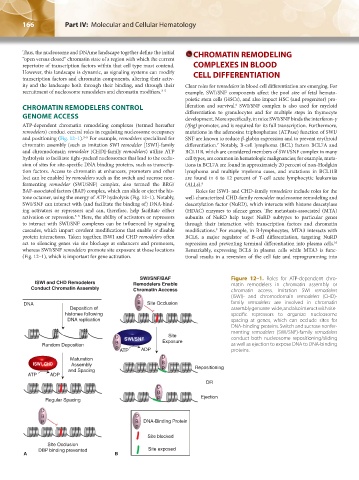
               and positioning (Fig. 12–1).  For example, remodelers specialized for   SNF are known to reduce β-globin expression and to prevent erythroid
                                    3–5
               chromatin assembly (such as imitation SWI remodeler [ISWI]-family   differentiation.  Notably, B-cell lymphoma (BCL) factors BCL7A and
                                                                                 7
               and chromodomain remodeler [CHD]-family remodelers) utilize ATP   BCL11B, which are considered members of SWI/SNF complex in many
               hydrolysis to facilitate tight-packed nucleosomes that lead to the occlu-  cell types, are common in hematologic malignancies; for example, muta-
               sion of sites for site-specific DNA binding proteins, such as transcrip-  tions in BCL7A are found in approximately 20 percent of non-Hodgkin
               tion factors. Access to chromatin at enhancers, promoters and other   lymphoma and  multiple  myeloma cases,  and mutations  in BCL11B
               loci can be enabled by remodelers such as the switch and sucrose non-   are found in 6 to 12 percent of T-cell acute lymphocytic leukemias
               fermenting  remodeler (SWI/SNF) complex, also termed the BRG/  (ALLs). 8
               BAF-associated factors (BAF) complex, which can slide or eject the his-  Roles for ISWI- and CHD-family remodelers include roles for the
               tone octamer, using the energy of ATP hydrolysis (Fig. 12–1). Notably,   well-characterized CHD-family remodeler nucleosome remodeling and
               SWI/SNF can interact with (and facilitate the binding of) DNA-bind-  deacetylation factor (NuRD), which interacts with histone deacetylase
               ing  activators  or  repressors and  can,  therefore,  help  facilitate  either   (HDAC) enzymes to silence genes. The metastasis-associated (MTA)
               activation or repression.  Here, the ability of activators or repressors   subunits of NuRD help target NuRD subtypes to particular genes
                                 3–5
               to interact with SWI/SNF complexes can be influenced by signaling   through their interaction with transcription factors and chromatin
               cascades, which impart covalent modifications that enable or disable   modifications.  For example, in B-lymphocytes, MTA3 interacts with
                                                                                9
               protein interactions. Taken together, ISWI and CHD remodelers often   BCL6,  a  major  regulator  of  B-cell  differentiation,  targeting  NuRD
               act to silencing genes via site blockage at enhancers and promoters,   repression and preventing terminal differentiation into plasma cells.
                                                                                                                        10
               whereas SWI/SNF remodelers promote site exposure at those locations   Remarkably, expressing BCL6 in plasma cells while MTA3 is func-
               (Fig. 12–1), which is important for gene activation.   tional results in a reversion of the cell fate and reprogramming into


                                                       SWI/SNF/BAF                   Figure 12–1.  Roles for ATP-dependent chro-
                    ISWI and CHD Remodelers          Remodelers Enable               matin remodelers in chromatin assembly or
                  Conduct Chromatin Assembly         Chromatin Acccess               chromatin access. Imitation SWI  remodelers
                                                      D                              (ISWI)- and chromodomain  remodelers (CHD)-
                DNA                                   B  Site Occlusion              family  remodelers are involved in chromatin
                               Deposition of          P                              assembly genome-wide, and also interact with site-
                              histones following                                     specific repressors to organize nucleosome
                               DNA replication                                       spacing at genes, which can occlude sites for
                                                                                     DNA-binding proteins. Switch and sucrose nonfer-
                                                                                     menting  remodelers (SWI/SNF)-family  remodelers
                                               D  SWI/SNF       Site                 conduct both nucleosome repositioning/sliding
                      Random Deposition        B              Exposure               as well as ejection to expose DNA to DNA-binding
                                               P  ATP  ADP                           proteins.
                               Maturation                     D
                   ISWI, CHD    Assembly                      B
                               and Spacing                    P          Repositioning
                 ATP     ADP
                                                                             OR
                                                             D
                                                             B
                       Regular Spacing                       P             Ejection

                      D
                      B                              D
                      P                              B  DNA-Binding Protein
                                                     P
                                                         Site blocked
                        Site Occlusion
                     DBP binding prevented                Site exposed
                A                             B


          Kaushansky_chapter 12_p0165-0172.indd   166                                                                   17/09/15   6:28 pm

