


Page 192 - Williams Hematology ( PDFDrive )
P. 192
166  Part IV:  Molecular and Cellular Hematology                                   Chapter 12:  Epigenetics           167


                  B lymphocytes.  Furthermore, the recruitment of the ISWI-family com-  being acetylation, methylation, ubiquitylation, and phosphorylation.
                             10
                  plex nucleosome remodeling factor (NURF) to the early growth response   An inventory and functional analysis of all of these modifications, the
                  protein 1 (EGR1) locus (important for thymocyte maturation) involves   enzymes that place and remove these modifications, is beyond the scope
                  interaction with the transcription factor serum response factor (SRF)   of this chapter; however, more important are the concepts, which can
                                                                    11
                  by the NURF subunit BPTF, enabling its stable binding to promoters.    then be applied widely to various contexts.
                  Notably, Ikaros (which drives lymphoid differentiation) acts to inhibit   First, the vast majority of histone modifications occur either on
                  both the ATP-dependent remodeling and HDAC activities of NuRD at   the extended aminoterminal “tails” of histones, whereas a minority also
                                                                                                   13
                  target genes to enable activation rather than silencing.  Taken together,   occur on the histone octamer “core.”  The core of the histone octamer
                                                        12
                  these and other examples illustrate the use of remodeler function and   wraps the DNA, whereas histone tails serve as platforms for the regu-
                  recruitment to activate or repress key genes in blood differentiation.  lated binding of proteins, and covalent modifications can either enhance
                                                                        or deter binding of  chromatin  remodelers, chromatin  modifiers, and
                                                                        transcription factors, and help to orchestrate protein associations dur-
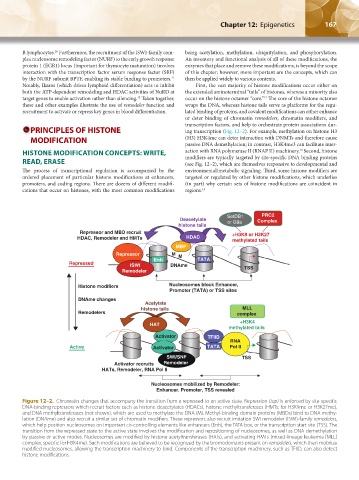
                       PRINCIPLES OF HISTONE                            ing transcription (Fig. 12–2). For example, methylation on histone H3
                     MODIFICATION                                       (H3) H3K4me can deter interaction with DNMTs and therefore cause
                                                                        passive DNA demethylation; in contrast, H3K4me3 can facilitate inter-
                                                                                                               14
                  HISTONE MODIFICATION CONCEPTS: WRITE,                 action with RNA polymerase II (RNAP II) machinery.  Second, histone
                  READ, ERASE                                           modifiers are typically targeted by site-specific DNA binding proteins
                                                                        (see Fig. 12–2), which are themselves responsive to developmental and
                  The process of transcriptional regulation is accompanied by the   environmental/metabolic signaling. Third, some histone modifiers are
                  ordered placement of particular histone modifications at enhancers,   targeted or regulated by other histone modifications, which underlies
                  promoters, and coding regions. There are dozens of different modifi-  (in part) why certain sets of histone modifications are coincident in
                  cations that occur on histones, with the most common modifications   regions. 13


                                                                                      SetDB1      PRC2
                                                                       Deacetylate     or G9a    Complex
                                                                      histone tails
                                     Repressor and MBD recruit                          +H3K9 or H3K27
                                    HDAC, Remodeler and HMTs             HDAC           methylated tails
                                                                     MBP
                                                 Repressor          M  M
                                                              Enh
                                 Repressed            ISWI   Enh   DNAme     TATA
                                                   Remodeler                                TSS


                                    Histone modifiers              Nucleosomes block Enhancer,
                                                                   Promoter (TATA) or TSS sites
                                    DNAme changes
                                                           Acetylate
                                                          histone tails                     MLL
                                    Remodelers                                            complex
                                                                                           +H3K4
                                                             HAT
                                                                                       methylated tails
                                                              Activator         TFIID
                                                                                        RNA
                                  Active                      Activator         TATA   Pol II
                                                                  SWI/SNF                  TSS
                                                 Activator recruits  Remodeler
                                             HATs, Remodeler, RNA Pol II

                                                             Nucleosomes mobilized by Remodeler:
                                                               Enhancer, Promoter, TSS revealed

                  Figure 12–2.  Chromatin changes that accompany the transition from a repressed to an active state. Repression (top) is enforced by site-specific
                  DNA-binding repressors which recruit factors such as histone deacetylates (HDACs), histone methyltransferases (HMTs; for H3K9me or H3K27me),
                  and DNA methyltransferases (not shown), which are used to methylate the DNA (M). Methyl-binding domain proteins (MBDs) bind to DNA methy-
                  lation (DNAme) and also recruit a similar set of chromatin modifiers. These repressors also recruit imitation SWI remodeler (ISWI)-family remodelers,
                  which help position nucleosomes on important cis-controlling elements like enhancers (Enh), the TATA box, or the transcription start site (TSS). The
                  transition from the repressed state to the active state involves the modification and repositioning of nucleosomes, as well as DNA demethylation
                  by passive or active modes. Nucleosomes are modified by histone acetyltransferases (HATs), and activating HMTs (mixed-lineage leukemia [MLL]
                  complex, specific for H3K4me). Such modifications are believed to be recognized by the bromodomains present on remodelers, which then mobilize
                  modified nucleosomes, allowing the transcription machinery to bind. Components of the transcription machinery, such as TFIID, can also detect
                  histone modifications.


          Kaushansky_chapter 12_p0165-0172.indd   167                                                                   17/09/15   6:28 pm

