


Page 194 - Williams Hematology ( PDFDrive )
P. 194
168  Part IV:  Molecular and Cellular Hematology                                   Chapter 12:  Epigenetics           169


                      TET PROTEINS AND ACTIVE                           N-terminus to the ALL1-fused (AF) genes (AF9) and AF4 proteins
                                                                        (partial internal tandem duplications are also leukemogenic, which
                    DNA DEMETHYLATION                                   likely also affect interactions with chromatin modifiers). Interestingly,
                                                                        the AF9 and AF4 partners are themselves members of more than one
                  DNAme is chemically highly stable, and therefore very useful in stable   chromatin and transcription complex, 38,39  and therefore capable of
                  propagation of epigenetic states, even through germline inheritance.   recruiting a range of chromatin modifiers, including a H3 methyltrans-
                  Although stable, DNA demethylation can occur, and does so mainly   ferase, DOT1 (which methylates histone H3K79), 40–42  or TIP60, CBP,
                  through two routes: (1) “passive” demethylation (dilution of DNAme by   and EP300 (which acetylate histones H3 and H4). AF4 is also a member
                  the failure to conduct maintenance DNAme after DNA replication), and   of a complex important for transcriptional elongation, 38,39  which inter-
                  (2) “active” demethylation, mainly involving proteins of the TET family.   acts with acetylated histone tails via a bromo and extraterminal (BET)-
                  TET proteins are dioxygenase enzymes that oxidize the methyl group of   family bromodomain present in the BRD4 subunit. MLL fusions also
                  5-methylcytosine (5mC) to 5-hydroxymethylcytosine 33,34  (5hmC) and   involve direct fusion to a chromatin modifier, including fusion to the
                  additional oxidized intermediates (not addressed further). Here, 5hmC   HAT enzymes CBP or EP300. (Fusion of MLL to TET proteins are cov-
                  and other intermediates cause DNA demethylation by one of two modes:   ered separately in the context of DNAme in the section “Misregulation
                  first, following replication the maintenance DNMT1 and its partner,   of Dna Methylation/Demethylation In Hematologic Malignancies”).
                  UHRF1, do not recognize these oxidized products as 5mC, leading to   Regarding mechanism, current thinking supports the targeting
                  passive demethylation.  Second, glycosylases with roles in DNA repair   of MLL fusions to constitutively activate key genes involved in blood
                                  24
                  (e.g., thymine DNA glycosylase [TDG]) can remove 5-hydroxymeth-  development, causing a block in differentiation. This block (and contin-
                  ylcytosine (5hmC) and similar oxidized intermediates, which are then   ued proliferation) provides the opportunity for other genetic and epige-
                  replaced with an unmodified cytosine by base-excision repair systems.    netic events that enhance proliferation and survival. Confirmed targets
                                                                    35
                  An important aspect of TET-family dioxygenases is their use of iron   for MLL fusions include HoxA9 and the Meis1 gene in mouse, where
                  and 2-oxoglutarate (2OG) as cofactors during the oxidation reaction; a   the fusion contributes to their transcriptional activation.  However, it
                                                                                                                  41
                  feature that renders TET enzymes sensitive to concentrations of these   is likely that a larger repertoire of target genes is involved, as ectopic
                  metabolites and related compounds, which can act as inhibitors during   expression of HoxA9 and Meis1 in mice is effective at inducing leuke-
                  metabolic dysregulation (see section “Misregulation of Dna Methylation/   mias only under certain contexts. Finally, it is important to note that
                  Demethylation In Hematologic Malignancies”).
                                                                        MLL fusions represent one particular class and mechanism; in contrast,
                                                                        fusions involving the retinoic acid receptor (RAR) (e.g., RAR-PLZF) are
                       EPIGENETICS AND HEMATOLOGIC                      known to block differentiation through the constitutive recruitment of
                                                                        repressive chromatin modifiers (e.g., HDACs), conferring repression
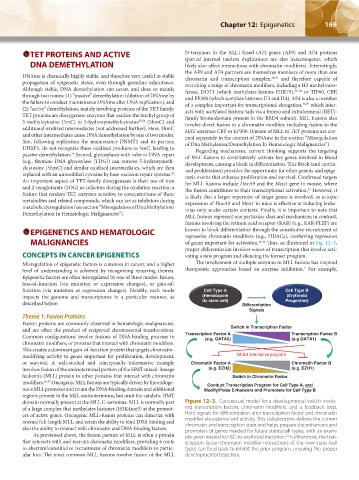
                     MALIGNANCIES                                       of genes important for activation. 43,44  Thus, as illustrated in Fig. 12–3,
                                                                        proper differentiation involves waves of transcription that involve acti-
                  CONCEPTS IN CANCER EPIGENETICS                        vating a new program and silencing the former program.
                  Misregulation of epigenetic factors is common in cancer, and a higher   The involvement of multiple enzymes in MLL fusions has inspired
                                                                                                                2
                  level of understanding is achieved by recognizing recurring themes.   therapeutic approaches based on enzyme inhibition.  For example,
                  Epigenetic factors are often misregulated by one of three modes: fusion,
                  loss-of-function (via mutation or expression changes), or gain-of-
                  function  (via  mutation  or  expression  changes).  Notably,  each  mode   Cell Type A  Cell Type B
                  impacts the genome and transcriptome in a particular manner, as   (Hematopoie           (Erythroid
                  described below:                                            tic stem cell)  Differentiation  Progenitor)
                                                                                              Signals
                  Theme 1: Fusion Proteins
                  Fusion proteins are commonly observed in hematologic malignancies,
                  and are often the product of reciprocal chromosomal translocations.   Switch in Transcription Factor
                  Common configurations involve fusions of DNA-binding proteins to   Transcription Factor A  Transcription Factor B
                                                                                                            (e.g GATA1)
                                                                               (e.g. GATA2)
                  chromatin modifiers, or proteins that interact with chromatin modifiers.
                  This creates a dominant gain-of-function protein that targets chromatin-
                  modifying activity to genes important for proliferation, development,   Inhibit alternative program
                  or  survival.  A well-studied and  conceptually  informative  example   Chromatin Factor A  Chromatin Factor B
                  involves fusion of the aminoterminal portion of the HMT mixed-lineage    (e.g. EZH2)      (e.g. EZH1)
                  leukemia (MLL) protein to other proteins that interact with chromatin   Switch in Chromatin Factor
                  modifiers. 36,37  Oncogenic MLL fusions are typically driven by the endoge-
                                                                                Conduct Transcription Program for Cell Type A, and
                  nous MLL promoter and retain the DNA-binding domain and additional   Modify/Poise Enhancers and Promoters for Cell Type B
                  regions present in the MLL aminoterminus, but omit the catalytic HMT
                  domain normally present at the MLL C-terminus. MLL is normally part   Figure 12–3.  Conceptual model for a developmental switch involv-
                  of a large complex that methylates histones (H3K4me3) at the promot-  ing transcription factors, chromatin modifiers, and a feedback loop.
                  ers of active genes. Oncogenic MLL-fusion proteins can dimerize with   Here signals for differentiation alter transcription factor and chromatin
                  normal full-length MLL, and retain the ability to bind DNA binding and   modifier abundance and activity. This collaboration defines the current
                  also the ability to interact with chromatin and DNA-binding factors.  chromatin and transcription state and helps prepare the enhancers and
                                                                        promoters of genes needed for future states/cell types, with an exam-
                     As previewed above, the fusion partner of MLL is often a protein   ple given related to HSC-to-erythroid transition.  Furthermore, the tran-
                                                                                                          21
                  that interacts with and recruits chromatin modifiers, providing a route   scription factor-chromatin modifier interactions of the new state (cell
                  to aberrant/constitutive recruitment of chromatin modifiers to partic-  type) can feed back to inhibit the prior program, ensuring the proper
                  ular loci. The most common MLL fusions involve fusion of the MLL   developmental trajectory.


          Kaushansky_chapter 12_p0165-0172.indd   169                                                                   17/09/15   6:30 pm

