


Page 1993 - Williams Hematology ( PDFDrive )
P. 1993
1968           Part XII:  Hemostasis and Thrombosis                                                                                                                       Chapter 115:  Vascular Function In Hemostasis          1969


                TABLE 115–1.  Chronology of Endothelial Cell          activating guanylate cyclase, the resulting increase in cyclic guanylate
                                                                      monophosphate (GMP) inhibits platelet function and induces vascu-
                Thromboregulators                                     lar relaxation. 10,11  Endothelial cell ecto-ATP/Dase-1/CD39 is a mem-
                Early thromboregulators                               brane-associated  apyrase  that  metabolizes  adenosine  diphosphate
                  Nitric oxide (NO)                                   (ADP) in the primary platelet releasate, preventing further platelet acti-
                  Eicosanoids (prostacyclin and prostaglandin D )     vation and recruitment. 12,13
                                                    2
                  Endothelial cell CD39/ENTPDase1                         Late thromboregulators produced by endothelial cells act either
                  Endothelin                                          to prevent excessive thrombin generation or to promote lysis of intra-
                Late thromboregulators                                vascular thrombi (see Tabl e 115–1). Antithrombin, a natural anticoag-
                  Endothelin                                          ulant, acts as an inhibitor of thrombin and factor Xa in the circulation.
                                                                      Endothelial cell heparan proteoglycans act as cofactors for antith-
                  Antithrombin                                        rombin. The tissue factor pathway inhibitor (TFPI) inhibits the com-
                  Endothelial cell/heparin proteoglycans              plex between factor VIIa and tissue factor (TF). The thrombomodulin/
                  Tissue factor pathway inhibitor                     endothelial  cell  protein  C  receptor  (EPCR)/protein  C  system  in  the
                  Thrombomodulin-protein C-protein S pathway          vascular wall regulates hemostasis through inactivation of procoagu-
                  Fibrinolytic system (plasminogen activators, inhibitors, and   lant cofactors, and antiinflammatory activity.  The fibrinolytic system
                                                                                                       14
                  receptors)                                          is intimately involved with the vascular endothelium because endo-
                  Inflammatory thromboregulators                      thelial cells not only synthesize and secrete tissue plasminogen activa-
                  Thrombomodulin-protein C-protein S pathway          tor (t-PA), but also regulate formation of plasmin from its precursor,
                                                                                                            15
                  Cellular adhesion molecules                         plasminogen, through the expression of receptors.  Impairment of
                  Selectins                                           fibrinolytic potential can play a central role in the etiology of occlu-
                                                                      sive vascular disease.  Finally, endothelial cell adhesion molecules,
                                                                                      16
                                                                      including the cell adhesion molecules (CAMs: mucosal addressin cell
                                       t-PA  Thr  PC                  adhesion molecule [MAdCAM]-1, intercellular adhesion molecule
                        AT   u-PA   PLG                 VIIa          [ICAM]-1, vascular cell adhesion molecule [VCAM]-1, and plate-
                                       A2    TM  EPCR  TFPI           let endothelial cell adhesion molecule [PECAM]-1) and the selectins
                        HS   uPAR   p11                 TF            (P- and E-selectin), are glycoproteins that modulate multiple inter-
                  CD39                                                actions between the endothelium and various classes of circulating
                                                                                                            17
                                                            CAMs      leukocytes, thereby modulating vascular patency.  Together, these
                   NO                                                 mechanisms define thromboregulation, the processes by which blood
                                   Endothelial cell         JAMs      cells and cells of the vessel wall, through their close proximity, interact
                  PGI 2
                                                           Selectins  to facilitate or inhibit thrombus formation. 18
                                                                          The physiologic defense systems that render endothelial surfaces
                   ET                                       CD99      and blood cells antithrombotic can be overwhelmed by excessive shear
                                                                      stress, increased turbulence, injury, inflammation, and severe athero-
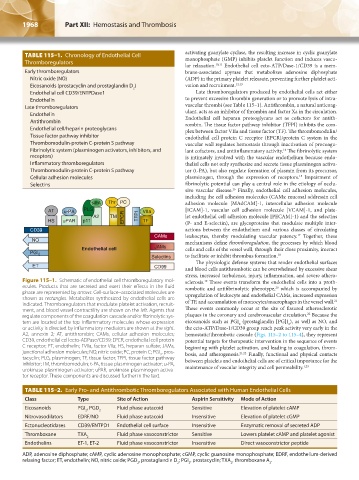
               Figure 115–1.  Schematic of endothelial cell thromboregulatory mol-  sclerosis.  These events transform the endothelial cells into a proth-
                                                                            19
               ecules. Products that are secreted and exert their effects in the fluid   rombotic and antifibrinolytic phenotype,  which is accompanied by
                                                                                                    20
               phase are represented by arrows. Cell-surface–associated molecules are   upregulation of leukocyte and endothelial CAMs, increased expression
               shown as rectangles. Metabolites synthesized by endothelial cells are                                    21
               indicated. Thromboregulators that modulate platelet activation, recruit-  of TF, and accumulation of monocytes/macrophages in the vessel wall.
               ment, and blood vessel contractility are shown on the left. Agents that   These events commonly occur at the site of fissured atherosclerotic
                                                                                                               22
               regulate components of the coagulation cascade and/or fibrinolytic sys-  plaques in the coronary and cerebrovascular circulation.  Because the
               tem are located at the top. Inflammatory molecules whose expression   eicosanoids such as PGI  (prostaglandin [PG]I ), as well as NO, and
                                                                                        2
                                                                                                         2
               or activity is directed by inflammatory mediators are shown at the right.   the ecto-ATP/Dase-1/CD39 group reach peak activity very early in the
               A2, annexin 2; AT, antithrombin; CAMs, cellular adhesion molecules;   hemostatic/thrombotic cascade (Figs. 115–2 to 115–4), they represent
               CD39, endothelial cell ecto-ADPase/CD39; EPCR, endothelial cell protein   potential targets for therapeutic intervention in the sequence of events
               C receptor; ET, endothelin; FVIIa, factor VIIa; HS, heparan sulfate; JAMs,   beginning with platelet activation, and leading to coagulation, throm-
               junctional adhesion molecules; NO, nitric oxide; PC, protein C; PGI , pros-  bosis, and atherogenesis. 21,22  Finally, functional and physical contacts
                                                              2
               tacyclin; PLG, plasminogen; TF, tissue factor; TFPI, tissue factor pathway   between platelets and endothelial cells are of critical importance for the
               inhibitor; TM, thrombomodulin; t-PA, tissue plasminogen activator; u-PA,                       1,23
               urokinase plasminogen activator; uPAR, urokinase plasminogen activa-  maintenance of vascular integrity and cell permeability.
               tor receptor. These components are discussed further in the text.
                TABLE 115–2.  Early Pro- and Antithrombotic Thromboregulators Associated with Human Endothelial Cells
                Class             Type         Site of Action           Aspirin Sensitivity  Mode of Action
                Eicosanoids       PGI , PGD    Fluid phase autacoid     Sensitive        Elevation of platelet cAMP
                                     2   2
                Nitrovasodilators  EDRF/NO     Fluid phase autacoid     Insensitive      Elevation of platelet cGMP
                Ectonucleotidases  CD39/ENTPD1  Endothelial cell surface  Insensitive    Enzymatic removal of secreted ADP
                Thromboxane       TXA          Fluid phase vasoconstrictor  Sensitive    Lowers platelet cAMP and platelet agonist
                                     2
                Endothelins       ET-1, ET-2   Fluid phase vasoconstrictor  Insensitive  Direct vasoconstrictor peptide

               ADP, adenosine diphosphate; cAMP, cyclic adenosine monophosphate; cGMP, cyclic guanosine monophosphate; EDRF, endothelium-derived
               relaxing factor; ET, endothelin; NO, nitric oxide; PGD , prostaglandin D ; PGI , prostacyclin; TXA , thromboxane A .
                                                      2            2   2             2            2


          Kaushansky_chapter 115_p1967-1984.indd   1968                                                                 9/18/15   10:07 AM

