


Page 1998 - Williams Hematology ( PDFDrive )
P. 1998
1972  Part XII:  Hemostasis and Thrombosis                    Chapter 115:  Vascular Function In Hemostasis          1973


                  muscles cells, and macrophages, which express plasminogen activators,   In vivo, the circulating half-life of t-PA is approximately 5 min-
                  plasminogen activator inhibitors, and fibrinolytic receptors.  utes. Infusion of DDAVP, bradykinin, platelet-activating factor (PAF),
                                                                        endothelin, or thrombin is associated with an acute release of t-PA,
                                                                                                                        123
                  ENDOTHELIAL CELL PRODUCTION OF                        and a burst of fibrinolytic activity can be detected within minutes.  In
                  FIBRINOLYTIC PROTEINS                                 the mouse lung, exposure to hyperoxia leads to 4.5-fold upregulation
                                                                                                           107
                                                                        of t-PA mRNA in small-vessel endothelial cells.  In humans, infusion
                  In 1958, Todd demonstrated that human blood vessels possess fibrino-  of TNF into patients with malignancy is associated with an increase in
                  lytic activity that is dependent upon an intact endothelium. 102,103  We   plasma t-PA.  Deficient release of t-PA in response to venous occlusion
                                                                                  123
                                                                                                               124
                  now know that the endothelium is the principal source of t-PA in vivo   in humans is associated with deep venous thrombosis,  as well as atro-
                  where it appears to be highly restricted to small blood vessels in specific   phie blanche and other cutaneous vasculitides. 125
                  anatomic locations, a pattern that likely reflects the heterogeneity of   In vivo, urokinase plasminogen activator (u-PA) is not a product
                                                                                          126
                  endothelial cells as they respond to a myriad of tissue-specific cues. 104,105    of resting endothelium,  but is produced primarily by renal tubular
                                                                                 127
                  In the baboon, for example, sites of t-PA production include 7 to 30 μm   epithelium.  Expression of u-PA mRNA in endothelium, however, is
                  precapillary arterioles and postcapillary venules, but not large arteries   strongly stimulated during wound repair and physiologic angiogenesis
                         106
                  and veins.  In the mouse lung, similarly, bronchial, but not pulmonary,   within ovarian follicles, corpus luteum, and maternal decidua.  Endo-
                                                                                                                     128
                                       107
                                                                                                             129
                  endothelial cells express t-PA.  Moreover, enhanced expression of t-PA   thelial cells passaged in culture do synthesize u-PA,  and expression of
                                                                                                             130
                  at branch points of pulmonary blood vessels may reflect stimulation by   its mRNA is stimulated by TNF-α by 5- to 30-fold.  Small increases in
                  laminar shear stress.  In addition, peripheral sympathetic neurons that   u-PA have also been observed in vitro in response to IL-1 and LPS. 131–133
                                108
                  invest the walls of small arteries may represent a significant source of   The association of u-PA with the blood vessel wall appears to reflect
                  circulating t-PA. 109                                 its association with the u-PA receptor (uPAR) which may fulfill a variety
                     Although in vitro studies suggest that t-PA expression in cultured   of nonproteolytic functions ranging from directed cell migration to cel-
                  endothelial cells is regulated by a wide array of factors, only a few of these   lular adhesion, differentiation, and proliferation (Fig. 115–6).  In the
                                                                                                                     134
                  pathways have been confirmed  in  vivo. Thrombin,  histamine, 111,112    adult mouse, uPAR mRNA is not normally detected by in situ hybrid-
                                                        110
                              113
                                                                                                                          135
                  oxygen  radicals,   phorbol  myristate  acetate,   DDAVP  (deamino   ization in the endothelium of either large or small blood vessels.
                                                    114
                                    115
                  D-arginine vasopressin),  and butyric acid liberated from dibutyryl   However, upon stimulation with endotoxin, expression is detected in
                  cAMP   all  increase  t-PA  mRNA  in  cultured  endothelial  cells.  Both   endothelium lining aorta, as well as arteries, veins, and capillaries in
                      116
                                                                                              135
                  thrombin and histamine appear to act via receptor-mediated activation   heart, kidney, brain, and liver,  and in renal tubular epithelial cells. 127
                                         105
                  of the protein kinase C pathway.  Laminar shear stress stimulates both   Plasminogen activator inhibitor (PAI)-1 is likely to function as a
                                                    118
                  t-PA secretion  and steady-state mRNA levels.  Hyperosmotic stress   major regulator of plasmin generation in the vicinity of the endothelial
                            117
                  and repetitive stretch also enhance t-PA expression. 119,120  In addition,   cell. Thrombin, IL-1, transforming growth factor β, TNF, lipoprotein(a)
                  differentiating agents, such as retinoids, 121,122  stimulate transcription of   (Lp[a]),  and LPS  all  induce dramatic increases in  steady state  PAI-1
                  t-PA in endothelial cells in vitro.                   message levels. 110,131,132,136,137  Heparin-binding growth factor 1 reduces
                                                  Plasmin
                                           t-PA              t-PA
                                   A-tail                           A-tail
                                               PLG       PLG
                                                                                                 u-PA
                                                                                   A 2
                              A 1  A 2  A 3  A 4             A 1  A 2  A 3  A 4                   U 1

                                                 p11   p11                                                 uPAR
                                                                                                     U
                                                                                                U 3   2

                           A                   Plasma membrane                          B     Plasma membrane

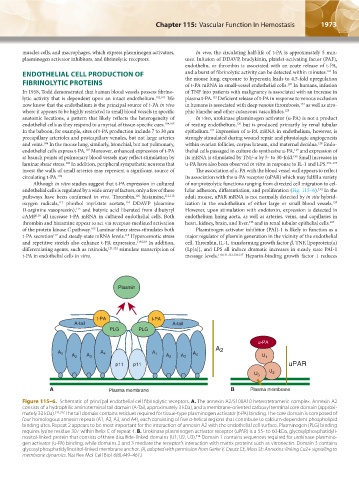
                  Figure 115–6.  Schematic of principal endothelial cell fibrinolytic receptors. A. The annexin A2/S100A10 heterotetrameric complex. Annexin A2
                  consists of a hydrophilic aminoterminal tail domain (A-Tail, approximately 3 kDa), and a membrane-oriented carboxyl terminal core domain (approxi-
                  mately 33 kDa). 311,312  The tail domain contains residues required for tissue-type plasminogen activator (t-PA) binding. The core domain is composed of
                  four homologous annexin repeats (A1, A2, A3, and A4), each consisting of five α-helical regions that contribute to calcium-dependent phospholipid
                  binding sites. Repeat 2 appears to be most important for the interaction of annexin A2 with the endothelial cell surface. Plasminogen (PLG) binding
                  requires lysine residue 307 within helix C of repeat 4. B. Urokinase plasminogen activator receptor (uPAR) is a 55- to 60-kDa, glycosylphosphatidyli-
                  nositol-linked protein that consists of three disulfide-linked domains (U1, U2, U3).  Domain 1 contains sequences required for urokinase plasmino-
                                                                            314
                  gen activator (u-PA) binding, while domains 2 and 3 mediate the receptor’s interaction with matrix proteins such as vitronectin. Domain 3 contains
                  glycosylphosphatidylinositol-linked membrane anchor. (A, adapted with permission from Gerke V, Creutz CE, Moss SE: Annexins: linking Ca2+ signalling to
                  membrane dynamics. Nat Rev Mol Cell Biol  6(6):449–461.)


          Kaushansky_chapter 115_p1967-1984.indd   1973                                                                 9/18/15   10:08 AM

