


Page 1994 - Williams Hematology ( PDFDrive )
P. 1994
1968  Part XII:  Hemostasis and Thrombosis                    Chapter 115:  Vascular Function In Hemostasis          1969


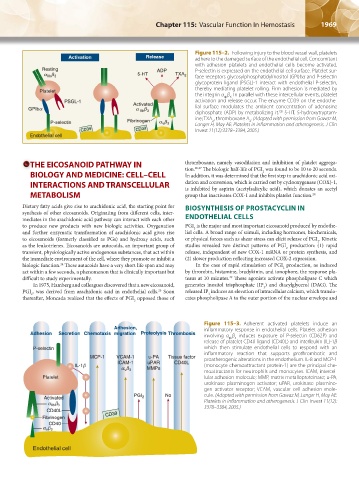
                                                                            Figure 115–2.  Following injury to the blood vessel wall, platelets
                                                                            adhere to the damaged surface of the endothelial cell. Concomitant
                                                                            with adhesion platelets and endothelial cells become activated.
                                                                            P-selectin is expressed on the endothelial cell surface. Platelet sur-
                                                                            face receptors glycosylphosphatidylinositol (GPI)bα and P-selectin
                                                                            glycoprotein ligand (PSGL)-1 interact with endothelial P-selectin,
                                                                            thereby mediating platelet rolling. Firm adhesion is mediated by
                                                                            the integrin α β . In parallel with these intercellular events, platelet
                                                                                     IIb 3
                                                                            activation and release occur. The enzyme CD39 on the endothe-
                                                                            lial surface modulates the ambient concentration of adenosine
                                                                                                        7,8
                                                                            diphosphate (ADP) by metabolizing it.  5-HT, 5-hydroxytryptam-
                                                                            ine; TXA , thromboxane A . (Adapted with permission from Gawaz M,
                                                                                 2
                                                                                              2
                                                                            Langer H, May AE: Platelets in inflammation and atherogenesis. J Clin
                                                                            Invest 11(12):3378–3384, 2005.)


                      THE EICOSANOID PATHWAY IN                         thromboxane, namely vasodilation and inhibition of platelet aggrega-
                                                                        tion.
                                                                               The biologic half-life of PGI  was found to be 10 to 20 seconds.
                                                                            26,27
                    BIOLOGY AND MEDICINE: CELL–CELL                     In addition, it was determined that the first step in arachidonic acid oxi-
                                                                                                  2
                    INTERACTIONS AND TRANSCELLULAR                      dation and conversion, which is carried out by cyclooxygenase (COX)-1,
                                                                        is  inhibited  by  aspirin  (acetylsalicylic acid),  which  donates  an acetyl
                    METABOLISM                                          group that inactivates COX-1 and inhibits platelet function. 28
                  Dietary fatty acids give rise to arachidonic acid, the starting point for   BIOSYNTHESIS OF PROSTACYCLIN IN
                  synthesis of other eicosanoids. Originating from different cells, inter-
                  mediates in the arachidonic acid pathway can interact with each other   ENDOTHELIAL CELLS
                  to produce new products with new biologic activities. Oxygenation   PGI  is the major and most important eicosanoid produced by endothe-
                                                                           2
                  and further enzymatic transformation of arachidonic acid gives rise   lial cells. A broad range of stimuli, including hormones, biochemicals,
                  to eicosanoids (formerly classified as PGs) and hydroxy acids, such   or physical forces such as shear stress can elicit release of PGI . Kinetic
                                                                                                                     2
                  as the leukotrienes. Eicosanoids are autocoids, an important group of   studies revealed two distinct patterns of PGI  production: (1) rapid
                                                                                                          2
                  transient, physiologically active endogenous substances, that act within   release, independent of new COX-1 mRNA or protein synthesis, and
                  the immediate environment of the cell, where they promote or inhibit a   (2) slower production reflecting increased COX-2 expression.
                  biologic function.  These autacoids have a very short life span and may   In the case of rapid stimulation of PGI  production, as induced
                               24
                                                                                                         2
                  act within a few seconds, a phenomenon that is clinically important but   by thrombin, histamine, bradykinin, and ionophore, the response pla-
                  difficult to study experimentally.                    teaus at 10 minutes.  These agonists activate phospholipase C which
                                                                                       29
                     In 1975, Hamberg and colleagues discovered that a new eicosanoid,   generates inositol trisphosphate (IP ) and diacylglycerol (DAG). The
                                                                                                   3
                  PGI , was derived from arachidonic acid in endothelial cells.  Soon   released IP  induces an elevation of intracellular calcium, which translo-
                                                               25
                                                                                3
                     2
                  thereafter, Moncada realized that the effects of PGI  opposed those of   cates phospholipase A to the outer portion of the nuclear envelope and
                                                       2
                                                                               Figure 115–3.  Adherent activated platelets induce an
                                                                               inflammatory response in endothelial cells. Platelet adhesion
                                                                               involving  α β  induces exposure of P-selectin (CD62P) and
                                                                                       IIb 3
                                                                               release of platelet CD40 ligand (CD40L) and interleukin (IL)-1β
                                                                               which then stimulate endothelial cells to respond with an
                                                                               inflammatory reaction that supports prothrombotic and
                                                                               proatherogenic alterations in the endothelium. IL-8 and MCP-1
                                                                               (monocyte chemoattractant protein-1) are the principal che-
                                                                               moattractants for neutrophils and monocytes. ICAM, intercel-
                                                                               lular adhesion molecule; MMP, matrix metalloproteinase; u-PA,
                                                                               urokinase plasminogen activator; uPAR, urokinase plasmino-
                                                                               gen activator receptor;  VCAM, vascular cell adhesion mole-
                                                                               cule. (Adapted with permission from Gawaz M, Langer H, May AE:
                                                                               Platelets in inflammation and atherogenesis. J Clin Invest 11(12):
                                                                               3378–3384, 2005.)


          Kaushansky_chapter 115_p1967-1984.indd   1969                                                                 9/18/15   10:08 AM

