


Page 1995 - Williams Hematology ( PDFDrive )
P. 1995
1970           Part XII:  Hemostasis and Thrombosis                                                                                                                       Chapter 115:  Vascular Function In Hemostasis          1971


                                                                      that of COX-1. 30–34  COX-2 is inducible in endothelial cells by prothrom-
                                                                      botic, inflammatory, or mitogenic stimuli, and in neutrophils by inflam-
                                                                      matory stimuli. 35,36
                                                                          Within a specific species, there is approximately 60 percent homol-
                                                                      ogy between deduced amino acid sequences of COX-1 (576 residues) and
                                                                      COX-2 (587 residues). The C-terminal sequence of 18 amino acids in
                                                                      COX-2 is absent in COX-1. Therefore, antibodies directed at this C-ter-
                                                                      minal sequence can identify COX-2 in tissues by immunoblot. The cata-
                                                                      lytic activity of both COX enzymes are similar and all amino acids critical
                                                                      for COX-1 activity are conserved in COX-2. The active site in COX-1
                                                                      is slightly larger than that of COX-2, a fact that has impacted design of
                                                                      COX inhibitors. COX-2 contains mannose, and an N-glycosylation site
                                                                      within the 18-amino acid C-terminal sequence. An N-glycosylation site at
                                                                      Asn410 is required for COX-1 to fold into its active conformation.
                                                                          The gene for COX-1 is located on chromosome 9 and spans 22 kb of
                                                                      genomic DNA, while the gene for COX-2 is located on chromosome 1 and
                                                                      spans 8 kb of DNA. Transcription of COX-2 proceeds via several signal-
                                                             JAM
                                                                      ing mechanisms initiated by cyclic adenosine monophosphate (cAMP)/
                                                                      protein kinase A, protein kinase C, tyrosine kinases, and pathways acti-
                                                                      vated by growth factors, endotoxin, and cytokines. 33,37–39  The discoveries of
                                                                      COX-1 and COX-2 were of great importance and have led to new concepts
                                                                      concerning the structure and function of COX-induced autacoids. 40

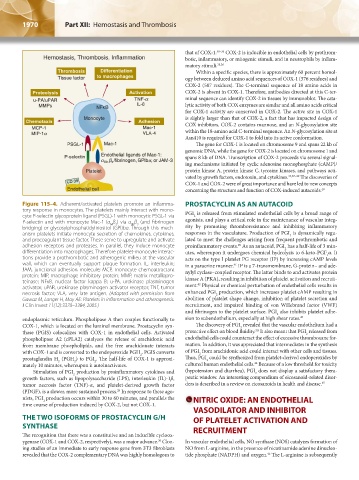
               Figure 115–4.  Adherent/activated platelets promote an inflamma-  PROSTACYCLIN AS AN AUTACOID
               tory response in monocytes. The platelets mainly interact with mono-  PGI  is released from stimulated endothelial cells by a broad range of
               cyte P-selectin glycoprotein ligand (PSGL)-1 with monocytic PSGL-1 via   2
               P-selectin and with monocyte Mac-1 (α β ) via α β  (and fibrinogen   agonists, and plays a critical role in the maintenance of vascular integ-
                                             M 2
                                                    IIb 3
               bridging) or glycosylphosphatidylinositol (GPI)bα. Through this mech-  rity by promoting thromboresistance and inhibiting inflammatory
               anism platelets initiate monocyte secretion of chemokines, cytokines,   responses in the vasculature. Production of PGI  is dynamically regu-
                                                                                                         2
               and procoagulant tissue factor. These serve to upregulate and activate   lated to meet the challenges arising from frequent prothrombotic and
               adhesion receptors and proteases. In parallel, they induce monocyte   proinflammatory events.  As an autacoid, PGI  has a half-life of 3 min-
                                                                                        29
                                                                                                       2
               differentiation into macrophages. Therefore platelet-monocyte interac-  utes, whereupon it undergoes chemical hydrolysis to 6-keto-PGF α. It
                                                                                                                     1
               tions provide a prothrombotic and atherogenic milieu at the vascular   acts on the type I platelet PG receptor (IP) by increasing cAMP levels
               wall,  which  can  eventually  support  plaque  formation.  IL,  interleukin;   in a paracrine manner.  IP is a 7-transmembrane, G-protein– and ade-
                                                                                      41
               JAM, junctional adhesion molecule; MCP, monocyte chemoattractant   nylyl cyclase–coupled receptor. The latter binds to and activates protein
               protein; MIP, macrophage inhibitory protein; MMP, matrix metallopro-  kinase A (PKA), resulting in inhibition of platelet activation and recruit-
               teinase;  NFκB, nuclear factor kappa  B; u-PA, urokinase  plasminogen   42
               activator; uPAR, urokinase plasminogen activator receptor; TNF, tumor   ment.  Physical or chemical perturbation of endothelial cells results in
               necrosis factor; VLA, very late antigen.  (Adapted with permission from   enhanced PGI  production, which increases platelet cAMP resulting in
                                                                                2
               Gawaz M, Langer H, May AE: Platelets in inflammation and atherogenesis.    abolition of platelet shape change, inhibition of platelet secretion and
               J Clin Invest 11(12):3378–3384, 2005.)                 recruitment, and impaired binding  of von Willebrand factor  (VWF)
                                                                      and fibrinogen to the platelet surface. PGI  also inhibits platelet adhe-
                                                                                                     2
               endoplasmic reticulum. Phospholipase A then couples functionally to   sion to subendothelium, especially at high shear rates. 43
               COX-1, which is located on the luminal membrane. Prostacyclin syn-  The discovery of PGI  revealed that the vascular endothelium had a
                                                                                        2
                                                                                              2,8
               thase (PGIS) colocalizes with COX-1 in endothelial cells. Activated   protective effect on blood fluidity.  It also meant that PGI  released from
                                                                                                               2
               phospholipase A2 (cPLA2) catalyzes the release of arachidonic acid   endothelial cells could counteract the effect of excessive thromboxane for-
               from membrane phospholipids, and the free arachidonate interacts   mation. In addition, it was appreciated that intermediates in the synthesis
               with COX-1 and is converted to the endoperoxide PGH . PGIS converts   of PGI  from arachidonic acid could interact with other cells and tissues.
                                                                           2
                                                       2
               prostaglandin H  (PGH ) to PGI . The half-life of COX-1 is approxi-  Thus, PGI  could be synthesized from platelet-derived endoperoxides by
                                                                             2
                                 2
                           2
                                        2
                                                                                             44
               mately 10 minutes, whereupon it autoinactivates.       cultured human endothelial cells.  Because of a low threshold for toxicity
                   Stimulation of PGI  production by proinflammatory cytokines and   (hypotension and diarrhea), PGI  does not display a satisfactory thera-
                                                                                             2
                                2
               growth factors, such as lipopolysaccharide (LPS), interleukin (IL)-1β,     peutic window. An interesting compendium of eicosanoid-related disor-
               tumor necrosis factor (TNF)-α, and platelet-derived growth factor   ders is described in a review on eicosanoids in health and disease. 45
               (PDGF), is a slower, more sustained process.  In response to these ago-
                                               29
               nists, PGI  production occurs within 30 to 60 minutes, and parallels the     NITRIC OXIDE: AN ENDOTHELIAL
                      2
               time course of production induced by COX-2, but not COX-1.
                                                                         VASODILATOR AND INHIBITOR
               THE TWO ISOFORMS OF PROSTACYCLIN G/H                      OF PLATELET ACTIVATION AND
               SYNTHASE                                                  RECRUITMENT
               The recognition that there was a constitutive and an inducible cycloox-
               ygenase (COX-1 and COX-2, respectively), was a major advance.  Clon-  In vascular endothelial cells, NO synthase (NOS) catalyzes formation of
                                                             30
               ing studies of an immediate to early response gene from 3T3 fibroblasts   NO from L-arginine, in the presence of nicotinamide adenine dinucleo-
               revealed that the COX-2 complementary DNA was highly homologous to   tide phosphate (NADPH) and oxygen.  The L-arginine is subsequently
                                                                                                  46
          Kaushansky_chapter 115_p1967-1984.indd   1970                                                                 9/18/15   10:08 AM

