


Page 1997 - Williams Hematology ( PDFDrive )
P. 1997
1972           Part XII:  Hemostasis and Thrombosis                                                                                                                       Chapter 115:  Vascular Function In Hemostasis          1973


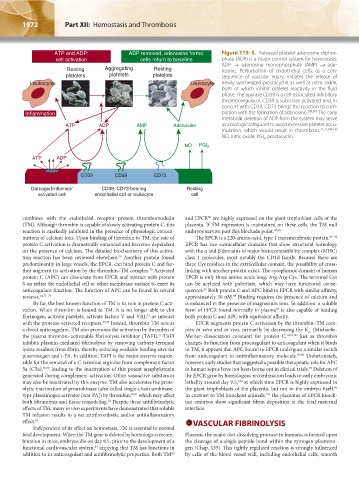
                          ATP and ADP:             ADP removed, adenosine forms:  Figure 115–5.  Released platelet adenosine diphos-
                           cell activation             cells return to baseline   phate (ADP) is a major control system for hemostasis:
                                                                                  ADP  → adenosine monophosphate (AMP)  → ade-
                              Resting      Aggregating     Resting                nosine. Perturbation of endothelial cells, as a con-
                              platelets      platelets     platelets              sequence of vascular injury, initiates the release of
                  Leukocyte                                             Leukocyte  newly synthesized prostacyclin as well as nitric oxide,
                                                                                  both of which inhibit platelet reactivity in the fluid
                                                                                  phase. The apyrase CD39 is a cell-associated inhibitory
                                                                                  thromboregulator. CD39 is substrate-activated and, in
                                                                                  concert with CD39, CD73 brings the reaction to com-
                Inflammation                                                      pletion with the formation of adenosine. 309,310  The early
                                                                                  metabolic deletion of ADP from the system may serve
                              ATP        ADP          AMP         Adenosine       as a biologic safeguard to avoid excessive platelet accu-
                                                                                  mulation, which would result in   thrombosis. 21,22,309,310
                                                                                  NO, nitric oxide; PGI , prostacyclin.
                                                                                                2
                                                                      NO   PGI 2

                   ATP     ADP

                                   CD39       CD39          CD73

                  Damaged/inflamed/       CD39, CD73-bearing           Resting
                     activated cell     endothelial cell or leukocyte   cell


               combines with the endothelial receptor protein thrombomodulin   and EPCR  are highly expressed on the giant trophoblast cells of the
                                                                              86
               (TM). Although thrombin is capable of slowly activating protein C, this   placenta. If TM expression is maintained on these cells, the TM null
               reaction is markedly inhibited in the presence of physiologic concen-  embryos survive past this blockade point. 87,88
               trations of calcium ions. Upon binding of thrombin to TM, the rate of   The EPCR is a 220-amino-acid, type 1 transmembrane protein. 89–92
               protein C activation is dramatically enhanced and becomes dependent   EPCR has two extracellular domains that show structural homology
               on the presence of calcium. The detailed biochemistry of this activa-  with the α and β domains of major histocompatibility complex (MHC)
               tion reaction has been reviewed elsewhere.  Another protein found   class 1 molecules, most notably the CD1d family. Because there are
                                                70
               predominantly in large vessels, the EPCR, can bind protein C and fur-  three Cys residues in the extracellular domain, the possibility of cross-
               ther augment its activation by the thrombin–TM complex.  Activated   linking with another protein exists. The cytoplasmic domain of human
                                                          70
               protein C (APC) can dissociate from EPCR and interact with protein   EPCR is only three amino acids long, Arg-Arg-Cys. The terminal Cys
               S on either the endothelial cell or other membrane surface to exert its   can be acylated with palmitate, which may have functional conse-
               anticoagulant function. The function of APC can be found in several   quences.  Both protein C and APC bind to EPCR with similar affinity,
                                                                            93
               reviews. 14,71–73                                      approximately 30 nM.  Binding requires the presence of calcium and
                                                                                      89
                   By far, the best known function of TM is its role in protein C acti-  is enhanced in the presence of magnesium ions. In addition, a soluble
               vation. When thrombin is bound to TM, it is no longer able to clot   form of EPCR found normally in plasma  is also capable of binding
                                                                                                    94
               fibrinogen, activate platelets, activate factors V and VIII,  or interact   both protein C and APC with equivalent affinity.
                                                         74
               with the protease-activated receptors. 75,76  Instead, thrombin-TM acts as   EPCR augments protein C activation by the thrombin–TM com-
               a direct anticoagulant. TM also promotes the activation by thrombin of   plex in vitro and in vivo, primarily by decreasing the K  (Michaelis-
                                                                                                               m
               the plasma thrombin-activatable fibrinolysis inhibitor (TAFI).  TAFI   Menten dissociation constant) for protein C. 70,95,96  Just as thrombin
                                                             77
               inhibits plasmin-mediated fibrinolysis by removing carboxy-terminal   changes its function from procoagulant to anticoagulant when it binds
               lysine residues from fibrin, thereby reducing available binding sites for   to TM, it appears that APC bound to EPCR undergoes a similar switch
               plasminogen and t-PA. In addition, TAFI is the major enzyme respon-  from anticoagulant to antiinflammatory molecule. 97,98  Unfortunately,
               sible for the removal of a C-terminal arginine from complement factor   however, early studies that suggested a possible therapeutic role for APC
               5a (C5a), 78,79  leading to the inactivation of this potent anaphylotoxin   in human sepsis have not been borne out in clinical trials.  Deletion of
                                                                                                               99
               generated during complement activation. Other vasoactive substances   the EPCR gene by homologous recombination leads to early embryonic
               may also be inactivated by this enzyme. TM also accelerates the prote-  lethality around day 9.5,  at which time EPCR is highly expressed in
                                                                                        100
               olytic inactivation of prourokinase (also called single-chain urokinase-  the giant trophoblasts of the placenta, but not in the embryo itself.
                                                                                                                        86
               type plasminogen activator [scu-PA]) by thrombin, 80,81  which may affect   In contrast to TM knockout animals,  the placentas of EPCR knock-
                                                                                                 101
               both fibrinolysis and tissue remodeling.  Despite these antifibrinolytic   out embryos show significant fibrin deposition at the fetal maternal
                                            82
               effects of TM, many in vivo experiments have demonstrated that soluble   interface.
               TM infusion results in a net antithrombotic and/or antiinflammatory
               effect. 83                                                VASCULAR FIBRINOLYSIS
                   Independent of its effect on hemostasis, TM is essential to normal
               fetal development. When the TM gene is deleted by homologous recom-  Plasmin, the major clot-dissolving protease in humans, is formed upon
               bination in mice, embryos die on day 8.5, prior to the development of a   the cleavage of a single peptide bond within the zymogen plasmino-
               functional cardiovascular system,  implying that TM has functions in   gen (Chap. 135). This tightly regulated reaction is strongly influenced
                                        84
               addition to its anticoagulant and antifibrinolytic properties. Both TM    by cells of the blood vessel wall, including endothelial cells, smooth
                                                                 85


          Kaushansky_chapter 115_p1967-1984.indd   1972                                                                 9/18/15   10:08 AM

