


Page 200 - Williams Hematology ( PDFDrive )
P. 200
174  Part IV:  Molecular and Cellular Hematology       Chapter 13:  Cytogenetics and Genetic Abnormalities            175


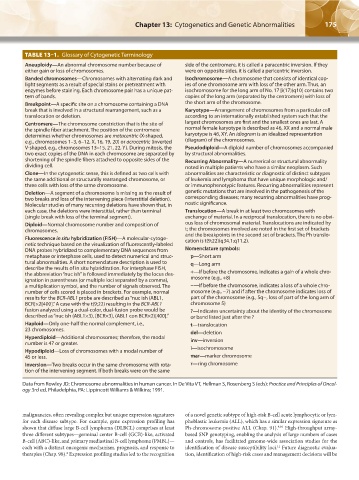
                   TABLE 13–1.  Glossary of Cytogenetic Terminology
                   Aneuploidy—An abnormal chromosome number because of   side of the centromere, it is called a paracentric inversion. If they
                   either gain or loss of chromosomes.                  were on opposite sides, it is called a pericentric inversion.
                   Banded chromosomes—Chromosomes with alternating dark and   Isochromosome—A chromosome that consists of identical cop-
                   light segments as a result of special stains or pretreatment with   ies of one chromosome arm with loss of the other arm. Thus, an
                   enzymes before staining. Each chromosome pair has a unique pat-  isochromosome for the long arm of No. 17 [i(17)(q10] contains two
                   tern of bands.                                       copies of the long arm (separated by the centromere) with loss of
                   Breakpoint—A specific site on a chromosome containing a DNA   the short arm of the chromosome.
                   break that is involved in a structural rearrangement, such as a   Karyotype—Arrangement of chromosomes from a particular cell
                   translocation or deletion.                           according to an internationally established system such that the
                   Centromere—The chromosome constriction that is the site of   largest chromosomes are first and the smallest ones are last. A
                   the spindle fiber attachment. The position of the centromere   normal female karyotype is described as 46, XX and a normal male
                   determines whether chromosomes are metacentric (X-shaped,   karyotype is 46, XY. An idiogram is an idealized representation
                   e.g., chromosomes 1–3, 6–12, X, 16, 19, 20) or acrocentric (inverted   (diagram) of the chromosomes.
                   V-shaped, e.g., chromosomes 13–15, 21, 22, Y). During mitosis, the   Pseudodiploid—A diploid number of chromosomes accompanied
                   two exact copies of the DNA in each chromosome are separated by   by structural abnormalities.
                   shortening of the spindle fibers attached to opposite sides of the   Recurring Abnormality—A numerical or structural abnormality
                   dividing cell.                                       noted in multiple patients who have a similar neoplasm. Such
                   Clone—In the cytogenetic sense, this is defined as two cells with   abnormalities are characteristic or diagnostic of distinct subtypes
                   the same additional or structurally rearranged chromosome, or   of leukemia and lymphoma that have unique morphologic and/
                   three cells with loss of the same chromosome.        or immunophenotypic features. Recurring abnormalities represent
                   Deletion—A segment of a chromosome is missing as the result of   genetic mutations that are involved in the pathogenesis of the
                   two breaks and loss of the intervening piece (interstitial deletion).   corresponding diseases; many recurring abnormalities have prog-
                   Molecular studies of many recurring deletions have shown that, in   nostic significance.
                   each case, the deletions were interstitial, rather than terminal    Translocation—A break in at least two chromosomes with
                   (single break with loss of the terminal segment).    exchange of material. In a reciprocal translocation, there is no obvi-
                   Diploid—Normal chromosome number and composition of   ous loss of chromosomal material. Translocations are indicated by
                   chromosomes.                                         t; the chromosomes involved are noted in the first set of brackets
                   Fluorescence in situ hybridization (FISH)—A molecular-cytoge-  and the breakpoints in the second set of brackets. The Ph translo-
                                                                        cation is t(9;22)(q34.1;q11.2).
                   netic technique based on the visualization of fluorescently-labeled
                   DNA probes hybridized to complementary DNA sequences from   Nomenclature symbols:
                   metaphase or interphase cells, used to detect numerical and struc-    p—Short arm
                   tural abnormalities. A short nomenclature description is used to     q—Long arm
                   describe the results of in situ hybridization. For interphase FISH,
                   the abbreviation “nuc ish” is followed immediately by the locus des-    +—If before the chromosome, indicates a gain of a whole chro-
                   ignation in parentheses (or multiple loci separated by a comma),   mosome (e.g., +8)
                   a multiplication symbol, and the number of signals observed. The      −—If before the chromosome, indicates a loss of a whole chro-
                   number of cells scored is placed in brackets. For example, normal   mosome (e.g., −7) and if after the chromosome indicates loss of
                   results for the BCR-ABL1 probe are described as “nuc ish (ABL1,   part of the chromosome (e.g., 5q−, loss of part of the long arm of
                   BCR)×2[400].” A case with the t(9;22) resulting in the BCR-ABL1   chromosome 5)
                   fusion analyzed using a dual-color, dual-fusion probe would be      ?—Indicates uncertainty about the identity of the chromosome
                   described as “nuc ish (ABL1×3), (BCR×3), (ABL1 con BCR×2)[400].”  or band listed just after the ?
                   Haploid—Only one-half the normal complement, i.e.,      t—translocation
                   23 chromosomes.                                        del—deletion
                   Hyperdiploid—Additional chromosomes; therefore, the modal     inv—inversion
                   number is 47 or greater.
                   Hypodiploid—Loss of chromosomes with a modal number of      i—isochromosome
                   45 or less.                                            mar—marker chromosome
                   Inversion—Two breaks occur in the same chromosome with rota-    r—ring chromosome
                   tion of the intervening segment. If both breaks were on the same

                  Data from Rowley JD: Chromosome abnormalities in human cancer. In De Vita VT, Hellman S, Rosenberg S (eds): Practice and Principles of Oncol-
                  ogy 3rd ed. Philadelphia, PA: Lippincott Williams & Wilkins; 1991.


                  malignancies, often revealing complex but unique expression signatures   of a novel genetic subtype of high-risk B-cell acute lymphocytic or lym-
                  for each disease subtype. For example, gene expression profiling has   phoblastic leukemia (ALL), which has a similar expression signature as
                  shown that diffuse large B-cell lymphoma (DLBCL) comprises at least   Ph-chromosome-positive ALL (Chap. 91).  High-throughput array-
                                                                                                       9,10
                  three different subtypes—germinal center B-cell (GCB)-like, activated   based SNP genotyping, enabling the analysis of large numbers of cases
                  B-cell (ABC)-like, and primary mediastinal B-cell lymphoma (PMBL)—  and controls, has facilitated genome-wide association studies for the
                  each with a distinct oncogenic mechanism, prognosis, and response to   identification of disease susceptibility loci.  Future diagnostic evalua-
                                                                                                       11
                  therapies (Chap. 98).  Expression profiling studies led to the recognition   tion, identification of high-risk cases and management decisions will be
                                 8


          Kaushansky_chapter 13_p0173-0190.indd   175                                                                   17/09/15   6:32 pm

