


Page 205 - Williams Hematology ( PDFDrive )
P. 205
180            Part IV:  Molecular and Cellular Hematology                                                                                                         Chapter 13:  Cytogenetics and Genetic Abnormalities             181


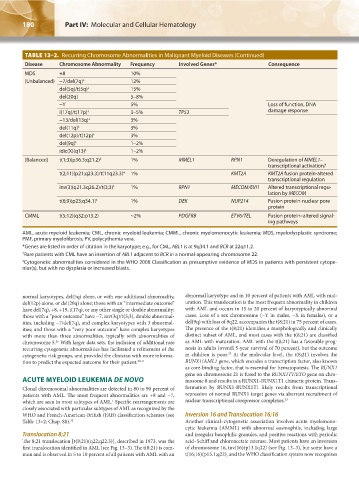
                TABLE 13–2.  Recurring Chromosome Abnormalities in Malignant Myeloid Diseases (Continued)
                Disease     Chromosome Abnormality  Frequency       Involved Genes*               Consequence
                MDS         +8                      10%
                (Unbalanced) −7/del(7q) ‡           12%
                            del(5q)/t(5q) ‡         15%
                            del(20q)                5–8%
                            −Y                      5%                                            Loss of function, DNA
                            i(17q)/t(17p) ‡         3–5%            TP53                          damage response
                            −13/del(13q) ‡          3%
                            del(11q) ‡              3%
                            del(12p)/t(12p) ‡       3%
                            del(9q) ‡               1–2%
                            idic(X)(q13) ‡          1–2%
                (Balanced)  t(1;3)(p36.3;q21.2)   ‡  1%             MMEL1            RPN1         Deregulation of MMEL1–
                                                                                                  transcriptional activation?
                            t(2;11)(p21;q23.3)/t(11q23.3)   1%                       KMT2A        KMT2A fusion protein-altered
                                                 ‡
                                                                                                  transcriptional regulation
                            inv(3)(q21.3q26.2)/t(3;3)    1%         RPN1             MECOM/EVI1   Altered transcriptional regu-
                                              ‡
                                                                                                  lation by MECOM
                            t(6;9)(p23;q34.1) ‡     1%              DEK              NUP214       Fusion protein-nuclear pore
                                                                                                  protein
                CMML        t(5;12)(q32;p13.2)      ~2%             PDGFRB           ETV6/TEL     Fusion protein–altered signal-
                                                                                                  ing pathways
               AML, acute myeloid leukemia; CML, chronic myeloid leukemia; CMML, chronic myelomonocytic leukemia; MDS, myelodysplastic syndrome;
               PMF, primary myelofibrosis; PV, polycythemia vera.
               *Genes are listed in order of citation in the karyotype; e.g., for CML, ABL1 is at 9q34.1 and BCR at 22q11.2.
               † Rare patients with CML have an insertion of ABL1 adjacent to BCR in a normal-appearing chromosome 22.
               ‡ Cytogenetic abnormalities considered in the WHO 2008 Classification as presumptive evidence of MDS in patients with persistent cytope-
               nias(s), but with no dysplasia or increased blasts.


               normal karyotypes, del(5q) alone, or with one additional abnormality,   abnormal karyotype and in 10 percent of patients with AML with mat-
               del(12p) alone, or del(20q) alone; those with an “intermediate outcome”   uration. This translocation is the most frequent abnormality in children
               have del(7q), +8, +19, i(17q), or any other single or double abnormality;   with AML and occurs in 15 to 20 percent of karyotypically abnormal
               those with a “poor outcome” have −7, inv(3q)/t(3;3), double abnormal-  cases. Loss of a sex chromosome (−Y in males, −X in females), or a
               ities, including −7/del(7q), and complex karyotypes with 3 abnormal-  del(9q) with loss of 9q22, accompanies the t(8;21) in 75 percent of cases.
               ities; and those with a “very poor outcome” have complex karyotypes   The presence of the t(8;21) identifies a morphologically and clinically
               with more  than three abnormalities, typically with abnormalities of   distinct subset of AML, and most cases with the t(8;21) are classified
               chromosome 5.  With larger data sets, the inclusion of additional rare   as AML with maturation. AML with the t(8;21) has a favorable prog-
                           26
               recurring cytogenetic abnormalities has facilitated a refinement of the   nosis in adults (overall 5-year survival of 70 percent), but the outcome
                                                                                    33
               cytogenetic risk groups, and provided the clinician with more informa-  in children is poor.  At the molecular level, the t(8;21) involves the
               tion to predict the expected outcome for their patient. 30,31  RUNX1/AML1 gene, which encodes a transcription factor, also known
                                                                      as core-binding factor, that is essential for hematopoiesis. The RUNX1
                                                                      gene on chromosome 21 is fused to the RUNX1T1/ETO gene on chro-
               ACUTE MYELOID LEUKEMIA DE NOVO                         mosome 8 and results in a RUNX1-RUNX1T1 chimeric protein. Trans-
               Clonal chromosomal abnormalities are detected in 80 to 90 percent of   formation by RUNX1-RUNX1T1 likely results from transcriptional
               patients with AML. The most frequent abnormalities are +8 and −7,   repression of normal RUNX1 target genes via aberrant recruitment of
               which are seen in most subtypes of AML.  Specific rearrangements are   nuclear transcriptional corepressor complexes. 33
                                             1
               closely associated with particular subtypes of AML as recognized by the
               WHO and French-American-British (FAB) classification schemes (see   Inversion 16 and Translocation 16;16
               Table  13–2; Chap. 88). 32                             Another clinical–cytogenetic association involves acute myelomono-
                                                                      cytic leukemia (AMML) with abnormal eosinophils, including large
               Translocation 8;21                                     and irregular basophilic granules, and positive reactions with periodic
               The 8;21 translocation [t(8;21)(q22;q22.3)], described in 1973, was the   acid–Schiff and chloroacetate esterase. Most patients have an inversion
               first translocation identified in AML (see Fig. 13–3). The t(8;21) is com-  of chromosome 16, inv(16)(p13.1q22) (see Fig. 13–3), but some have a
               mon and is observed in 5 to 10 percent of all patients with AML with an   t(16;16)(p13.1;q22), and the WHO classification system now recognizes


          Kaushansky_chapter 13_p0173-0190.indd   180                                                                   17/09/15   6:32 pm

