


Page 2004 - Williams Hematology ( PDFDrive )
P. 2004
1978  Part XII:  Hemostasis and Thrombosis                    Chapter 115:  Vascular Function In Hemostasis          1979


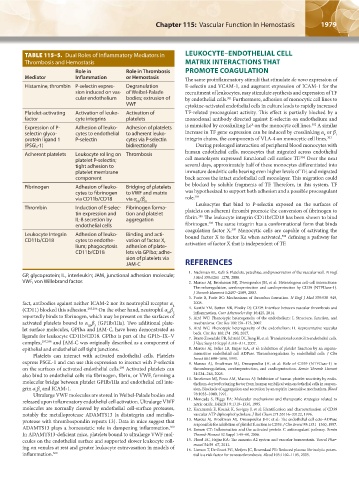
                   TABLE 115–5.  Dual Roles of Inflammatory Mediators in   LEUKOCYTE–ENDOTHELIAL CELL
                   Thrombosis and Hemostasis                            MATRIX INTERACTIONS THAT
                                    Role in          Role in Thrombosis   PROMOTE COAGULATION
                   Mediator         Inflammation     or Hemostasis      The same proinflammatory stimuli that stimulate de novo expression of
                   Histamine, thrombin P-selectin expres-  Degranulation   E-selectin and VCAM-1, and augment expression of ICAM-1 for the
                                    sion induced on vas- of Weibel-Palade   recruitment of leukocytes, may stimulate synthesis and expression of TF
                                    cular endothelium  bodies; extrusion of   by endothelial cells.  Furthermore, adhesion of monocytic cell lines to
                                                                                      301
                                                     VWF                cytokine-activated endothelial cells in culture leads to rapidly increased
                   Platelet-activating   Activation of leuko-  Activation of   TF-related procoagulant activity. This effect is partially blocked by a
                   factor           cyte integrins   platelets          monoclonal antibody directed against E-selectin on endothelium and
                                                                                               X
                                                                                                                   302
                   Expression of P-     Adhesion of leuko-  Adhesion of platelets   is mimicked by crosslinking Le  on the monocyte cell lines.  A similar
                   selectin glyco-  cytes to endothelial   to adherent leuko-  increase in TF gene expression can be induced by crosslinking α  or β
                                                                                                                       4
                                                                                                                           1
                   protein ligand 1   P-selectin     cytes via P-selectin   integrin chains, the components of VLA-4 on monocytic cell lines. 303
                   (PSGL-1)                          bidirectionally        During prolonged interaction of peripheral blood monocytes with
                                                                        human endothelial cells, monocytes that migrated across endothelial
                   Adherent platelets  Leukocyte rolling on  Thrombosis                                        304
                                    platelet P-selectin;                cell monolayers expressed functional cell surface TF.  Over the next
                                    tight adhesion to                   several days, approximately half of these monocytes differentiated into
                                    platelet membrane                   immature dendritic cells bearing even higher levels of TF, and migrated
                                    component                           back across the intact endothelial cell monolayer. This migration could
                   Fibrinogen       Adhesion of leuko-  Bridging of platelets   be blocked by soluble fragments of TF. Therefore, in this system, TF
                                    cytes to fibrinogen   to VWF and matrix   was hypothesized to support both adhesion and a possible procoagulant
                                    via CD11b/CD18   via α /β           role. 304
                                                        IIb  III            Leukocytes  that  bind to  P-selectin  exposed  on  the surfaces  of
                   Thrombin         Induction of E-selec- Fibrinogen forma-  platelets on adherent thrombi promote the conversion of fibrinogen to
                                    tin expression and   tion and platelet   305
                                    IL-8 secretion by   aggregation     fibrin.  The leukocyte integrin CD11b/CD18 has been shown to bind
                                                                                306
                                    endothelial cells                   fibrinogen.  The same integrin has a conformational form that binds
                                                                        coagulation factor X.  Monocytic cells are capable of activating the
                                                                                        307
                   Leukocyte Integrin   Adhesion of leuko-  Binding and acti-  bound factor X to factor Xa when activated,  defining a pathway for
                                                                                                         308
                   CD11b/CD18       cytes to endothe-  vation of factor X,   activation of factor X that is independent of TF.
                                    lium; phagocytosis   adhesion of plate-
                                    CD11b/CD18       lets via GPIbα; adhe-
                                                     sion of platelets via
                                                     JAM-C              REFERENCES
                                                                          1.  Nachman RL, Rafii S: Platelets, petechiae, and preservation of the vascular wall. N Engl
                  GP, glycoprotein; IL, interleukin; JAM, junctional adhesion molecule;   J Med 359:1261–1270, 2008.
                  VWF, von Willebrand factor.                             2.  Marcus AJ, Broekman MJ, Drosopoulos JH, et al: Heterologous cell-cell interactions:
                                                                           Thromboregulation, cerebroprotection and cardioprotection by CD39 (NTPDase-1).
                                                                           J Thromb Haemost 1:2497–2509, 2003.
                                                                          3.  Furie B, Furie BC: Mechanisms of thrombus formation. N Engl J Med 359:938–949,
                  fact, antibodies against neither ICAM-2 nor its neutrophil receptor α    2008.
                                                                    L
                  (CD11) blocked this adhesion. 295,296  On the other hand, neutrophil α β      4.  Kanthi YM, Sutton NR, Pinsky DJ: CD39: Interface between vascular thrombosis and
                                                                  M 2
                                                                           inflammation. Curr Atheroscler Rep 16:425, 2014.
                  reportedly binds to fibrinogen, which may be present on the surfaces of     5.  Aird WC: Phenotypic heterogeneity of the endothelium: I. Structure, function, and
                  activated platelets bound to α β  (GPIIb/IIIa). Two additional plate-  mechanisms. Circ Res 100:158–173, 2007.
                                        IIb 3
                  let surface molecules, GPIbα and JAM-C, have been demonstrated as     6.  Aird WC: Phenotypic heterogeneity of the endothelium: II. Representative vascular
                                                                           beds. Circ Res 100:174–190, 2007.
                  ligands for leukocyte CD11b/CD18. GPIbα is part of the GP1b–IX–V     7.  Brant-Zawadzki PB, Schmid DI, Jiang H, et al: Translational control in endothelial cells.
                  complex, 297,298  and JAM-C was originally described as a component of   J Vasc Surg 45 Suppl A:A8–A14, 2007.
                  epithelial and endothelial cell tight junctions.        8.  Marcus AJ, Safier LB, Hajjar KA, et al: Inhibition of platelet function by an aspirin-
                     Platelets can interact with activated endothelial cells. Platelets   insensitive endothelial cell ADPase. Thromboregulation by endothelial cells.  J Clin
                                                                           Invest 88:1690–1696, 1991.
                  express PSGL-1 and can use this expression to interact with P-selectin     9.  Marcus AJ, Broekman MJ, Drosopoulos JH, et al: Role of CD39 (NTPDase-1) in
                  on the surfaces of activated endothelial cells.  Activated platelets can   thromboregulation,  cerebroprotection,  and  cardioprotection.  Semin Thromb Hemost
                                                  299
                  also bind to endothelial cells via fibrinogen, fibrin, or VWF, forming a   31:234–246, 2005.
                  molecular bridge between platelet GPIIb/IIIa and endothelial cell inte-    10.  Broekman MJ, Eiroa AM, Marcus AJ: Inhibition of human platelet reactivity by endo-
                                                                           thelium-derived relaxing factor from human umbilical vein endothelial cells in suspen-
                  grin α β  and ICAM-1.                                    sion. Blockade of aggregation and secretion by an aspirin-insensitive mechanism. Blood
                      v 3
                     Ultralarge VWF molecules are stored in Weibel-Palade bodies and   78:1033–1040, 1991.
                  released upon inflammatory endothelial cell activation. Ultralarge VWF     11.  Moncada S, Higgs EA: Molecular mechanisms and therapeutic strategies related to
                                                                           nitric oxide. FASEB J 9:1319–1330, 1995.
                  molecules are normally cleaved by endothelial cell-surface proteases,     12.  Kaczmarek E, Koziak K, Sevigny J, et al: Identification and characterization of CD39
                  notably the metalloprotease ADAMTS13 (a disintegrin and metallo-  vascular ATP diphosphohydrolase. J Biol Chem 271:33116–33122, 1996.
                  protease with thrombospondin repeats 13). Data in mice suggest that     13.  Marcus AJ, Broekman MJ, Drosopoulos JHF, et al: The endothelial cell ecto-ADPase
                                                                           responsible for inhibition of platelet function is CD39. J Clin Invest 99:1351–1360, 1997.
                  ADAMTS13 plays a homeostatic role in dampening inflammation.       14.  Esmon CT: Inflammation and the activated protein C anticoagulant pathway. Semin
                                                                   300
                  In ADAMTS13-deficient mice, platelets bound to ultralarge VWF mol-  Thromb Hemost 32 Suppl 1:49–60, 2006.
                  ecules on the endothelial surface and supported slower leukocyte roll-    15.  Flood EC, Hajjar KA: The annexin A2 system and vascular homeostasis. Vascul Phar-
                                                                           macol 54:59–67, 2011.
                  ing on venules at rest and greater leukocyte extravasation in models of     16.  Lisman T, De Groot PG, Meijers JC, Rosendaal FR: Reduced plasma fibrinolytic poten-
                  inflammation. 300                                        tial is a risk factor for venous thrombosis. Blood 105:1102–1105, 2005.

          Kaushansky_chapter 115_p1967-1984.indd   1979                                                                 9/18/15   10:09 AM

