


Page 2000 - Williams Hematology ( PDFDrive )
P. 2000
1974  Part XII:  Hemostasis and Thrombosis                    Chapter 115:  Vascular Function In Hemostasis          1975


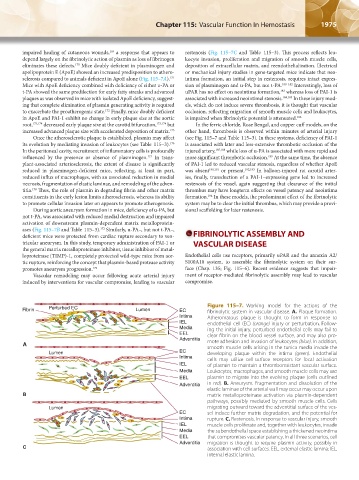
                  impaired healing of cutaneous wounds,  a response that appears to   restenosis (Fig. 115–7C and Table  115–3). This process reflects leu-
                                               169
                  depend largely on the fibrinolytic action of plasmin as loss of fibrinogen   kocyte  invasion,  proliferation  and  migration  of  smooth  muscle  cells,
                  eliminates these defects.  Mice doubly deficient in plasminogen and   deposition of extracellular matrix, and reendothelialization. Electrical
                                   170
                  apolipoprotein E (ApoE) showed an increased predisposition to athero-  or mechanical injury studies in gene-targeted mice indicate that neo-
                                                                   171
                  sclerosis compared to animals deficient in ApoE alone (Fig. 115–7A).    intima formation, an initial step in restenosis, requires intact expres-
                  Mice with ApoE deficiency combined with deficiency of either u-PA or   sion of plasminogen and u-PA, but not t-PA. 180–182  Interestingly, loss of
                                                                                                        183
                  t-PA showed the same predilection for early fatty streaks and advanced   uPAR has no effect on neointima formation,  whereas loss of PAI-1 is
                  plaques as was observed in mice with isolated ApoE deficiency, suggest-  associated with increased neointimal stenosis. 184,185  In these injury mod-
                  ing that complete elimination of plasmin generating activity is required   els, which do not induce severe thrombosis, it is thought that vascular
                                              172
                  to exacerbate the proatherogenic state.  Finally, mice doubly deficient   occlusion, reflecting migration of smooth muscle cells and leukocytes,
                  in ApoE and PAI-1 exhibit no change in early plaque size at the aortic   is impaired when fibrinolytic potential is attenuated. 186
                  root, 173,174  decreased early plaque size at the carotid bifurcation, 173,174  but   In the ferric chloride, Rose Bengal, and copper cuff models, on the
                  increased advanced plaque size with accelerated deposition of matrix. 175  other hand, thrombosis is observed within minutes of arterial injury
                     Once the atherosclerotic plaque is established, plasmin may affect   (see Fig. 115–7 and Table  115–3). In these systems, deficiency of PAI-1
                  its evolution by mediating invasion of leukocytes (see Table  115–3).    is associated with later and less-extensive thrombotic occlusion of the
                                                                   176
                  In the peritoneal cavity, recruitment of inflammatory cells is profoundly   injured artery, 187,188  while loss of u-PA is associated with more rapid and
                                                            177
                  influenced by the presence or absence of plasminogen.  In trans-  more significant thrombotic occlusion.  At the same time, the absence
                                                                                                    189
                  plant-associated arteriosclerosis, the extent of disease is significantly   of PAI-1 led to reduced vascular stenosis, regardless of whether ApoE
                  reduced in plasminogen-deficient mice, reflecting, at least in part,   was absent 190,191  or present. 192,193  In balloon-injured rat carotid arter-
                  reduced influx of macrophages, with an associated reduction in medial   ies, finally, transduction of a PAI-1–expressing gene led to increased
                  necrosis, fragmentation of elastic laminae, and remodeling of the adven-  restenosis  of  the  vessel,  again  suggesting  that  clearance  of  the  initial
                     178
                  titia.  Thus, the role of plasmin in degrading fibrin and other matrix   thrombus may have longterm effects on vessel patency and neointima
                  constituents in the early lesion limits atherosclerosis, whereas its ability   formation.  In these models, the predominant effect of the fibrinolytic
                                                                                194
                  to promote cellular invasion later on appears to promote atherogenesis.  system may be to clear the initial thrombus, which may provide a provi-
                     During aortic aneurysm formation in mice, deficiency of u-PA, but   sional scaffolding for later restenosis.
                  not t-PA, was associated with reduced medial destruction and impaired
                  activation of downstream plasmin-dependent matrix metalloprotein-
                  ases (Fig. 115–7B and Table  115–3).  Similarly, u-PA–, but not t-PA–,
                                            172
                  deficient mice were protected from cardiac rupture secondary to ven-    FIBRINOLYTIC ASSEMBLY AND
                  tricular aneurysm. In this study, temporary administration of PAI-1 or   VASCULAR DISEASE
                  the general matrix metalloproteinase inhibitor, tissue inhibitor of metal-
                  loproteinase (TIMP)-1, completely protected wild-type mice from aor-  Endothelial cells use receptors, primarily uPAR and the annexin A2/
                  tic rupture, reinforcing the concept that plasmin-based protease activity   S100A10 system, to assemble the fibrinolytic system on their sur-
                  promotes aneurysm progression. 179                    face (Chap. 135; Fig. 115–6).  Recent evidence suggests that impair-
                     Vascular remodeling may occur following acute arterial injury   ment of receptor-mediated fibrinolytic assembly may lead to vascular
                  induced by interventions for vascular compromise, leading to vascular   compromise.


                  Fibrin   Perturbed EC                 Lumen         EC        Figure 115–7.  Working model for the actions of the
                                                                                fibrinolytic system in vascular disease. A. Plaque formation.
                                                                      Intima    Atheromatous plaque is thought to form in response to
                                                                      IEL       endothelial cell (EC) (orange) injury or perturbation. Follow-
                                                                      Media     ing the initial injury, perturbed endothelial cells may fail to
                                                                      EEL       clear fibrin on the blood vessel surface, and may also pro-
                                                                      Adventitia
                  A                                                             mote adhesion and invasion of leukocytes (blue). In addition,
                                                                                smooth muscle cells arising in the tunica media invade the
                           Lumen                                      EC        developing plaque within the intima  (green). Endothelial
                                                                      Intima    cells may utilize cell-surface receptors for focal activation
                                                                      IEL       of plasmin to maintain a thromboresistant vascular surface.
                                                                      Media     Leukocytes, macrophages, and smooth muscle cells may use
                                                                      EEL       plasmin to migrate into the evolving plaque (cells outlined
                                                                      Adventitia  in red). B. Aneurysm. Fragmentation and dissolution of the
                                                                                elastic laminae of the arterial wall may occur may occur upon
                  B                                                             matrix metalloproteinase activation via plasmin-dependent
                                                                                pathways, possibly mediated by smooth muscle cells. Cells
                           Lumen                                                migrating outward toward the adventitial surface of the ves-
                                                                      EC        sel induce further matrix degradation, and the potential for
                                                                      Intima    rupture. C. Restenosis. In response to vascular injury, smooth
                                                                      IEL       muscle cells proliferate and, together with leukocytes, invade
                                                                      Media     the subendothelial space establishing a thickened neointima
                                                                      EEL       that compromises vascular patency. In all three scenarios, cell
                                                                      Adventitia  migration is thought to require plasmin activity, possibly in
                  C                                                             association with cell surfaces. EEL, external elastic lamina; IEL,
                                                                                internal elastic lamina.


          Kaushansky_chapter 115_p1967-1984.indd   1975                                                                 9/18/15   10:08 AM

