


Page 1999 - Williams Hematology ( PDFDrive )
P. 1999
1974           Part XII:  Hemostasis and Thrombosis                                                                                                                       Chapter 115:  Vascular Function In Hemostasis          1975


               PAI-1 mRNA production by cultured endothelial cells, but has no effect   TABLE 115–3.  The Fibrinolytic System in Cardiovascular
                     138
               on t-PA.  Thus, synthesis and secretion of PAI-1 by the endothelial cell
               in vitro appears to be regulated independently of t-PA.  Disease—Transgenic Mouse Models
                   In vivo, elevated levels of circulating PAI-1 have been linked epi-  Genotype  Result      Reference(s)
                                                   124
               demiologically to risk for myocardial infarction.  Although the liver   Atherogenesis:
               is the major source of plasma PAI-1, endothelial expression of PAI-1 is   –/–  –/–
               detected near neovascular sprouts during decidual neovascularization   PLG  ApoE  Increased atherogenesis  178
                        128
               in the ovary.  In addition, inflammatory cytokines are powerful stimuli   t-PA  ApoE –/–  Unchanged atherogenesis  179
                                                                          –/–
               for induction of PAI-1 in a variety of tissues including liver, as injection   u-PA  ApoE –/–  Unchanged atherogenesis  179
                                                                          –/–
               of TNF in both rats and humans with active malignancy results in a   –/–  –/–
               striking increase plasma concentrations of PAI-1. 105,123  PAI-1  ApoE  Decrease in early plaque size;   180–182
                                                                                    increase in advanced plaque size
                   The endothelial cell coreceptor for t-PA and plasminogen, the
               annexin A2/S100A10 complex (see Fig. 115–6), appears to be expressed   Transplant arteriosclerosis:
               constitutively in vivo by endothelial cells in a wide variety of tissues in   PLG –/–  Reduced leukocyte invasion in   185
                                    141
                                               142
                                140
               the chicken,  mouse,  rat,  and human.  Annexin A2 is upregu-        transplantation model; reduced
                        139
               lated transcriptionally by hypoxia both in vivo and in endothelial cells   extent of disease
               in vitro,  and by nerve growth factor in neuronal-like PC12 cells.  In   Coronary ligation:
                     143
                                                               144
               addition, the in vitro transition of human monocyte to macrophage is
               associated with a severalfold increase in both annexin A2 protein and   u-PA –/–  Protection from ventricular rup-  186
               steady state mRNA expression. 145                                    ture; but poor revascularization
                                                                                    and late death from heart failure
                   The evidence that the annexin A2 system plays a role in main-
               taining vascular patency includes the findings that (1) overexpression   t-PA –/–  No protection  186
               of annexin A2 in blast cells in acute promyelocytic leukemia blast cells   uPAR –/–  No protection  186
               increases plasmin production and contributes to hyperfibrinolytic
               bleeding, 146–149  (2) systemic injection of annexin A2 diminishes throm-  Aortic aneurysm:
                                                                          –/–
               botic vascular occlusion resulting from vascular injury in experimen-  u-PA  ApoE –/–  Protected  179
                        150
               tal animals,  (3) annexin A2–deficient mice display fibrin deposition   t-PA  ApoE –/–  Not protected  179
                                                                          –/–
               on microvessels and impaired clearance of arterial thrombi following
                          151
               vascular injury,  (4) high titer antibodies directed against annexin A2   Early oxidative injury:
               are associated with thrombosis in antiphospholipid syndrome and in   PAI-1 –/–  Attenuated thrombotic occlu-  194
               individuals with cerebral venous thrombosis, 152,153  and (5) that polymor-  sion (Rose Bengal)
               phisms in the ANXA2 gene are associated with cerebral vascular occlu-  PAI-1 –/–  Attenuated thrombotic occlu-  195
               sion and osteonecrosis of bone in patients with sickle cell disease. 154–156    sion (FeCl )
                                                                                           3
               Whether defects in S100A10, which could serve either as a chaperone   u-PA –/–  Increased thrombosis (FeCl )  196
                                                         157
               for annexin A2 or as a direct binding site for plasminogen,  might also                  3
               be associated with these clinical entities remains to be determined.  t-PA –/–  Increased thrombosis (FeCl )  196
                                                                                                        3
                                                                       A2 –/–       Increased thrombosis (FeCl )  155
                                                                                                        3
               NONFIBRINOLYTIC VASCULAR FUNCTIONS                      Restenosis with prominent thrombosis:
               OF PLASMIN                                              PAI-1 –/–    No neointima (Cu cuff)    199
               Although not yet demonstrated in vivo, plasmin may inactivate factor   PAI-1 –/–  Reduced neointima (ligation)  317
               Va in vitro by cleaving both the heavy and light chains of this 168-kDa   PAI-1 –/–  Reduced neointima (FeCl )  317
               protein, in a manner that is distinct from the action of activated protein              3
                                                                           –/–
               C. 158,159  Plasmin can also inactivate factor VIIIa, a procoagulant cofactor   PAI-1  ApoE –/–  Reduced neointima (FeCl )  198
                                                                                                       3
               that is structurally related to factor Va.  In addition, platelet GPIIb/IIIa   Restenosis without prominent thrombosis:
                                           160
               and GPIb, the cell surface receptors for fibrinogen and VWF, respec-  PLG –/–  Reduced neointima (electrical)  187, 188
               tively, are both plasmin substrates. 161,162  Thus, plasmin formation in the
               vicinity of a hemostatic plug could lead to impaired adhesion and poor   t-PA –/–  No change (electrical or   187, 189
               aggregation in response to agonists. In vivo, prolonged bleeding times   mechanical)
               were found in patients 90 minutes after t-PA infusion for thrombolysis,   u-PA –/–  Reduced neointima (electrical or  187, 189
               suggesting early impairment of platelet function upon plasmin gen-   mechanical)
               eration.  However, there is also evidence that platelets may promote   u-PA  t-PA –/–  Reduced neointima (electrical or  187, 189
                     163
                                                                          –/–
               thrombotic reocclusion following successful thrombolytic therapy. 164  mechanical)
                                                                       uPAR –/–     No change (electrical)    190
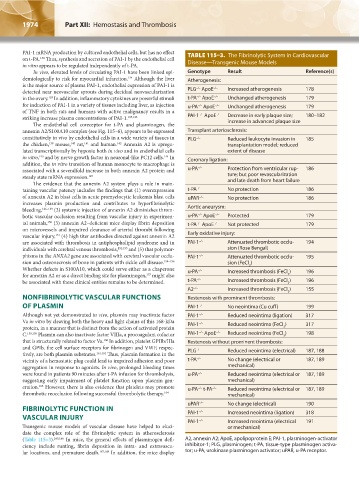
               FIBRINOLYTIC FUNCTION IN                                PAI-1 –/–    Increased neointima (ligation)  318
               VASCULAR INJURY                                         PAI-1 –/–    Increased neointima (electrical   191
               Transgenic  mouse models  of vascular  disease  have  helped  to  eluci-  or mechanical)
               date the complex role of the fibrinolytic system in atherosclerosis
               (Table 115–3). 165,166  In mice, the general effects of plasminogen defi-  A2, annexin A2; ApoE, apolipoprotein E; PAI-1, plasminogen-activator
               ciency include runting, fibrin deposition in intra- and extravascu-  inhibitor-1; PLG, plasminogen; t-PA, tissue-type plasminogen activa-
               lar locations, and premature death. 167,168  In addition, the mice display   tor; u-PA, urokinase plasminogen activator; uPAR, u-PA receptor.


          Kaushansky_chapter 115_p1967-1984.indd   1974                                                                 9/18/15   10:08 AM

