


Page 2002 - Williams Hematology ( PDFDrive )
P. 2002
1976  Part XII:  Hemostasis and Thrombosis                    Chapter 115:  Vascular Function In Hemostasis          1977


                  inflammation, as well as to CD34 constitutively expressed by cells of the   lymph nodes and Peyer patches, has structural features of both a
                  high endothelial venules.                             mucin and an immunoglobulin superfamily molecule. It can bind both
                     Adhesion of leukocytes to the endothelium at the site of inflamma-  L-selectin and the leukocyte integrin  α β , expressed by a subset of
                                                                                                      4 7
                  tion results in their rolling along the luminal surface, which slows their   memory T cells. It is believed to interact with L-selectin through its
                  movement and brings them into contact with a wide variety of chemi-  mucin (carbohydrate) domain and with α β  through its immunoglob-
                                                                                                       4 7
                  cal mediators that trigger the next stage of leukocyte emigration—tight   ulin domains. Until recently, identified protein ligands for L-selectin
                  adhesion to the endothelial surface. These mediators include sur-  (MAdCAM-1 and CD34) have been demonstrated to bind to L-selectin
                                    246
                  face-bound chemokines,  new adhesion molecules expressed by the   only in the context of lymphocyte homing, although recent evidence
                                                        247
                                                                                                                          255
                  endothelium in response to inflammatory cytokines,  PAF,  soluble   now suggests that they may play a role in rolling during inflammation.
                                                              248
                  chemokines,  and ligands that crosslink leukocyte CD31 250–252  and   Interestingly, intravital microscopy shows that leukocytes may roll on
                           249
                  seem to work by stimulating the activation of leukocyte integrin adhe-  already adherent leukocytes and platelets through the interactions of
                  sion molecules by so-called inside-out signaling. This process involves   L-selectin and PSGL-1 to amplify the inflammatory process. 256,257
                  a conformational change and/or clustering of the two chains of these   PAF is made and secreted acutely by leukocytes, mast cells, and
                  heterodimeric surface molecules such that the affinity or avidity, respec-  endothelial cells at the site of inflammation. PAF (1-alkyl-2-acetyl-sn-
                                                                   253
                  tively, for their ligands on the surfaces of endothelial cells is increased.    glycero-3-phosphocholine) is produced enzymatically from phosphati-
                  The ligands identified are members of a third family of adhesion mole-  dyl choline in the plasma membrane. Although its role as an activator of
                  cules, the immunoglobulin gene superfamily. 254       neutrophils in this environment has been established,  it appears to be
                                                                                                               248
                     Table 115–4 lists some of the more common leukocyte/endothelial   a relatively weak agonist of platelet activation in this location.
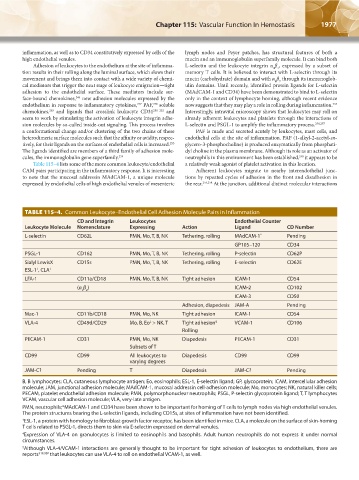
                  CAM pairs participating in the inflammatory response. It is interesting   Adherent  leukocytes  migrate  to  nearby  interendothelial  junc-
                  to note that the mucosal addressin MAdCAM-1, a unique molecule   tions by repeated cycles of adhesion in the front and disadhesion in
                  expressed by endothelial cells of high endothelial venules of mesenteric   the rear. 254,258  At the junction, additional distinct molecular interactions


                   TABLE 115–4.  Common Leukocyte–Endothelial Cell Adhesion Molecule Pairs in Inflammation
                                    CD and Integrin   Leukocytes                         Endothelial Counter
                   Leukocyte Molecule  Nomenclature   Expressing       Action            Ligand            CD Number
                   L-selectin       CD62L             PMN, Mo, T, B, NK  Tethering, rolling  MAdCAM-1 *    Pending
                                                                                         GP105–120         CD34
                   PSGL-1           CD162             PMN, Mo, T, B, NK  Tethering, rolling  P-selectin    CD62P
                   Sialyl LewisX    CD15s             PMN, Mo, T, B, NK  Tethering, rolling  E-selectin    CD62E
                       †
                   ESL-1 , CLA †
                   LFA-1            CD11a/CD18        PMN, Mo, T, B, NK  Tight adhesion  ICAM-1            CD54
                                    (α β )                                               ICAM-2            CD102
                                      L 2
                                                                                         ICAM-3            CD50
                                                                       Adhesion, diapedesis JAM-A          Pending
                   Mac-1            CD11b/CD18        PMN, Mo, NK      Tight adhesion    ICAM-1            CD54
                   VLA-4            CD49d/CD29        Mo, B, Eo  > NK, T  Tight adhesion §  VCAM-1         CD106
                                                             ‡
                                                                       Rolling
                   PECAM-1          CD31              PMN, Mo, NK      Diapedesis        PECAM-1           CD31
                                                      Subsets of T
                   CD99             CD99              All leukocytes to   Diapedesis     CD99              CD99
                                                      varying degrees
                   JAM-C?           Pending           T                Diapedesis        JAM-C?            Pending

                  B, B lymphocytes; CLA, cutaneous lymphocyte antigen; Eo, eosinophils; ESL-1, E-selectin ligand; GP, glycoprotein; ICAM, intercellular adhesion
                  molecule; JAM, junctional adhesion molecule; MAdCAM-1, mucosal addressin cell-adhesion molecule; Mo, monocytes; NK, natural killer cells;
                  PECAM, platelet endothelial adhesion molecule; PMN, polymorphonuclear neutrophils; PSGL, P-selectin glycoprotein ligand; T, T lymphocytes
                  VCAM, vascular cell adhesion molecule; VLA, very-late antigen.
                  PMN, neutrophils;*MAdCAM-1 and CD34 have been shown to be important for homing of T cells to lymph nodes via high endothelial venules.
                  The protein structures bearing the L-selectin ligands, including CD15s, at sites of inflammation have not been identified.
                  † ESL-1, a protein with homology to fibroblast growth factor receptor, has been identified in mice. CLA, a molecule on the surface of skin-homing
                  T cells related to PSGL-1, directs them to skin via E-selectin expressed on dermal venules.
                  ‡ Expression of VLA-4 on granulocytes is limited to eosinophils and basophils. Adult human neutrophils do not express it under normal
                  circumstances.
                  § Although VLA-4/VCAM-1 interactions are generally thought to be important for tight adhesion of leukocytes to endothelium, there are
                  reports 319,320  that leukocytes can use VLA-4 to roll on endothelial VCAM-1, as well.


          Kaushansky_chapter 115_p1967-1984.indd   1977                                                                 9/18/15   10:09 AM

