


Page 2019 - Williams Hematology ( PDFDrive )
P. 2019
1994           Part XII:  Hemostasis and Thrombosis                                                                                                                                    Chapter 117:  Thrombocytopenia            1995


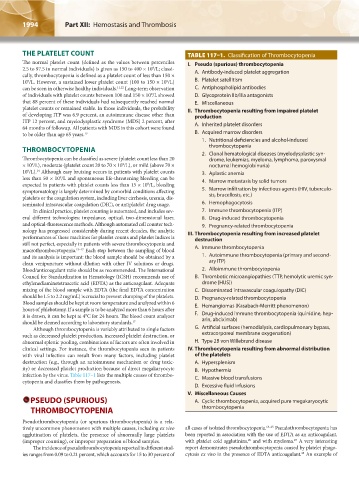
               THE PLATELET COUNT                                      TABLE 117–1.  Classification of Thrombocytopenia
               The normal platelet count (defined as the values between percentiles   I.  Pseudo (spurious) thrombocytopenia
               2.5 to 97.5 in normal individuals) is given as 150 to 400 × 10 /L; classi-
                                                           9
               cally, thrombocytopenia is defined as a platelet count of less than 150 ×     A.  Antibody-induced platelet aggregation
               10 /L. However, a sustained lower platelet count (100 to 150 × 10 /L)   B.  Platelet satellitism
                 9
                                                                9
               can be seen in otherwise healthy individuals. 11,12  Long-term observation   C.  Antiphospholipid antibodies
               of individuals with platelet counts between 100 and 150 × 10 /L showed   D.  Glycoprotein IIb/IIIa antagonists
                                                           9
               that 88 percent of these individuals had subsequently reached normal   E.  Miscellaneous
               platelet counts or remained stable. In those individuals, the probability   II.  Thrombocytopenia resulting from impaired platelet
               of developing ITP was 6.9 percent, an autoimmune disease other than   production
               ITP 12 percent, and myelodysplastic syndrome (MDS) 2 percent, after
               64 months of followup. All patients with MDS in this cohort were found   A.  Inherited platelet disorders
               to be older than age 65 years. 13                         B.  Acquired marrow disorders
                                                                            1.  Nutritional deficiencies and alcohol-induced
               THROMBOCYTOPENIA                                               thrombocytopenia
                                                                            2.  Clonal hematological diseases (myelodysplastic syn-
               Thrombocytopenia can be classified as severe (platelet count less than 20   drome, leukemias, myeloma, lymphoma, paroxysmal
                   9
                                                 9
               × 10 /L), moderate (platelet count 20 to 70 × 10 /L), or mild (above 70 ×   nocturnal hemoglobinuria)
                    14
               10 /L).  Although easy bruising occurs in patients with platelet counts   3.  Aplastic anemia
                 9
               less than 50 × 10 /L and spontaneous life-threatening bleeding can be   4.  Marrow metastasis by solid tumors
                            9
               expected in patients with platelet counts less than 15 × 10 /L, bleeding
                                                         9
               symptomatology is largely determined by comorbid conditions affecting   5.  Marrow infiltration by infectious agents (HIV, tuberculo-
               platelets or the coagulation system, including liver cirrhosis, uremia, dis-  sis, brucellosis, etc.)
               seminated intravascular coagulation (DIC), or antiplatelet drug usage.  6.  Hemophagocytosis
                   In clinical practice, platelet counting is automated, and includes sev-  7.  Immune thrombocytopenia (ITP)
               eral different technologies: impedance, optical, two-dimensional laser,   8.  Drug-induced thrombocytopenia
               and optical-fluorescence methods. Although automated cell counter tech-  9.  Pregnancy-related thrombocytopenia
               nology has progressed considerably during recent decades, the analytic   III. Thrombocytopenia resulting from increased platelet
               performances of these machines for platelet counts and platelet indices is   destruction
               still not perfect, especially in patients with severe thrombocytopenia and
               macrothrombocytopenia. 15–17  Each step between the sampling of blood   A.  Immune thrombocytopenia
               and its analysis is important: the blood sample should be obtained by a   1.  Autoimmune thrombocytopenia (primary and second-
               clean venipuncture without dilution with other IV solutions or drugs.   ary ITP)
               Blood/anticoagulant ratio should be as recommended. The International   2.  Alloimmune thrombocytopenia
               Council for Standardization in Hematology (ICSH) recommends use of   B.  Thrombotic microangiopathies (TTP, hemolytic uremic syn-
               ethylenediaminetetraacetic acid (EDTA) as the anticoagulant. Adequate   drome [HUS])
               mixing of the blood sample with EDTA (the final EDTA concentration   C.  Disseminated intravascular coagulopathy (DIC)
               should be 1.5 to 2.2 mg/mL) is crucial to prevent clumping of the platelets.   D.  Pregnancy-related thrombocytopenia
               Blood samples should be kept at room temperature and analyzed within 6   E.  Hemangiomas (Kasabach-Merritt phenomenon)
               hours of phlebotomy. If a sample is to be analyzed more than 6 hours after
               it is drawn, it can be kept at 4°C for 24 hours. The blood count analyzer   F.  Drug-induced immune thrombocytopenia (quinidine, hep-
               should be cleaned according to laboratory standards. 17      arin, abciximab)
                   Although thrombocytopenia is variably attributed to single factors   G.  Artificial surfaces (hemodialysis, cardiopulmonary bypass,
               such as decreased platelet production, increased platelet destruction, or   extracorporeal membrane oxygenation)
               abnormal splenic pooling, combinations of factors are often involved in   H.  Type 2B von Willebrand disease
               clinical settings. For instance, the thrombocytopenia seen in patients   IV. Thrombocytopenia resulting from abnormal distribution
               with viral infection can result from many factors, including platelet   of the platelets
               destruction (e.g., through an autoimmune mechanism or drug toxic-  A.  Hypersplenism
               ity) or decreased platelet production because of direct megakaryocyte   B.  Hypothermia
               infection by the virus. Table 117–1 lists the multiple causes of thrombo-  C.  Massive blood transfusions
               cytopenia and classifies them by pathogenesis.
                                                                         D.  Excessive fluid infusions
                                                                       V.  Miscellaneous Causes
                    PSEUDO (SPURIOUS)                                    A.  Cyclic thrombocytopenia, acquired pure megakaryocytic
                  THROMBOCYTOPENIA                                          thrombocytopenia

               Pseudothrombocytopenia (or spurious thrombocytopenia) is a rela-
               tively uncommon phenomenon with multiple causes, including ex vivo   all cases of isolated thrombocytopenia. 18–25  Pseudothrombocytopenia has
               agglutination of platelets, the presence of abnormally large platelets   been reported in association with the use of EDTA as an anticoagulant,
                                                                                                          27
                                                                                           26
               (improper counting), or improper preparation of blood samples.  with platelet cold agglutinins,  and with myeloma.  A very interesting
                   The incidence of pseudothrombocytopenia reported in different stud-  report demonstrates pseudothrombocytopenia caused by platelet phago-
                                                                                                             28
               ies ranges from 0.09 to 0.21 percent, which accounts for 15 to 30 percent of   cytosis ex vivo in the presence of EDTA anticoagulant.  An example of


          Kaushansky_chapter 117_p1993-2024.indd   1994                                                                 9/21/15   2:31 PM

