


Page 2024 - Williams Hematology ( PDFDrive )
P. 2024
1998  Part XII:  Hemostasis and Thrombosis                                Chapter 117:  Thrombocytopenia             1999


                          A                                      B                        C
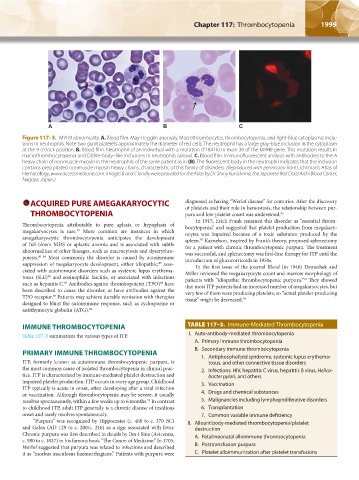
                  Figure 117–3.  MYH9 abnormality. A. Blood film. May-Hegglin anomaly. Macrothrombocytes, thrombocytopenia, and light-blue cytoplasmic inclu-
                  sions in neutrophils. Note two giant platelets approximately the diameter of red cells. The neutrophil has a large gray-blue inclusion in the cytoplasm
                  at the 9 o’clock position. B. Blood film. Neutrophil of an individual with a mutation (E1841K) in exon 38 of the MYH9 gene. This mutation results in
                  macrothrombocytopenia and Döhle-body–like inclusions in neutrophils (arrow). C. Blood film. Immunofluorescent analysis with antibodies to the A
                  heavy chain of nonmuscle myosin in the neutrophils of the same patient as in (B). The fluorescent body in the neutrophil indicates that the inclusion
                  contains precipitated nonmuscle myosin heavy chains, characteristic of this family of disorders. (Reproduced with permission from Lichtman’s Atlas of
                  Hematology, www.accessmedicine.com. Images B and C kindly were provided for the Atlas by Dr. Shinji Kunishima, the Japanese Red Cross Aichi Blood Center,
                  Nagoya, Japan.)


                       ACQUIRED PURE AMEGAKARYOCYTIC                    diagnosed as having “Werlof disease” for centuries. After the discovery
                                                                        of platelets and their role in hemostasis, the relationship between pur-
                     THROMBOCYTOPENIA                                   pura and low-platelet count was understood. 92
                                                                            In 1915, Erich Frank renamed this disorder as “essential throm-
                  Thrombocytopenia attributable to pure aplasia or hypoplasia of   bocytopenia,” and suggested that platelet production from megakary-
                  megakaryocytes  is  rare.   More  common  are  instances  in  which   ocytes was impaired because of a toxic substance produced by the
                                    79
                  amegakaryocytic thrombocytopenia anticipates the development   spleen.  Kaznelson, inspired by Frank’s theory, proposed splenectomy
                                                                             93
                  of full-blown MDS or aplastic anemia and is associated with subtle   for a patient with chronic thrombocytopenic purpura. The treatment
                  abnormalities of other lineages, such as macrocytosis and dyserythro-  was successful, and splenectomy was first-line therapy for ITP until the
                  poiesis. 80–84  Most commonly the disorder is caused by autoimmune   introduction of glucocorticoids in 1950s.
                  suppression of megakaryocyte development, either idiopathic,  asso-  In the first issue of the journal  Blood (in 1946) Damashek and
                                                               85
                  ciated with autoimmune disorders such as systemic lupus erythema-  Miller reviewed the megakaryocyte count and marrow morphology of
                  tosus (SLE)  and eosinophilic fasciitis, or associated with infections   patients with “idiopathic thrombocytopenic purpura.”  They showed
                          86
                                                                                                                94
                  such as hepatitis C.  Antibodies against thrombopoietin (TPO)  have   that most ITP patients had an increased number of megakaryocytes, but
                                87
                                                                88
                  been described to cause the disorder, as have antibodies against the   very few of them were producing platelets, so “actual platelet-producing
                  TPO receptor.  Patients may achieve durable remission with therapies   tissue” might be decreased. 94
                            89
                  designed to blunt the autoimmune response, such as cyclosporine or
                  antithymocyte globulin (ATG). 90
                  IMMUNE THROMBOCYTOPENIA                                TABLE 117–3.  Immune-Mediated Thrombocytopenia
                  Table 117–3 summarizes the various types of ITP.        I.  Auto-antibody-mediated thrombocytopenia
                                                                            A.  Primary immune thrombocytopenia
                                                                            B.  Secondary immune thrombocytopenia
                  PRIMARY IMMUNE THROMBOCYTOPENIA                             1.  Antiphospholipid syndrome, systemic lupus erythema-
                  ITP, formerly known as autoimmune thrombocytopenic purpura, is   tosus, and other connective tissue disorders
                  the most common cause of isolated thrombocytopenia in clinical prac-  2.  Infections: HIV, hepatitis C virus, hepatitis B virus, Helico-
                  tice. ITP is characterized by immune-mediated platelet destruction and   bacter pylori, and others
                  impaired platelet production. ITP occurs in every age group. Childhood   3.  Vaccination
                  ITP typically is acute in onset, often developing after a viral infection
                  or vaccination. Although thrombocytopenia may be severe, it usually   4.  Drugs and chemical substances
                  resolves spontaneously, within a few weeks up to 6 months.  In contrast   5.  Malignancies including lymphoproliferative disorders
                                                            91
                  to childhood ITP, adult ITP generally is a chronic disease of insidious   6.  Transplantation
                  onset and rarely resolves spontaneously.                    7.  Common variable immune deficiency
                     “Purpura” was recognized by Hippocrates (c. 460 to c. 370 BC)   II.  Alloantibody-mediated thrombocytopenia/platelet
                  and Galen (AD 129 to c. 200/c. 216) as a sign associated with fever.   destruction
                  Chronic purpura was first described in details by Ibn-i Sina (Avicenna,   A.  Fetal/neonatal alloimmune thrombocytopenia
                  c. 980 to c. 1037) in his famous book “The Canon of Medicine.” In 1705,
                  Werlof suggested that purpura was related to infections and described   B.  Posttransfusion purpura
                  it as “morbus maculosus haemorrhagicus.” Patients with purpura were   C.  Platelet alloimmunization after platelet transfusions


          Kaushansky_chapter 117_p1993-2024.indd   1999                                                                 9/21/15   2:32 PM

