


Page 2023 - Williams Hematology ( PDFDrive )
P. 2023
1998           Part XII:  Hemostasis and Thrombosis                                                                                                                                    Chapter 117:  Thrombocytopenia            1999


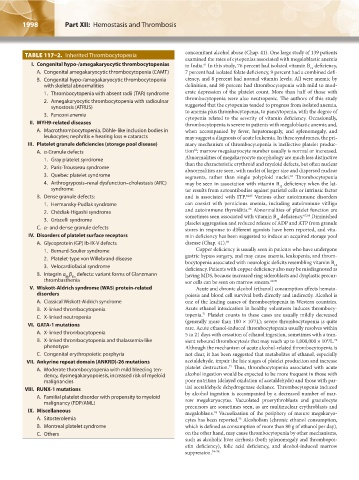
                TABLE 117–2.  Inherited Thrombocytopenia              concomitant alcohol abuse (Chap. 41). One large study of 139 patients
                                                                      examined the rates of cytopenias associated with megaloblastic anemia
                  I.  Congenital hypo-/amegakaryocytic thrombocytopenias  in India.  In this study, 76 percent had isolated vitamin B  deficiency,
                                                                            61
                                                                                                                12
                    A.  Congenital amegakaryocytic thrombocytopenia (CAMT)  7 percent had isolated folate deficiency, 9 percent had a combined defi-
                    B.  Congenital hypo-/amegakaryocytic thrombocytopenia   ciency, and 8 percent had normal vitamin levels. All were anemic by
                       with skeletal abnormalities                    definition, and 80 percent had thrombocytopenia with mild to mod-
                       1.  Thrombocytopenia with absent radii (TAR) syndrome  erate depression of the platelet count. More than half of those with
                       2.  Amegakaryocytic thrombocytopenia with radioulnar   thrombocytopenia were also neutropenic. The authors of this study
                         synostosis (ATRUS)                           suggested that the cytopenias tended to progress from isolated anemia,
                       3.  Fanconi anemia                             to anemia plus thrombocytopenia, to pancytopenia, with the degree of
                                                                      cytopenia related to the severity of vitamin deficiency. Occasionally,
                  II.  MYH9-related diseases                          thrombocytopenia is severe in patients with megaloblastic anemia and,
                    A.  Macrothrombocytopenia, Döhle-like inclusion bodies in   when accompanied by fever, hepatomegaly, and splenomegaly, and
                       leukocytes; nephritis ± hearing loss ± cataracts  may suggest a diagnosis of acute leukemia. In these syndromes, the pri-
                 III.  Platelet granule deficiencies (storage pool disease)  mary mechanism of thrombocytopenia is ineffective platelet produc-
                                                                         62
                    A.  α-Granule defects                             tion ; marrow megakaryocyte number usually is normal or increased.
                       1.  Gray platelet syndrome                     Abnormalities of megakaryocyte morphology are much less distinctive
                       2.  Paris-Trousseau syndrome                   than the characteristic erythroid and myeloid defects, but often nuclear
                                                                      abnormalities are seen, with nuclei of larger size and dispersed nuclear
                       3.  Quebec platelet syndrome                   segments, rather than single polyploid nuclei.  Thrombocytopenia
                                                                                                         63
                       4.  Arthrogryposis–renal dysfunction–cholestasis (ARC)   may be seen in association with vitamin B  deficiency when the lat-
                                                                                                      12
                         syndrome                                     ter results from autoantibodies against parietal cells or intrinsic factor
                    B.  Dense granule defects:                        and is associated with ITP. 64,65  Various other autoimmune disorders
                       1.  Hermansky-Pudlak syndrome                  can coexist with pernicious anemia, including autoimmune vitiligo
                                                                                           66
                       2.  Chédiak-Higashi syndrome                   and autoimmune thyroiditis.  Abnormalities of platelet function are
                                                                                                              67,68
                       3.  Griscelli syndrome                         sometimes seen associated with vitamin B  deficiency.   Diminished
                                                                                                     12
                                                                      platelet aggregation and reduced release of ADP and ATP from granule
                    C.  α- and dense granule defects                  stores in response to different agonists have been reported, and vita-
                 IV.  Disorders of platelet surface receptors         min deficiency has been suggested to induce an acquired storage pool
                    A.  Glycoprotein (GP) Ib-IX-V defects             disease (Chap. 41). 68
                       1.  Bernard-Soulier syndrome                       Copper deficiency is usually seen in patients who have undergone
                       2.  Platelet-type von Willebrand disease       gastric bypass surgery, and may cause anemia, leukopenia, and throm-
                                                                      bocytopenia associated with neurologic deficits resembling vitamin B
                                                                                                                        12
                       3.  Velocardiofacial syndrome                  deficiency. Patients with copper deficiency also may be misdiagnosed as
                    B.  Integrin α β  defects: variant forms of Glanzmann   having MDS, because increased ring sideroblasts and dysplastic precur-
                              IIb IIIa
                       thrombasthenia                                 sor cells can be seen on marrow smears. 69,70
                  V.  Wiskott-Aldrich syndrome (WAS) protein-related      Acute and chronic alcohol (ethanol) consumption affects hemato-
                    disorders                                         poiesis and blood cell survival both directly and indirectly. Alcohol is
                    A.  Classical Wiskott-Aldrich syndrome            one of the leading causes of thrombocytopenia in Western countries.
                    B.  X-linked thrombocytopenia                     Acute ethanol intoxication in healthy volunteers induces thrombocy-
                                                                            71
                    C.  X-linked neutropenia                          topenia.  Platelet counts in these cases are usually mildly decreased
                                                                                             9
                 VI.  GATA-1 mutations                                (generally more than 100 × 10 /L); severe thrombocytopenia is quite
                                                                      rare. Acute ethanol-induced thrombocytopenia usually resolves within
                    A.  X-linked thrombocytopenia                     5 to 21 days with cessation of ethanol ingestion, sometimes with a tran-
                    B.  X-linked thrombocytopenia and thalassemia-like   sient rebound thrombocytosis that may reach up to 1,000,000 × 10 /L.
                                                                                                                      9
                                                                                                                        72
                       phenotype                                      Although the mechanism of acute alcohol-related thrombocytopenia is
                    C.  Congenital erythropoietic porphyria           not clear, it has been suggested that metabolites of ethanol, especially
                 VII.  Ankyrine repeat domain (ANKRD)-26 mutations    acetaldehyde, impair the late stages of platelet production and increase
                                                                                     73
                    A.  Moderate thrombocytopenia with mild bleeding ten-  platelet destruction.  Thus, thrombocytopenia associated with acute
                       dency, dysmegakaryopoiesis, increased risk of myeloid   alcohol ingestion would be expected to be more frequent in those with
                       malignancies                                   poor nutrition (delayed oxidation of acetaldehyde) and those with par-
                VIII.  RUNX-1 mutations                               tial acetaldehyde dehydrogenase defiance. Thrombocytopenia induced
                    A.  Familial platelet disorder with propensity to myeloid   by alcohol ingestion is accompanied by a decreased number of mar-
                                                                      row megakaryocytes. Vacuolated proerythroblasts and granulocyte
                       malignancy (FDP/AML)
                 IX.  Miscellaneous                                   precursors are sometimes seen, as are multinuclear erythroblasts and
                                                                                74
                                                                      megaloblasts.  Vacuolization of the periphery of mature megakaryo-
                    A.  Sitosterolemia                                cytes has been reported.  Alcoholism (chronic ethanol consumption,
                                                                                        75
                    B.  Montreal platelet syndrome                    which is defined as consumption of more than 80 g of ethanol per day),
                    C.  Others                                        on the other hand, may cause thrombocytopenia by other mechanisms,
                                                                      such as alcoholic liver cirrhosis (both splenomegaly and thrombopoi-
                                                                      etin deficiency), folic acid deficiency, and alcohol-induced marrow
                                                                      suppression. 74–78


          Kaushansky_chapter 117_p1993-2024.indd   1998                                                                 9/21/15   2:31 PM

