


Page 2051 - Williams Hematology ( PDFDrive )
P. 2051
2026           Part XII:  Hemostasis and Thrombosis                                                                                                                  Chapter 118:  Heparin-induced Thrombocytopenia              2027


                TABLE 118–1.  Heparin-Induced Thrombocytopenia Risk   exists as a tetramer. Crystal structure analysis shows that this tetramer
                                                                      is  encircled  by  a  ring  of  positive  charge  (Fig.  118–2),   and  heparin
                                                                                                              26
                Factors
                                                                                              27
                                                                      is thought to bind to this region.  There are two closely spaced HIT
                Patient-Specific Factors  Heparin-Specific Factors    antibody recognition domains (Fig. 118–2).  These domains are dis-
                                                                                                      28
                Patient population (surgical >   Type of heparin (unfractionated    tinct from the heparin-binding domain. About half of patients have
                medical > obstetric > pediatric)  heparin > low-molecular-   antibodies that react with one or the other HIT antigenic domain
                                          weight heparin)             and one-third of patients do not have antibodies that react to either
                Major trauma > minor trauma  Duration of heparin (~5 days   domain, suggesting that there are other HIT antigenic sites on PF4.
                                          > shorter courses)          Studies of antihuman PF4 monoclonal antibodies suggest that unlike
                                                                      nonpathogenic anti-PF4 antibodies, HIT antibodies markedly increase
                Sex (female > male)
                                                                      their binding affinity for PF4 maintained in a tetrameric as opposed
                                                                      to dimeric state.  Moreover, tetrameric PF4 and UFH need to be at
                                                                                  29
                                                                      approximately 1:1 molar ratio for optimal HIT antigenicity. 30,31  At this
               bacterial wall (Fig. 118–1) and that antibodies against this complex may   ratio, ultralarge complexes (>670 kDa) of PF4 and heparin form that
               be an important antimicrobial defensive mechanism.  These antigenic   appear as visible colloidal complexes, and these are likely to be the anti-
                                                      24
               complexes, as well as circulating PF4–heparin complexes, are detected   genic source in HIT. 32,33  At higher or lower ratios, PF4 predominantly
               by splenic marginal B cells that subsequently produce pathogenic HIT   forms smaller and less antigenic PF4–heparin complexes. Ultralarge
               antibodies. 25                                         complexes are inefficiently formed with LMWH, offering a potential
                   The nature of the antigenic heparin–PF4 complex has been par-  explanation as to why this class of agents is associated with a lower
               tially defined. At the concentrations reached  at sites of injury, PF4   incidence of HIT compared with UFH. Fondaparinux does not form

                                        Hypothesized initial               Initial
                                            exposure                    IgM response
                                     Microbes
                                                               V H


                                                               V L

                                 Atherosclerotic plaque
                                                                                            Targeted activation of
                                                      Endothelial cells          Heparin       vascular cells
                                                                               PF4 tetramer

                                                  Macrophages
                                 A
                   Heparin                                                                               Surface protein
                   exposure                                                                                with GAG
                                         Postheparin IgG                                                side chains bound
                          Heparin          response                                                         to PF4
                          infusion


                                                            Heparin                       Activated platelet
                                         Marginal         PF4 tetramer
                                        pre-B cells
                    Circulating
                       PF4
                B
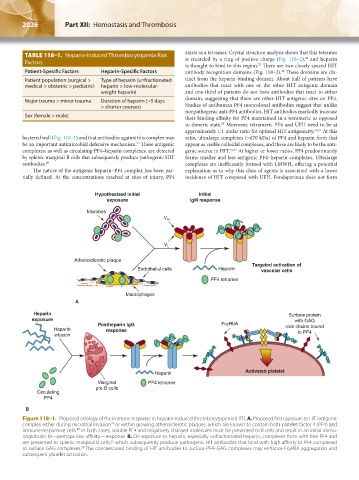
               Figure 118–1.  Proposed etiology of the immune response in heparin-induced thrombocytopenia (HIT). A. Proposed first exposure to HIT antigenic
               complex either during microbial invasion  or within growing atherosclerotic plaques, which are known to contain both platelet factor 4 (PF4) and
                                             24
               immune-responsive cells.  In both cases, soluble PF4 and negatively charged molecules must be presented to B cells and result in an initial immu-
                                  49
               noglobulin M—perhaps low affinity—response. B. On exposure to heparin, especially unfractionated heparin, complexes form with free PF4 and
               are presented to splenic marginal B cells,  which subsequently produce pathogenic HIT antibodies that bind with high affinity to PF4 complexed
                                             25
               to surface GAG complexes.  The concentrated binding of HIT antibodies to surface PF4–GAG complexes may enhance FcγRIIA aggregation and
                                   29
               subsequent platelet activation.


          Kaushansky_chapter 118_p2025-2034.indd   2026                                                                 9/18/15   5:43 PM

