


Page 2052 - Williams Hematology ( PDFDrive )
P. 2052
2026  Part XII:  Hemostasis and Thrombosis               Chapter 118:  Heparin-induced Thrombocytopenia              2027


                                PF4: EAEEDGDLQCLCVKTTSQVRPRHITSLEVIKAGPHCPTAQLIATLKNGRKICLDLQAPLYKKIIKKLLES
                                                                          Site 1
                                                        Site 2
                                      Front                           Side                           Top


                                               37
                           9
                         7
                       D -D  Antigenic        P  Antigenic
                                     34
                           Site 2   P  Ant igenic  Site 1
                                       Site 2
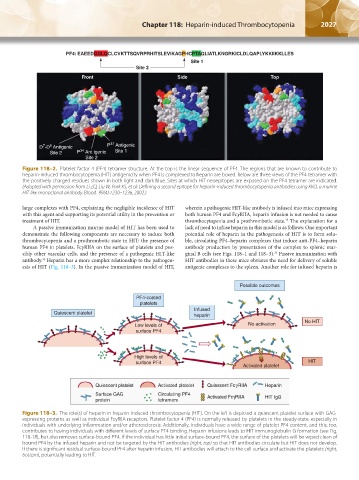
                  Figure 118–2.  Platelet factor 4 (PF4) tetramer structure. At the top is the linear sequence of PF4. The regions that are known to contribute to
                  heparin-induced thrombocytopenia (HIT) antigenicity when PF4 is complexed to heparin are boxed. Below are three views of the PF4 tetramer with
                  the positively charged residues shown in both light and dark blue. Sites at which HIT neoepitopes are exposed on the PF4 tetramer are indicated.
                  (Adapted with permission from Li ZQ, Liu W, Park KS, et al: Defining a second epitope for heparin-induced thrombocytopenia antibodies using KKO, a murine
                  HIT-like monoclonal antibody. Blood  99(4):1230–1236, 2002.)
                  large complexes with PF4, explaining the negligible incidence of HIT   wherein a pathogenic HIT-like antibody is infused into mice expressing
                  with this agent and supporting its potential utility in the prevention or   both human PF4 and FcγRIIA, heparin infusion is not needed to cause
                  treatment of HIT.                                     thrombocytopenia and a prothrombotic state.  The explanation for a
                                                                                                          35
                     A passive immunization murine model of HIT has been used to   lack of need to infuse heparin in this model is as follows: One important
                  demonstrate the following components are necessary to induce both   potential role of heparin in the pathogenesis of HIT is to form solu-
                  thrombocytopenia and a prothrombotic state in HIT: the presence of   ble, circulating PF4–heparin complexes that induce anti-PF4–heparin
                  human PF4 in platelets, FcγRIIA on the surface of platelets and pos-  antibody production by presentation of the complex to splenic mar-
                  sibly other vascular cells, and the presence of a pathogenic HIT-like   ginal B cells (see Figs. 118–1 and 118–3).  Passive immunization with
                                                                                                      25
                  antibody.  Heparin has a more complex relationship to the pathogen-  HIT antibodies in these mice obviates the need for delivery of soluble
                        34
                  esis of HIT (Fig. 118–3). In the passive immunization model of HIT,   antigenic complexes to the spleen. Another role for infused heparin is
                                                                                           Possible outcomes

                                                        PF4-coated
                                                         platelets
                                                                           Infused
                            Quiescent platelet                             heparin
                                                                                                                No HIT
                                                        Low levels of                         No activation
                                                        surface PF4


                                                       High levels of
                                                        surface PF4                                               HIT
                                                                                            Activated platelet

                                          Quiescent platelet   Activated platelet                  Heparin
                                          Surface GAG          Circulating PF4
                                          protein              tetramers                           HIT IgG

                  Figure 118–3.  The role(s) of heparin in heparin-induced thrombocytopenia (HIT). On the left is depicted a quiescent platelet surface with GAG-
                  expressing proteins as well as individual FcγRIIA receptors. Platelet factor 4 (PF4) is normally released by platelets in the steady-state, especially in
                  individuals with underlying inflammation and/or atherosclerosis. Additionally, individuals have a wide range of platelet PF4 content, and this, too,
                  contributes to having individuals with different levels of surface PF4 binding. Heparin infusions leads to HIT immunoglobulin G formation (see Fig.
                  118-1B), but also removes surface-bound PF4. If the individual has little initial surface-bound PF4, the surface of the platelets will be wiped clean of
                  bound PF4 by the infused heparin and not be targeted by the HIT antibodies (right, top) so that HIT antibodies circulate but HIT does not develop.
                  If there is significant residual surface-bound PF4 after heparin infusion, HIT antibodies will attach to the cell surface and activate the platelets (right,
                  bottom), potentially leading to HIT.


          Kaushansky_chapter 118_p2025-2034.indd   2027                                                                 9/18/15   5:43 PM

